
What this calculator does
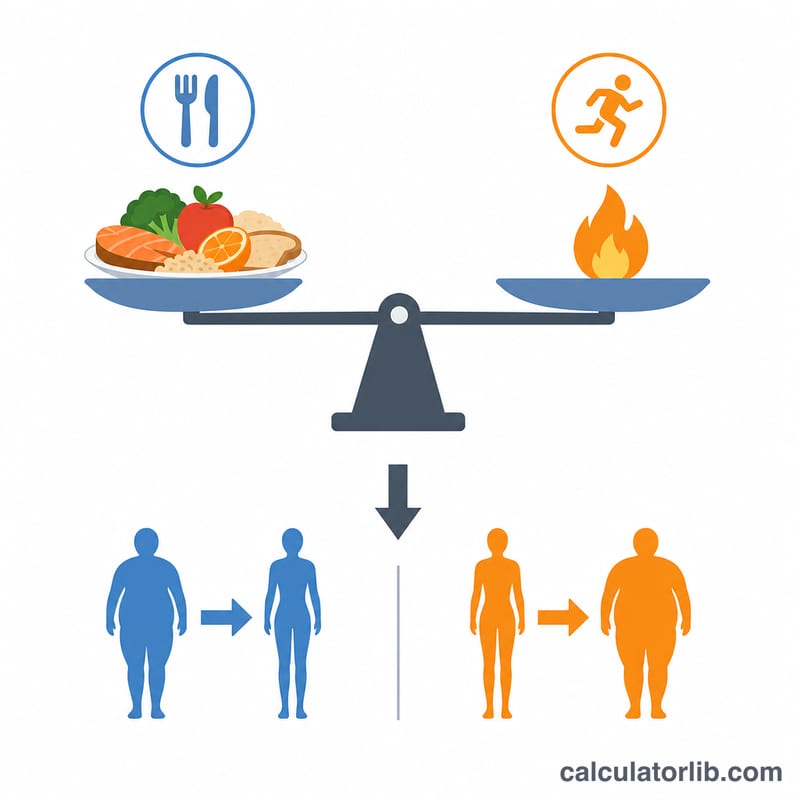
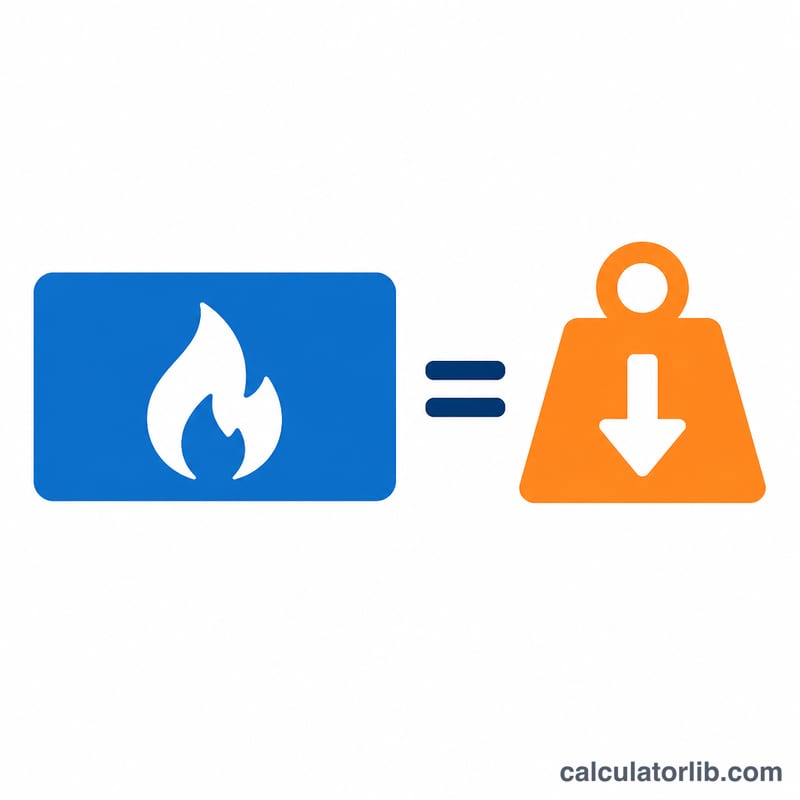
The Weight Change Predictor estimates how much weight you are likely to gain or lose each week based on the balance between the calories you eat (intake) and the calories your body burns (your Total Daily Energy Expenditure, or TDEE). It is built on the widely used rule of thumb that roughly 3,500 kilocalories equal one pound of body weight.
How to use it
Enter your average daily calorie intake and your estimated TDEE (often derived from your BMR multiplied by an activity factor). The calculator multiplies your daily calorie surplus or deficit by 7 to get a weekly total, then divides by 3,500 to translate that energy into pounds. A negative result means weight loss; a positive result means weight gain.
The formula explained
The core equation is $$\Delta w_{\text{week}} = \frac{7 \times \left( \text{intake} - \text{TDEE} \right)}{3500} \text{ lb}$$ The difference between intake and TDEE is your daily energy balance in kilocalories. Multiplying by 7 gives a weekly total, and dividing by 3,500 converts kilocalories to pounds of body mass.
Worked example
Suppose you eat 2,000 kcal per day but burn 2,500 kcal (TDEE). Your daily deficit is \(-500\) kcal. Over a week that is \(-3{,}500\) kcal, which divided by 3,500 equals \(-1\) pound: $$\Delta w_{\text{week}} = \frac{7 \times \left( 2000 - 2500 \right)}{3500} = -1 \text{ lb}$$ So you would lose about 1 pound per week — roughly 0.45 kg.
Weight Change Across Common Calorie Scenarios
The table below shows the predicted weekly weight change for a range of daily energy-balance values, using the 3,500 kcal-per-pound rule. The weekly change is computed as:
$$\Delta w_{\text{week}} = \frac{7 \times (\text{Intake} - \text{TDEE})}{3500}\ \text{lb}$$For example, a daily deficit of 500 kcal yields a predicted loss of \(\frac{7 \times (-500)}{3500} = -1.0\) lb per week, or about -1.0 lb (-0.45 kg).
| Daily energy balance (kcal) | Weekly change (lb) | Weekly change (kg) |
|---|---|---|
| -1000 | -2.00 | -0.91 |
| -750 | -1.50 | -0.68 |
| -500 | -1.00 | -0.45 |
| -250 | -0.50 | -0.23 |
| 0 | 0.00 | 0.00 |
| +250 | +0.50 | +0.23 |
| +500 | +1.00 | +0.45 |
Values use the conversion 1 lb = 0.4536 kg. A daily surplus of 1000 kcal (not shown) would predict roughly +2.00 lb per week.
Interpreting Your Result
A negative result means you are eating below your Total Daily Energy Expenditure (TDEE) and are predicted to lose weight. A positive result means you are eating above your TDEE and are predicted to gain weight. A result near zero indicates approximate maintenance.
This calculator relies on the classic estimate that 3,500 kcal equals about one pound of body fat. It is a useful planning rule of thumb, but it is a simplification. It ignores metabolic adaptation — as you lose weight your TDEE typically falls, so a fixed deficit produces progressively smaller losses over time. It also does not account for water-weight fluctuations driven by sodium, carbohydrate (glycogen) stores, hormones, and digestive contents, which can mask or exaggerate fat changes from day to day.
For these reasons, early changes may overstate true fat loss: much of the rapid drop in the first week or two of a deficit is water and glycogen rather than fat. Conversely, the scale may stall temporarily even when fat is still being lost.
A generally accepted, sustainable pace is roughly 1–2 lb (about 0.45–0.9 kg) per week, corresponding to a daily deficit of about 500–1,000 kcal. Faster rates raise the risk of muscle loss, nutrient shortfalls, and difficulty maintaining the change. This is general information, not medical or nutritional advice — consult a qualified professional before making significant dietary changes.
Key Terms Explained
- Calorie Intake
- The total energy you consume from food and drink in a day, measured in kilocalories (kcal). This is the "calories in" side of the energy-balance equation.
- TDEE (Total Daily Energy Expenditure)
- The total number of calories your body burns in a day, including basal metabolism, digestion, daily movement, and exercise. It is the "calories out" side and your approximate maintenance level.
- BMR (Basal Metabolic Rate)
- The energy your body uses at complete rest to maintain vital functions such as breathing, circulation, and cell repair. BMR is the largest component of TDEE and is commonly estimated with the Mifflin-St Jeor or Harris-Benedict equations.
- Activity Factor
- A multiplier applied to BMR to estimate TDEE based on how active you are, typically ranging from about 1.2 (sedentary) to 1.9 (very intense daily activity).
- Energy Balance
- The difference between calorie intake and TDEE. Negative balance favors weight loss; positive balance favors weight gain; zero is maintenance.
- Caloric Deficit
- An energy balance in which intake is below TDEE, prompting the body to draw on stored energy and lose weight.
- Caloric Surplus
- An energy balance in which intake exceeds TDEE, supplying extra energy that the body can store as added weight (fat and, with training, muscle).
FAQ
Is the 3,500-calorie rule exact? No. It is a useful approximation. Metabolism adapts over time, so real results vary and weight loss often slows as you lose mass.
How do I find my TDEE? Multiply your Basal Metabolic Rate (BMR) by an activity factor (1.2 sedentary to 1.9 very active), or use a TDEE calculator.
Should I aim for huge deficits? A deficit of 500–750 kcal/day (about 1–1.5 lb per week) is generally considered safe and sustainable. Always consult a professional for personalized advice.