

What Is the Future Salary Calculator?
The Future Salary Calculator projects how much you could earn in the future if your pay grows by a fixed percentage each year. By treating annual raises like compound interest, it shows the long-term impact of even modest yearly increases on your income.
How to Use It
Enter your current annual salary, your expected annual raise rate as a percentage, and the number of years you want to project forward. The calculator returns your projected future salary along with the total dollar increase over that period.
The Formula Explained
The tool uses the compound growth formula:
$$\text{Future Salary} = \text{Current Salary} \times (1 + r)^{n}$$
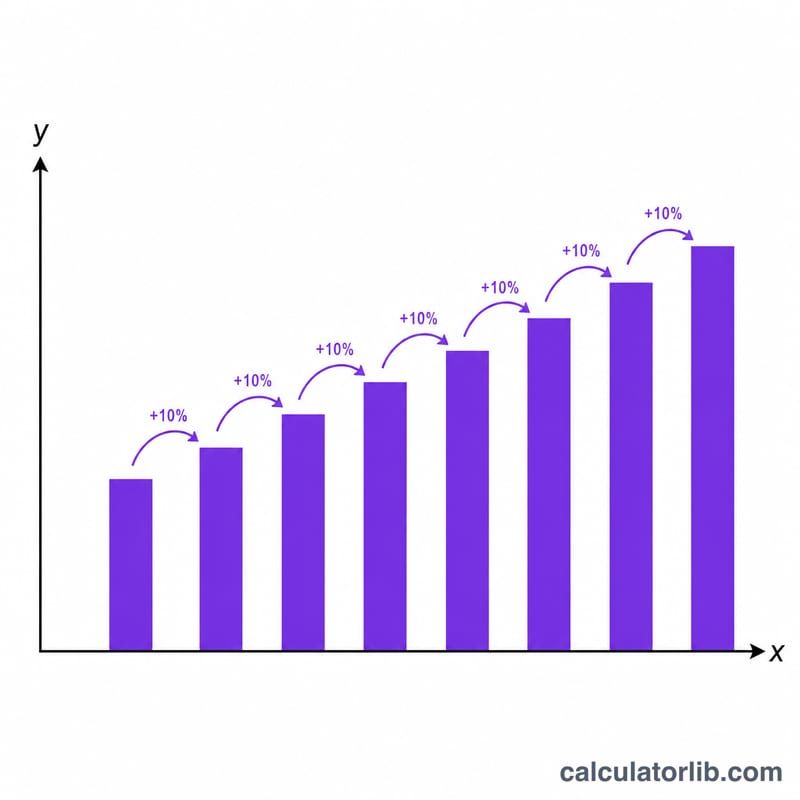
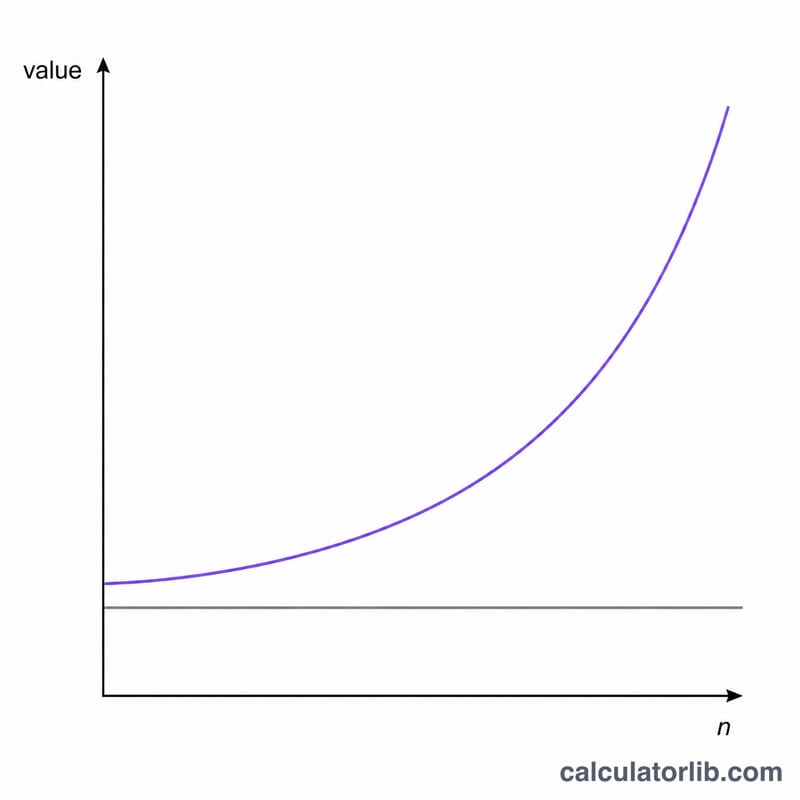
Here r is the annual raise rate written as a decimal (a 3% raise is \(0.03\)) and n is the number of years. Because the raise compounds on the new, higher salary each year, the growth accelerates over time rather than staying flat.
Worked Example
Suppose you earn $50,000 today and expect a 3% raise every year for 10 years. The projection is $$50{,}000 \times (1.03)^{10} = 50{,}000 \times 1.343916 \approx \$67{,}196$$ That is roughly a $17,196 increase from your current salary, purely from compounding annual raises.
FAQ
Does this account for inflation? No. It shows nominal salary growth. To estimate real (inflation-adjusted) growth, subtract the expected inflation rate from your raise rate before entering it.
What raise rate should I use? Use your company's typical merit increase, often 2–5% per year. You can run several scenarios to compare outcomes.
Can I model promotions? For a single steady rate, no — but you can break the projection into segments (e.g., a few years at one rate, then more years at a higher rate after a promotion).