
What this converter does
This tool converts an absorbed dose measured in gray (Gy) into an equivalent dose measured in sievert (Sv). The gray is a physical quantity: 1 Gy = 1 joule of energy absorbed per kilogram of tissue. The sievert is a protection quantity that scales the absorbed dose by how biologically damaging the radiation type is. The conversion follows the radiation weighting factors recommended in ICRP Publication 103 (2007).
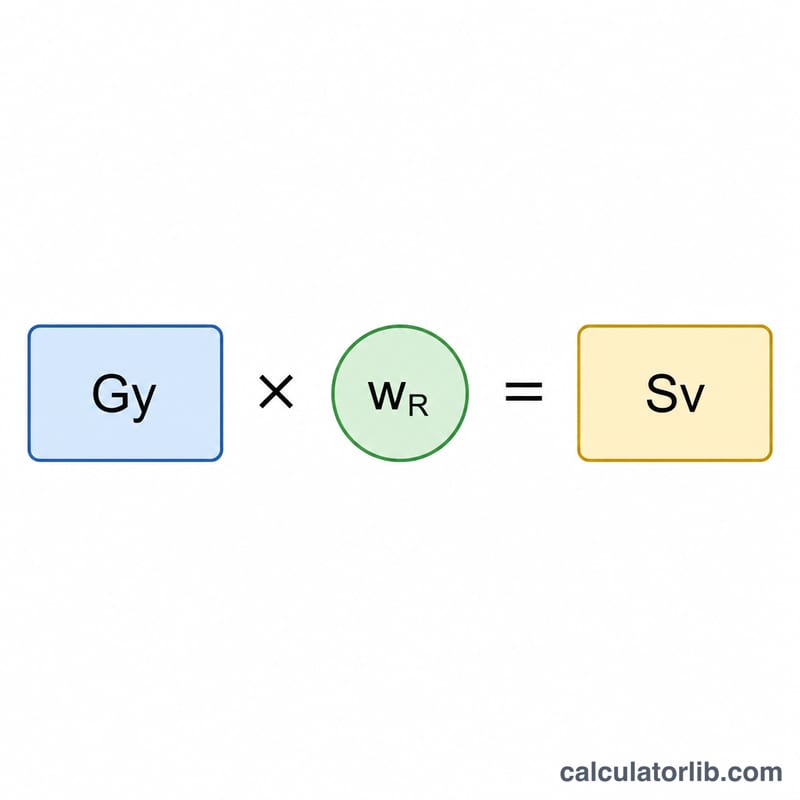
The formula
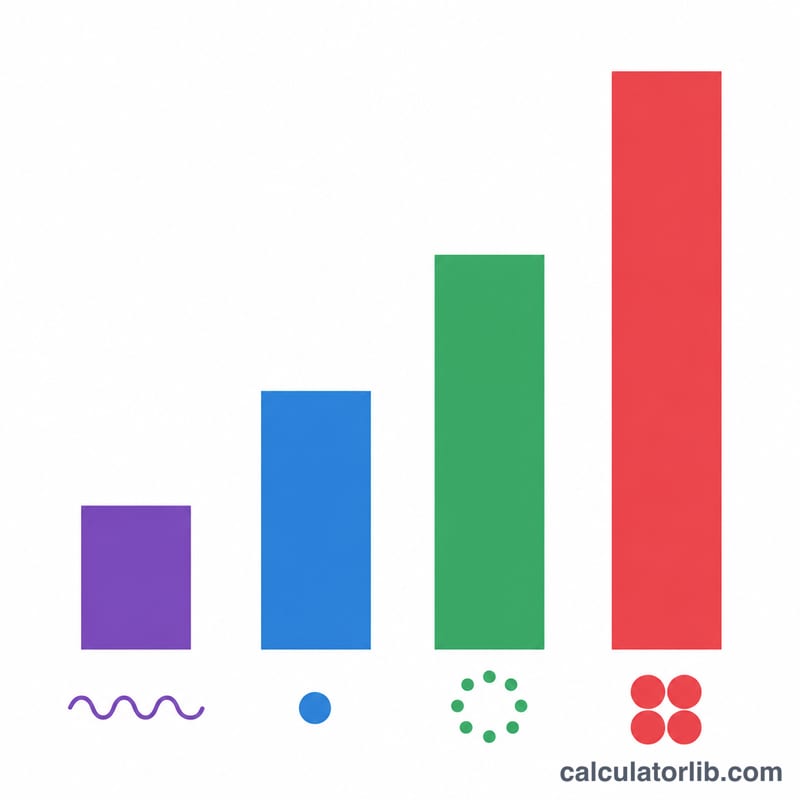
Equivalent dose is calculated as $$H = D \times w_R$$ where \(D\) is the absorbed dose in gray and \(w_R\) is the dimensionless radiation weighting factor. Photons (X-rays, gamma rays), electrons (beta particles) and muons all have \(w_R = 1\), so 1 Gy equals 1 Sv for those. Protons and charged pions have \(w_R = 2\). Alpha particles, fission fragments and heavy ions have \(w_R = 20\). Neutrons use an energy-dependent continuous function of the neutron energy \(E_n\) in MeV.
Note: this tool computes the equivalent dose only. To obtain the full effective dose you would additionally apply organ-specific tissue weighting factors (\(w_T\)) that sum to 1 over the whole body, which is beyond the scope of a single-conversion tool.
How to use it
Pick the radiation type, enter the absorbed dose in gray, and read off the equivalent dose in sievert. For neutrons, also enter the neutron energy in MeV. If you already know the weighting factor you want, type it in the optional override field and it will be used directly.
Worked example
Suppose 0.5 Gy is delivered by alpha particles. Alpha particles have \(w_R = 20\), so the equivalent dose is $$0.5 \times 20 = 10 \text{ Sv}$$ For 2 Gy of gamma rays (\(w_R = 1\)), the equivalent dose is simply 2 Sv.
FAQ
Why is 1 Gy not always 1 Sv? Only for radiation with \(w_R = 1\) (photons, electrons, muons). High-LET radiation like alpha particles or neutrons causes more biological damage per gray, so the equivalent dose is larger.
What energy do I use for neutrons? The neutron energy in MeV; the \(w_R\) peaks (around 20) near 1 MeV and decreases at very low and very high energies per the ICRP 2007 curve.
Is this effective dose? No. It is equivalent dose. Effective dose also requires tissue weighting factors per organ.