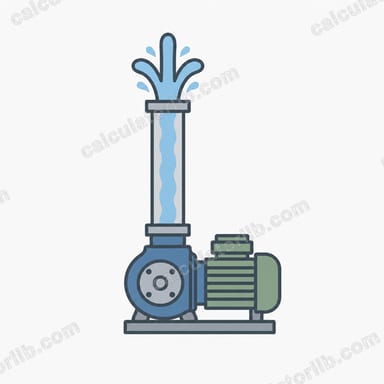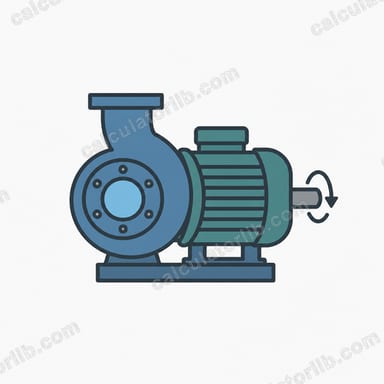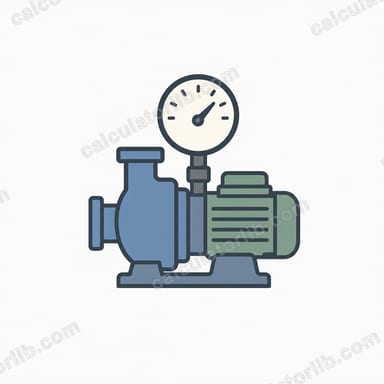

What This Calculator Does
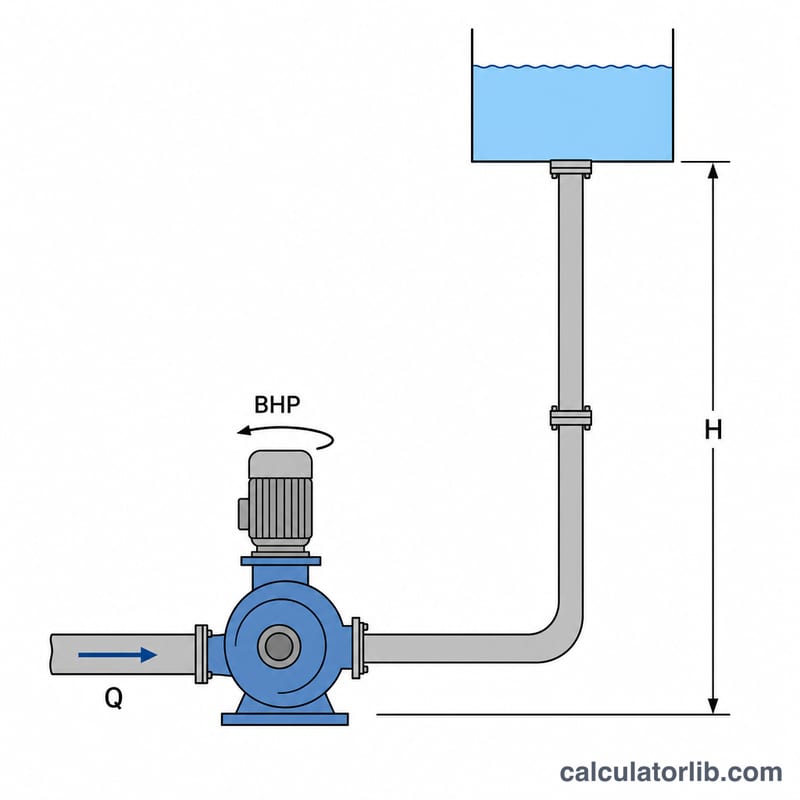
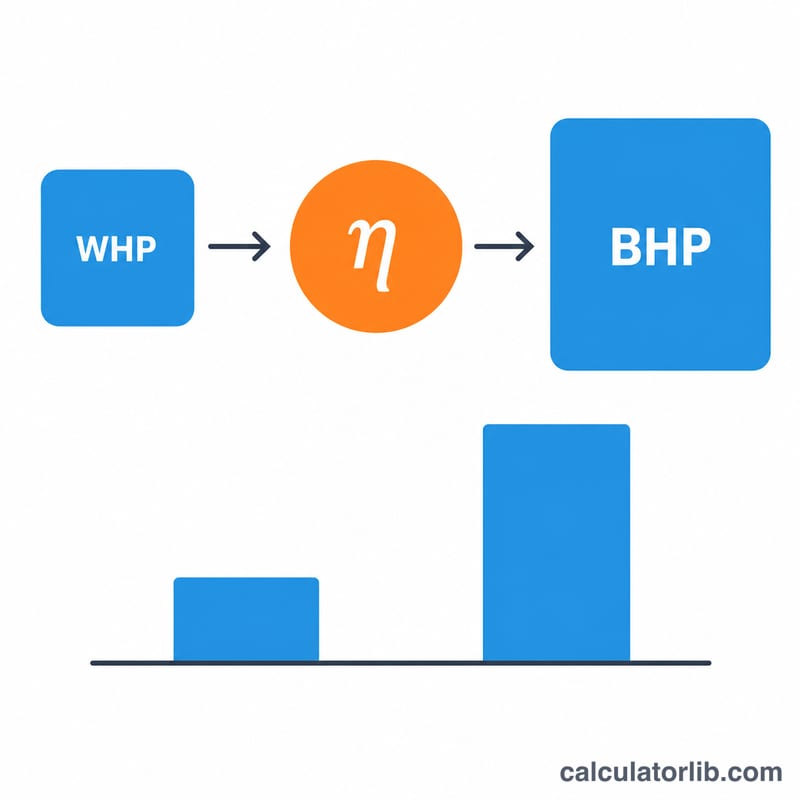
This tool estimates the power a centrifugal pump needs to move liquid at a given flow rate and head. It reports both water horsepower (WHP) — the useful hydraulic power delivered to the fluid — and brake horsepower (BHP) — the actual shaft power the motor must supply once pump inefficiencies are accounted for. The result is also converted to kilowatts for convenience.
How to Use It
Enter the flow rate in US gallons per minute (GPM), the total dynamic head in feet, the specific gravity of the fluid (water = 1.0), and the pump efficiency as a percentage. Typical centrifugal pump efficiencies range from 60% to 85%. The calculator returns BHP, WHP, and the equivalent power in kW.
The Formula Explained
The governing equation is:
$$\text{BHP} = \frac{\text{Q} \times \text{H} \times \text{SG}}{3960 \times \eta}$$
The constant 3960 comes from unit conversion: one horsepower equals 33,000 ft·lb/min, and water weighs 8.34 lb/gallon, so \(33{,}000 / 8.34 \approx 3960\). Specific gravity scales the result for fluids denser or lighter than water, and efficiency (\(\eta\), as a decimal) accounts for friction and hydraulic losses inside the pump.
Worked Example
For 100 GPM, 100 ft of head, water (SG = 1.0), and 70% efficiency: $$\text{WHP} = \frac{100 \times 100 \times 1.0}{3960} = 2.525 \text{ HP}.$$ $$\text{BHP} = \frac{2.525}{0.70} = 3.608 \text{ HP},$$ or about 2.69 kW.
FAQ
What is the difference between WHP and BHP? WHP is the power actually transferred to the fluid; BHP is the larger value the motor must deliver because no pump is 100% efficient.
Why does specific gravity matter? Heavier fluids require more power to lift. SG above 1.0 increases required power; SG below 1.0 decreases it.
How do I pick an efficiency value? Use the pump manufacturer's efficiency at your operating point. If unknown, 65–75% is a reasonable estimate for many centrifugal pumps.