
What Is the Least Common Denominator?
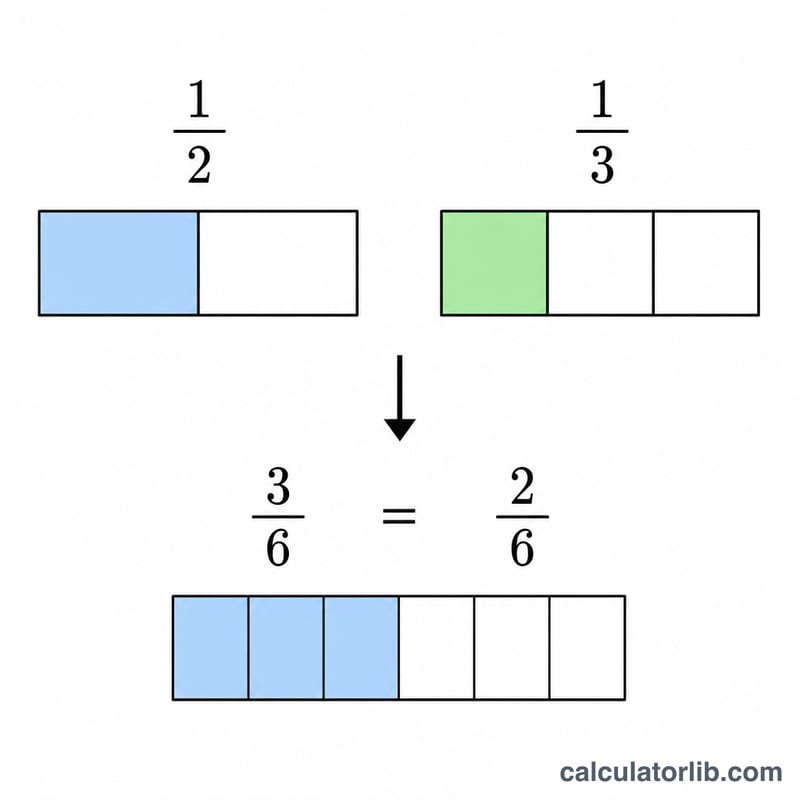
The least common denominator (LCD) is the smallest positive whole number that every denominator in a set of fractions divides evenly into. It is exactly the same as the least common multiple (LCM) of those denominators. Finding the LCD is the first step when you want to add, subtract, or compare fractions, because the fractions must share a common bottom number before you can combine the numerators.
How to Use This Calculator
Enter the denominators of your fractions in the boxes — two are required and two more are optional, so you can handle up to four fractions at once. Leave the optional boxes blank (or zero) if you do not need them. Press calculate and the tool returns the least common denominator along with a count of how many denominators it combined.
The Formula Explained
The calculator builds the LCD by combining denominators two at a time. For any pair of numbers it uses the identity \(\operatorname{lcm}(a, b) = \frac{|a \cdot b|}{\gcd(a, b)}\), where gcd is the greatest common divisor found with the Euclidean algorithm. Starting from 1, it folds in each denominator: the running LCM is combined with the next value, and the process repeats until every denominator has been included. The result is guaranteed to be the smallest number divisible by all of them.
$$\text{LCD} = \operatorname{lcm}\left(\text{D}_1,\ \text{D}_2,\ \text{D}_3,\ \text{D}_4\right)$$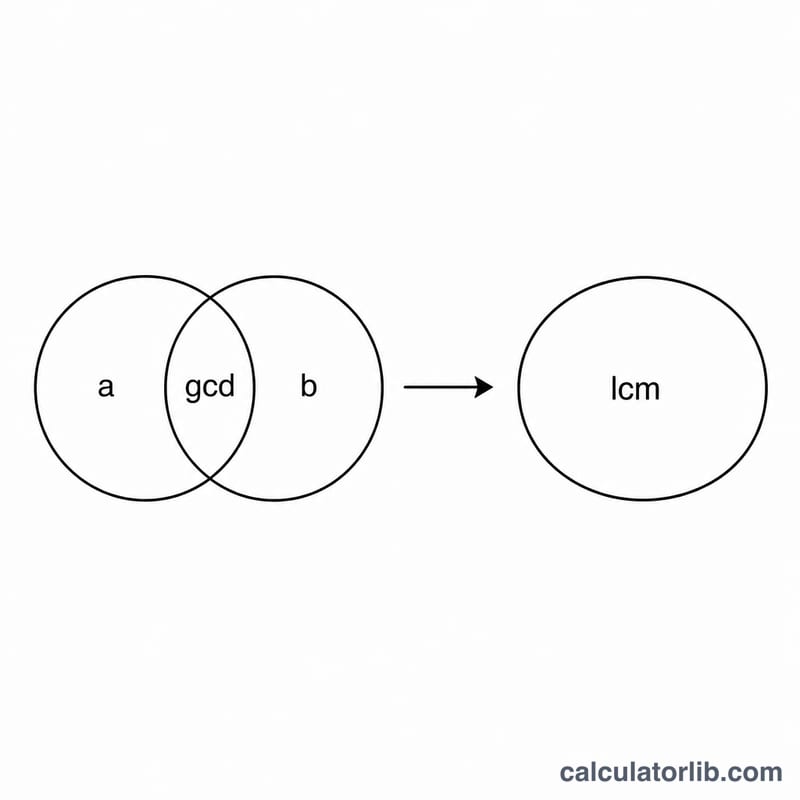
Worked Example
Suppose you want to add 1/4, 1/6, and 1/8. Start with \(\operatorname{lcm}(4, 6)\): \(\gcd(4, 6) = 2\), so \(\operatorname{lcm} = \frac{4 \times 6}{2} = 12\). Now combine 12 with 8: \(\gcd(12, 8) = 4\), so \(\operatorname{lcm} = \frac{12 \times 8}{4} = 24\). The least common denominator is 24. Rewriting the fractions over 24 gives 6/24, 4/24, and 3/24.
FAQ
Is the LCD the same as the LCM? Yes. When the numbers are denominators of fractions we call the LCM the least common denominator, but the calculation is identical.
What if two denominators are equal? The LCD simply equals that shared value (their gcd equals the number itself), so duplicates do not change the answer.
Can the LCD be the product of the denominators? Only when the denominators are pairwise coprime (share no common factor). For example, \(\operatorname{lcm}(3, 5) = 15\), which is just \(3 \times 5\).