
What this calculator does
This tool solves a logarithmic equation of the form \(\log_b(x) = y\) for the unknown value \(x\). Given the base \(b\) and the right-hand value \(y\), it returns the exact value of \(x\) by converting the equation from logarithmic form to exponential form. It works for any valid base — base 10 (common log), base e (natural log, use roughly 2.71828), base 2 (binary log), or any other positive base not equal to 1.
How to use it
Enter the logarithm base \(b\) in the first field. Common choices are 10 for the common logarithm, 2.71828 for the natural logarithm, and 2 for the binary logarithm. In the second field enter the value \(y\) that the logarithm equals. Press calculate and the tool returns \(x = b^y\). The base must be positive and cannot equal 1, since log base 1 is undefined.
The formula explained
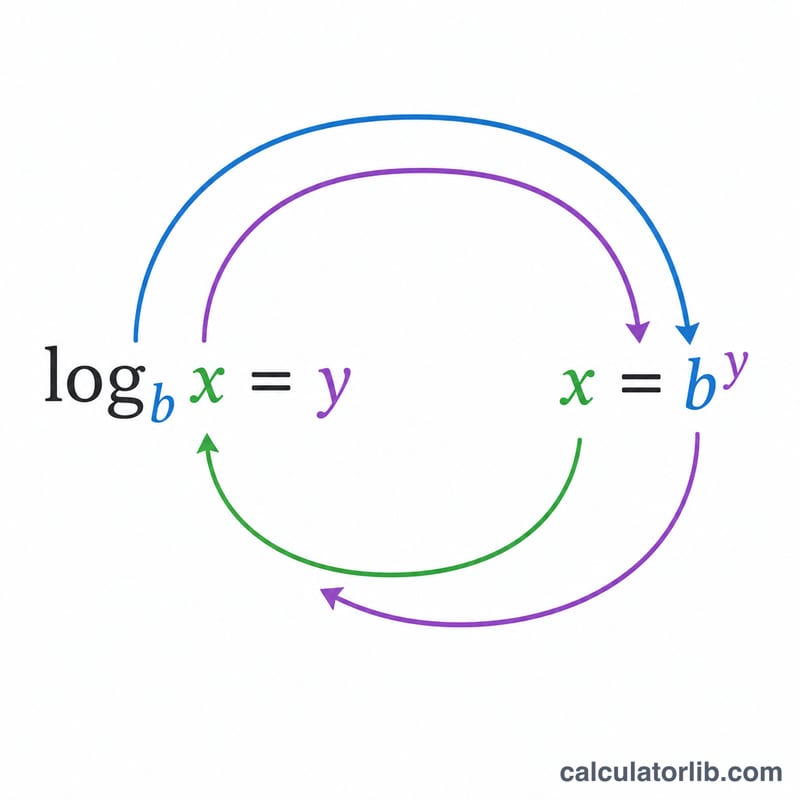
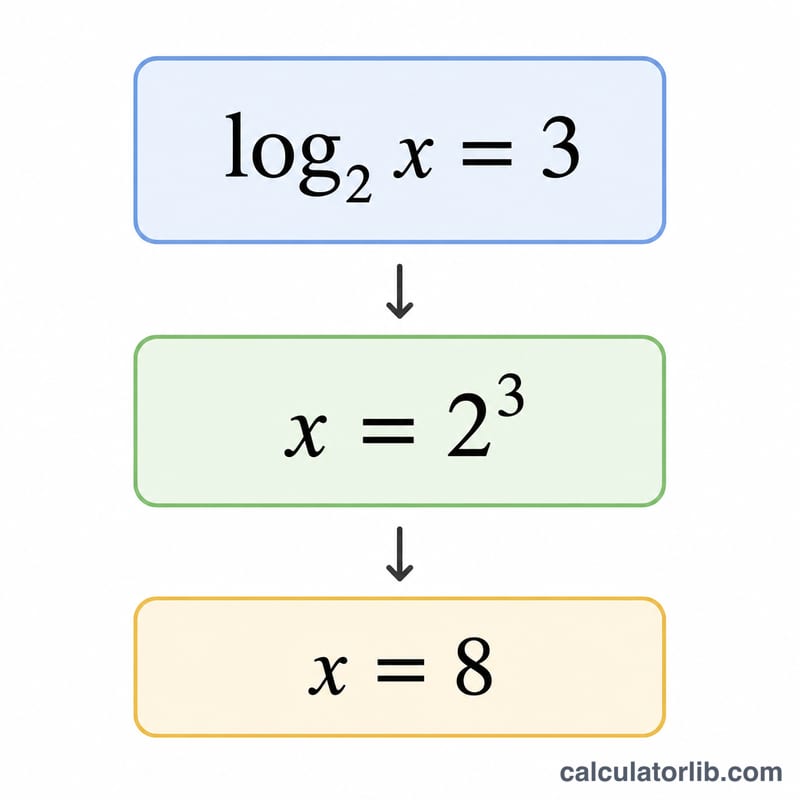
The definition of a logarithm states that $$\log_b(x) = y \;\Longrightarrow\; x = b^y$$ In words, the logarithm answers the question: to what power must the base \(b\) be raised to obtain \(x\)? So if you already know that power (\(y\)) and the base (\(b\)), you simply raise \(b\) to the power \(y\) to recover \(x\). This conversion between logarithmic and exponential form is the single key step for solving these equations.
Worked example
Suppose \(\log_{10}(x) = 3\). Using \(x = b^y\) we get $$x = 10^3 = 1000$$ As a check, \(\log_{10}(1000) = 3\), confirming the answer. Another example: \(\log_2(x) = 5\) gives $$x = 2^5 = 32$$
FAQ
Can x be negative? No. Because \(x = b^y\) and \(b\) is positive, \(x\) is always positive. The logarithm of a negative number is undefined in the real numbers — solving for \(x\) using the exponential form automatically yields a valid positive result.
Why must the base not be 1? Logarithms with base 1 are undefined because 1 raised to any power is always 1, so it cannot represent different values of \(x\).
What if y is negative or a fraction? That is fine. A negative \(y\) gives a value of \(x\) between 0 and 1 (e.g. \(10^{-2} = 0.01\)), and fractional \(y\) gives roots (e.g. \(4^{0.5} = 2\)).