
What Is the Faraday Electrolysis Mass Calculator?
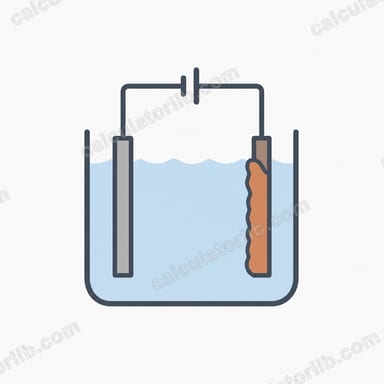
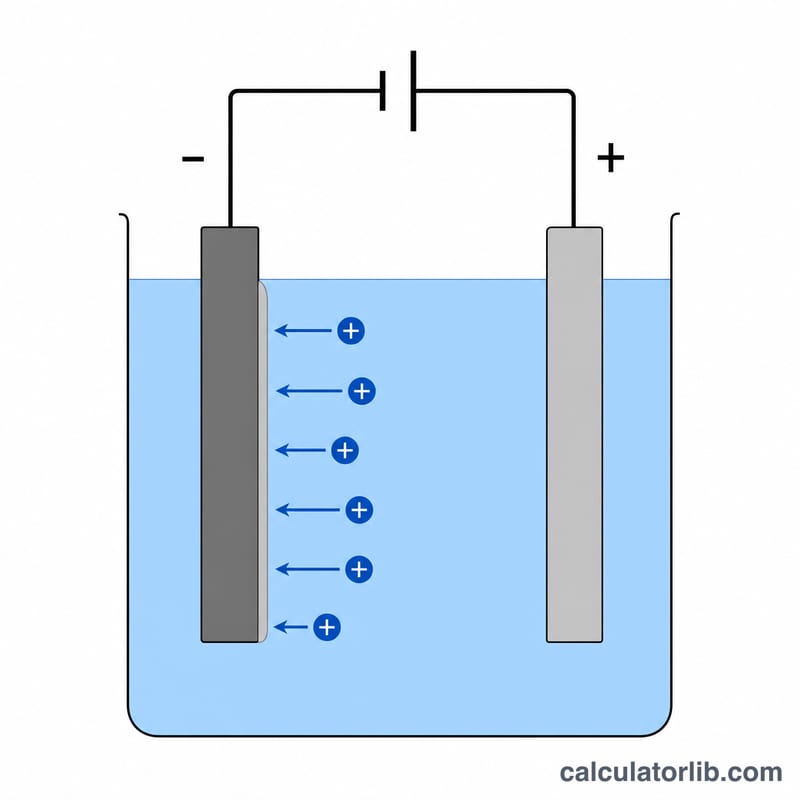
This tool applies Faraday's laws of electrolysis to predict how much of a substance is deposited at an electrode (or liberated as gas) when an electric current passes through an electrolyte. It is universal physics/chemistry — it applies anywhere — and is widely used in electroplating, metal refining, electrowinning and electrochemistry coursework.
The Formula Explained
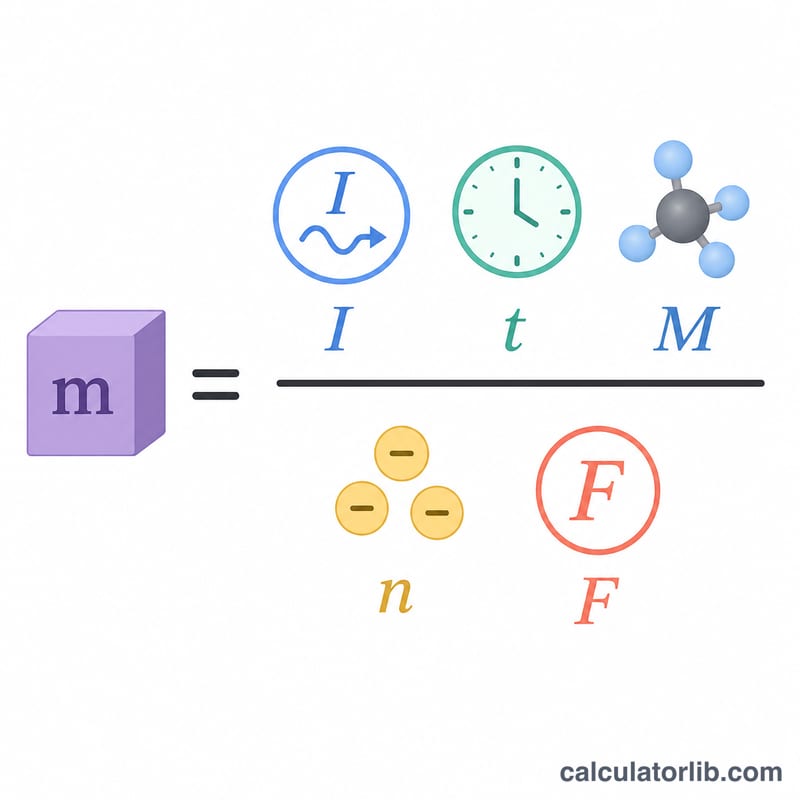
The mass produced is given by:
$$m = \frac{\text{Current (A)} \cdot \text{Time (s)} \cdot \text{Molar Mass}}{\text{Electrons (n)} \cdot 96485}$$where I is the current in amperes, t is time in seconds, M is the molar mass of the substance in g/mol, n is the number of electrons transferred per ion (the change in oxidation number), and F is the Faraday constant, 96,485 C/mol. The product \(I \cdot t\) is the total charge Q in coulombs. Dividing Q by \((n \cdot F)\) gives the moles of substance, and multiplying by M converts to grams.
How to Use It
Enter the current, the duration in seconds, the molar mass of the element being deposited, and the number of electrons in its half-reaction. For example, copper deposits via Cu²⁺ + 2e⁻ → Cu, so \(n = 2\); silver via Ag⁺ + e⁻ → Ag, so \(n = 1\).
Worked Example
Plating copper (M = 63.55 g/mol, n = 2) with a 2 A current for 1 hour (3600 s): \(Q = 2 \times 3600 = 7200\) C. Moles = \(7200 / (2 \times 96485) = 0.03731\) mol. Mass = \(0.03731 \times 63.55 \approx 2.371\) g of copper.
FAQ
What is n? It is the number of electrons gained or lost per ion in the relevant half-reaction — equal to the magnitude of the oxidation number change.
Does this work for gases? Yes. For hydrogen (2H⁺ + 2e⁻ → H₂) use M = 2 g/mol and n = 2 to get mass of H₂; convert to volume with the ideal gas law if needed.
What if my time is in minutes or hours? Convert to seconds first (multiply minutes by 60, hours by 3600) since the Faraday constant uses coulombs = ampere·seconds.