
What is the Volume from Molarity and Moles Calculator?
This calculator finds the volume of a solution when you know the number of moles of solute and the solution's molarity (concentration). It rearranges the fundamental concentration relationship to solve for volume, giving you an instant answer in both liters and milliliters. It is a universal chemistry tool useful for preparing solutions, dilutions, and titration prep work.
How to use it
Enter the amount of solute in moles (n) and the molarity of the solution in mol/L (M). The calculator divides moles by molarity to return the required solution volume. Make sure your molarity is greater than zero, since dividing by zero has no physical meaning.
The formula explained
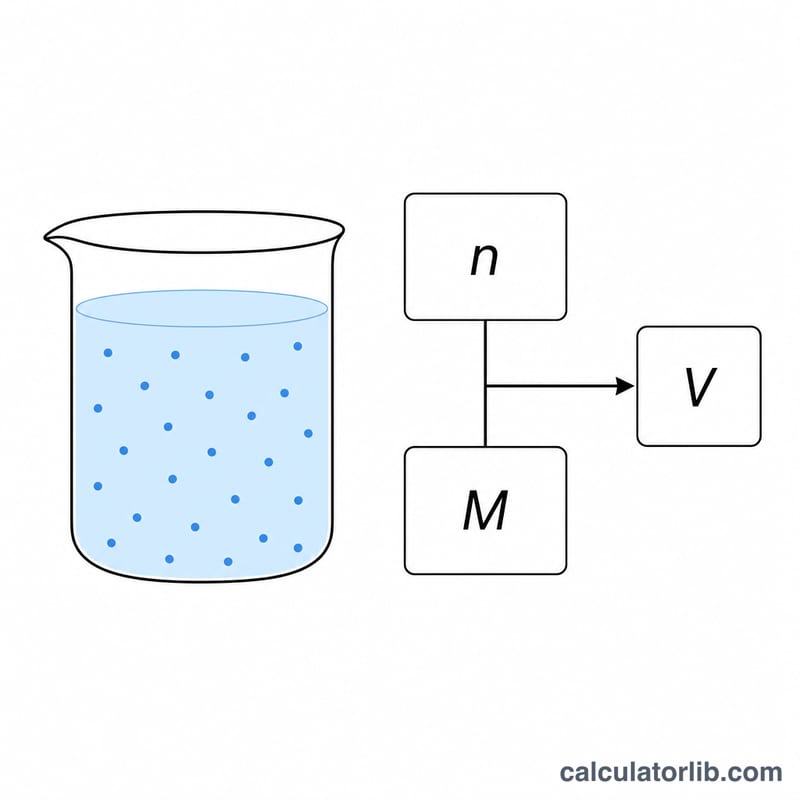
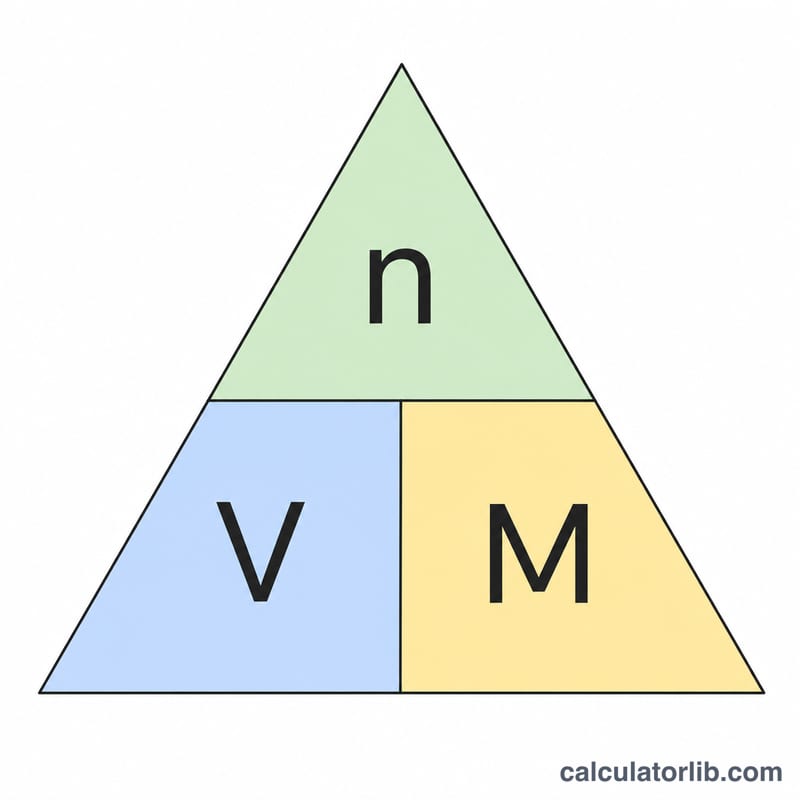
Molarity is defined as moles of solute per liter of solution: \(M = n / V\). Rearranging for volume gives:
$$V = \frac{n}{M}$$
Here \(V\) is volume in liters, \(n\) is moles of solute, and \(M\) is molarity in mol/L. To express the result in milliliters, multiply by 1000.
Worked example
Suppose you have 0.5 mol of NaCl and want a 0.25 mol/L solution. Then $$V = \frac{0.5}{0.25} = 2 \text{ L},$$ which equals 2000 mL. So you would dissolve the salt and dilute to a total volume of 2 liters.
FAQ
What units does the answer use? The primary result is in liters; the table also shows the equivalent in milliliters.
Can molarity be zero? No. A zero molarity would imply infinite volume, so the calculator guards against division by zero.
Does this account for temperature? No. Molarity depends on solution volume which can vary slightly with temperature, but this tool assumes the standard definition at the measurement temperature.