
What This Calculator Does
This tool converts a solution's molarity (moles of solute per litre) into its percent weight/volume concentration (% w/v), which expresses grams of solute per 100 mL of solution. It is a universal chemistry calculation used in laboratories, pharmacies, and classrooms worldwide.
How to Use It
Enter the molarity of your solution in mol/L and the molecular weight (molar mass) of the solute in g/mol. The calculator instantly returns the percent w/v concentration along with the mass concentration in grams per litre.
The Formula Explained
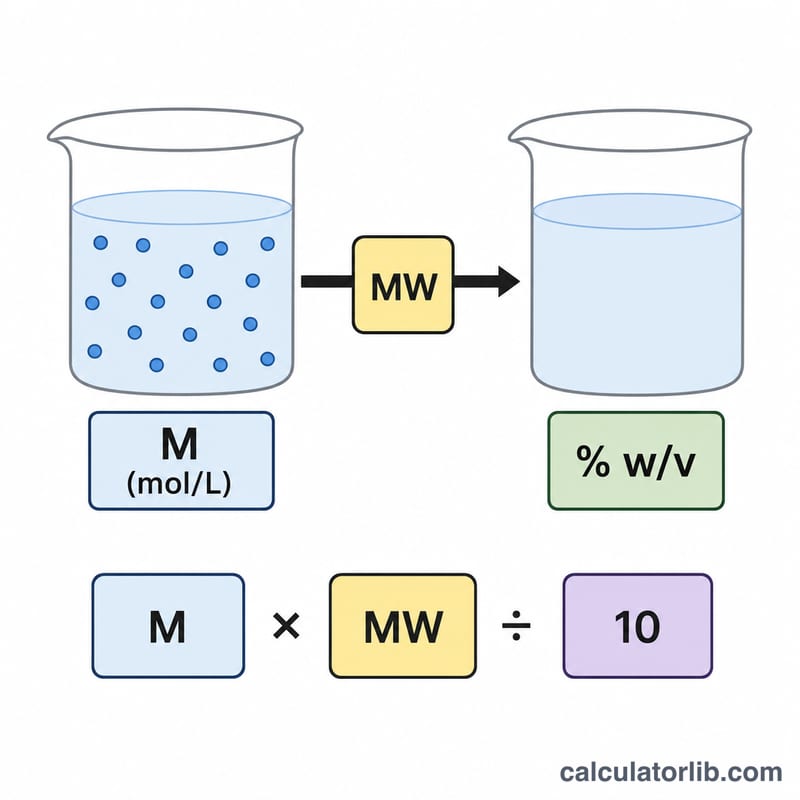
The conversion is $$\%\,\text{(w/v)} = \frac{\text{Molarity (mol/L)} \times \text{Molecular Weight (g/mol)}}{10}$$ Multiplying molarity by molecular weight gives grams of solute per litre (g/L). Since % w/v is defined as grams per 100 mL, and 1 litre = 1000 mL, you divide g/L by 10 to obtain grams per 100 mL, which equals the percent w/v value.
Worked Example
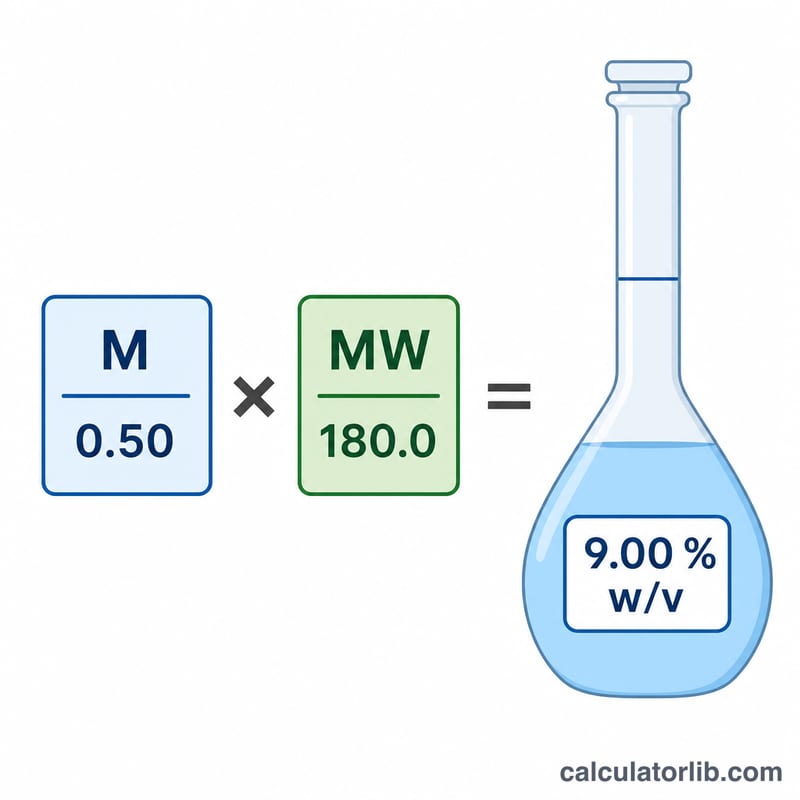
Consider a 1 M solution of sodium chloride (NaCl), which has a molecular weight of 58.44 g/mol. Multiply: \(1 \times 58.44 = 58.44\) g/L. Divide by 10: \(58.44 / 10 = 5.844\)% w/v. So a 1 molar NaCl solution is about 5.84% w/v.
FAQ
What is % w/v? Percent weight/volume describes the mass of solute (in grams) dissolved per 100 mL of total solution.
Where do I find molecular weight? Sum the atomic masses of all atoms in the compound's formula, or look it up on the compound's safety data sheet.
Does this work for any solute? Yes, as long as you supply the correct molecular weight; the relationship is purely mathematical.