What This Fixed Deposit Calculator Does
A fixed deposit (FD) — called a term deposit or CD in some countries — locks a lump sum with a bank for a set period at a fixed interest rate. This calculator takes four inputs and returns the maturity amount, the total interest earned, and an average annual return figure. It works with any currency, since the maths is currency-neutral.
The Inputs You Enter
- Principal Amount — the lump sum you deposit (defaults to 10,000 if left blank).
- Interest Rate (% per annum) — the quoted nominal annual rate, e.g. 7.25 (defaults to 5.5).
- Time Period (in years) — the tenure; decimals are allowed, so 18 months is 1.5 (defaults to 3).
- Compounding Frequency — Annually, Semi-Annually, Quarterly, Monthly or Daily, which maps to \(n = 1,\ 2,\ 4,\ 12\) or \(365\) compounding periods per year.
The Formula
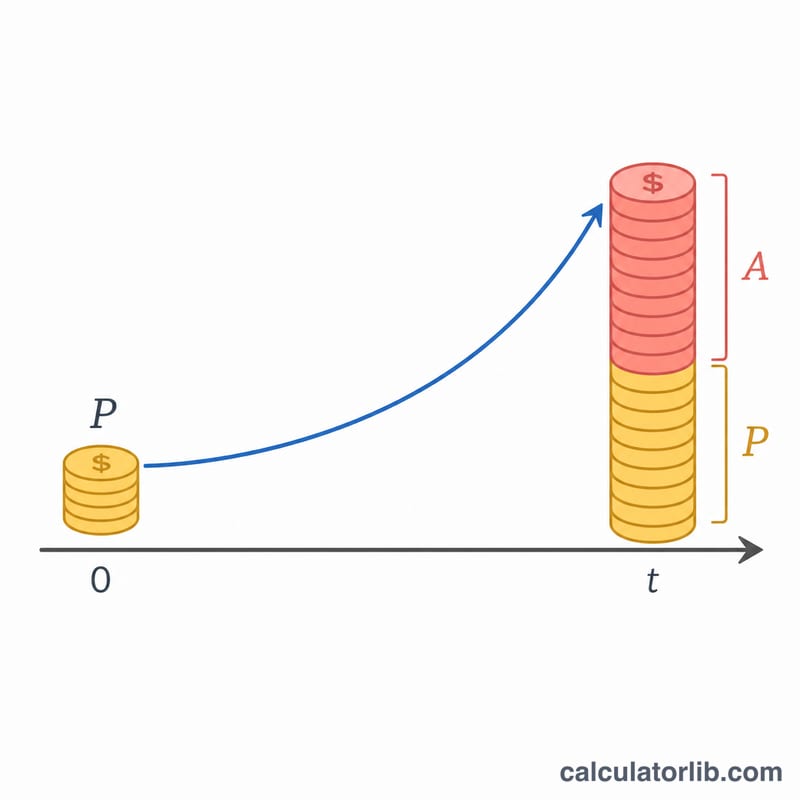
The calculator uses standard compound interest:
$$A = P\left(1 + \frac{r}{n}\right)^{n\,t}$$Here \(P\) is the principal, \(r\) is the rate divided by 100, \(t\) is the years and \(n\) is the compounds per year. Total interest is simply \(A - P\). The effective annual figure it reports is a simple average return:
$$\text{Avg rate} = \frac{A - P}{P \times t} \times 100$$Because interest compounds, this average sits slightly above the nominal rate on longer tenures.
Worked Example
Deposit 100,000 at 7% per annum for 3 years, compounded quarterly (\(n = 4\)):
$$A = 100{,}000\left(1 + \frac{0.07}{4}\right)^{4 \times 3} = 100{,}000 \times (1.0175)^{12}$$That gives \(A \approx 123{,}144\), so interest is \(123{,}144 - 100{,}000 = 23{,}144\). The average annual rate is \(\frac{23{,}144}{100{,}000 \times 3} \times 100 \approx 7.71\%\) — higher than 7% because each quarter's interest also earns interest.
FAQ
Does more frequent compounding really matter? Yes, but modestly. The same deposit above compounded annually matures at about 122,504 and daily at about 123,367 — a spread of roughly 860 over three years.
Can I enter part-years? Yes. Time accepts decimals, so a 9-month FD is 0.75 and the exponent \(n\,t\) handles it directly.
Is tax included? No. The result is gross interest. Many countries tax FD interest (and some banks deduct it at source), so your take-home will be lower — subtract your applicable tax rate from the interest figure to estimate net returns.