
What is the Pressure to Force Calculator?
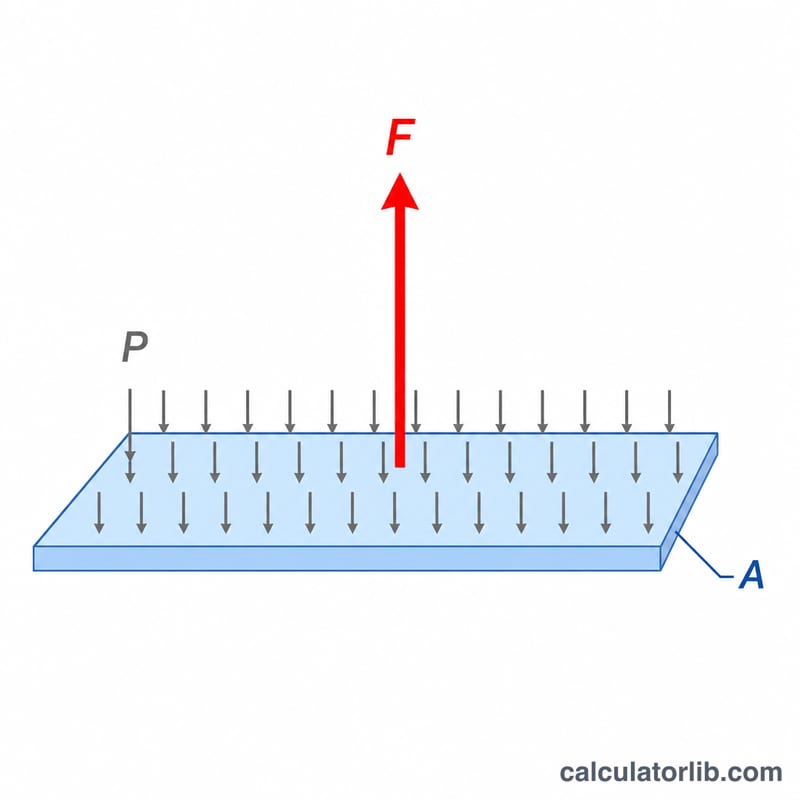
This calculator finds the total force produced when a given pressure acts over a surface area, using the fundamental relationship \(F = P \times A\). It is widely used in hydraulics, pneumatics, mechanical design, and physics to size cylinders, pistons, seals, and structural loads. The tool accepts common engineering units for both pressure and area and reports the resulting force in newtons, pound-force, and kilogram-force.
How to use it
Enter the pressure value and select its unit (Pa, kPa, MPa, bar, or PSI). Then enter the area the pressure acts on and choose its unit (m², cm², mm², or in²). The calculator converts everything to SI units internally, multiplies pressure by area, and displays the force. This makes it easy to mix units — for example, PSI with square inches — without manual conversion.
The formula explained
Pressure is defined as force per unit area, so \(P = F / A\). Rearranging gives the force equation:
$$F = P \times A$$In SI units, 1 pascal acting on 1 square meter produces 1 newton. To stay consistent, the calculator converts pressure to pascals (1 bar = 100{,}000 \text{ Pa}, 1 \text{ PSI} \approx 6{,}894.76 \text{ Pa}) and area to square meters before multiplying.
Worked example
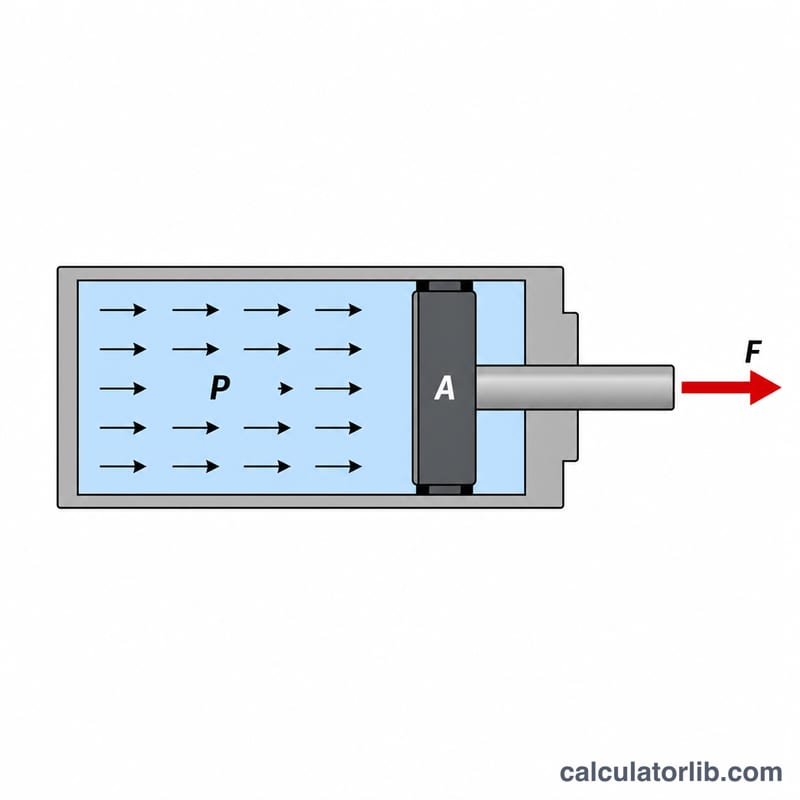
Suppose a hydraulic piston has a pressure of 200 kPa applied over an area of 0.05 m². Converting pressure: 200 \text{ kPa} = 200{,}000 \text{ Pa}. Then
$$F = 200{,}000 \times 0.05 = 10{,}000 \text{ N}$$which is about 2{,}248 lbf or 1{,}019.7 kgf. A 10,000 N force could lift roughly one metric ton.
FAQ
Does this work for any fluid or gas? Yes — \(F = P \times A\) applies to any pressure acting on a flat area, whether hydraulic fluid, compressed air, or vacuum.
What about curved surfaces? For force in a given direction, use the projected (flat) area perpendicular to that direction.
Is gauge or absolute pressure used? Use whichever pressure value reflects the actual differential acting on your surface; the math is identical.