
What Is the Drag Force Calculator?
This calculator finds the aerodynamic (or hydrodynamic) drag force acting on an object moving through a fluid such as air or water. Drag is the resistive force that opposes motion, and it grows with the square of velocity — which is why doubling your speed roughly quadruples the drag you must overcome. The tool is universal and unit-agnostic as long as you use SI units, returning the force in newtons.
How to Use It
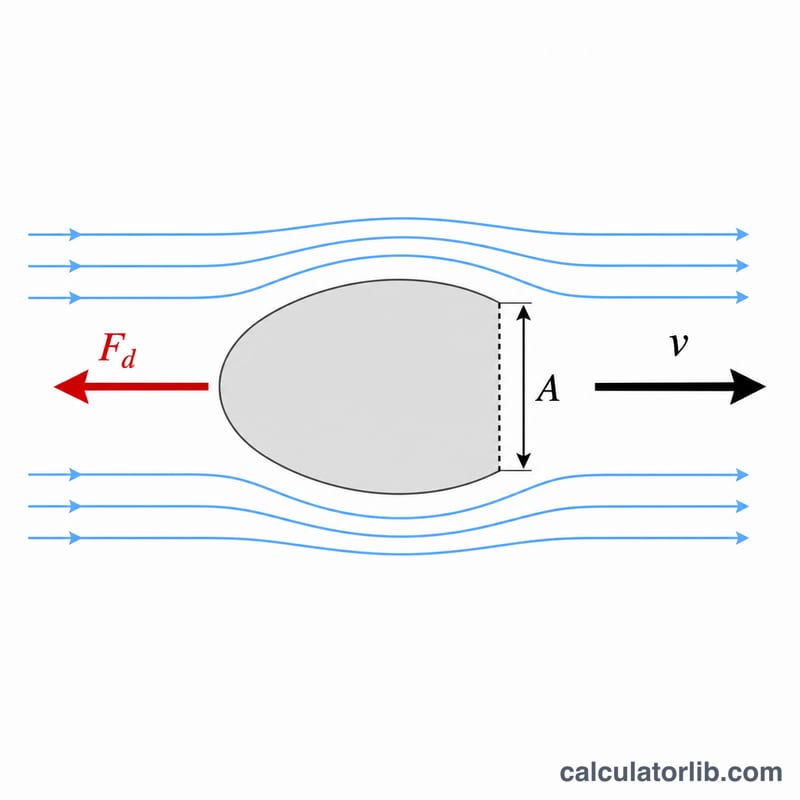
Enter four values: the fluid density \(\rho\) (about 1.225 kg/m³ for air at sea level, 1000 kg/m³ for water), the relative velocity \(v\) in meters per second, the dimensionless drag coefficient \(C_d\) (a sphere ≈ 0.47, a streamlined car ≈ 0.3, a flat plate ≈ 1.28), and the reference area \(A\) in square meters (usually the frontal cross-section). The calculator returns the drag force and the dynamic pressure \(\tfrac{1}{2}\rho v^{2}\).
The Formula Explained
The drag equation is $$F_d = \frac{1}{2} \cdot \rho \cdot v^{2} \cdot C_d \cdot A$$ The term \(\tfrac{1}{2}\rho v^{2}\) is the dynamic pressure of the flow, \(C_d\) packages the shape's resistance, and \(A\) scales it by how much area faces the flow. Multiplying these gives the total force in newtons.
Worked Example
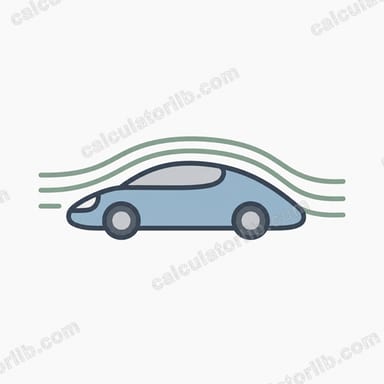
A car drives at 30 m/s through air (\(\rho = 1.225\) kg/m³) with \(C_d = 0.30\) and frontal area \(A = 2.2\) m². Then $$F_d = 0.5 \times 1.225 \times 30^{2} \times 0.30 \times 2.2 = 0.5 \times 1.225 \times 900 \times 0.30 \times 2.2 \approx 363.8 \ \text{N}$$
FAQ
Why does drag rise so fast with speed? Because velocity is squared in the equation — at high speed drag dominates fuel use.
What air density should I use? Sea-level standard air is 1.225 kg/m³; it decreases with altitude and temperature.
Is this the same as terminal velocity? At terminal velocity the drag force equals the object's weight, so this calculator helps you check that balance.