
What Is the 50/30/20 Rule Calculator?
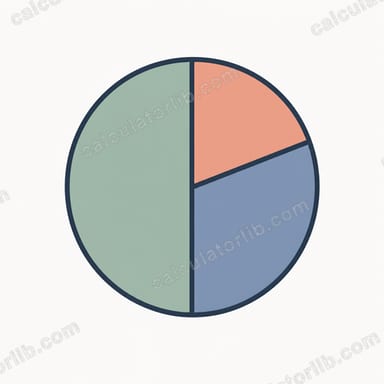
The 50/30/20 Rule Calculator is a simple budgeting tool that splits your monthly take-home pay into three spending categories based on a popular personal-finance guideline. The rule, made famous by US Senator Elizabeth Warren in her book All Your Worth, suggests dividing your after-tax income into 50% for needs, 30% for wants, and 20% for savings. While the framework is American in origin, the math applies to any currency or country.
How to Use It
This calculator asks for a single input:
- Monthly Income (After Tax) — your net take-home pay each month, after income tax and other deductions are removed.
Enter your monthly net income and the calculator instantly returns three allocations. There's nothing else to configure — the percentages are fixed at the classic 50/30/20 split.
The Formula Explained
The calculator applies three straightforward multiplications to your monthly after-tax income:
- Needs = Income × 0.50 — essentials like rent or mortgage, groceries, utilities, transport, insurance, and minimum debt payments.
- Wants = Income × 0.30 — discretionary spending such as dining out, streaming subscriptions, hobbies, and travel.
- Savings = Income × 0.20 — savings, investments, and extra debt repayments beyond the minimum.
The three results always add back up to 100% of your income.
Worked Example
Suppose your monthly after-tax income is 3,000. The calculator works out:
- Needs: 3,000 × 0.50 = 1,500
- Wants: 3,000 × 0.30 = 900
- Savings: 3,000 × 0.20 = 600
So you'd aim to spend no more than 1,500 on essentials, keep wants under 900, and put 600 toward savings and debt each month.
Budget Allocations at Different Income Levels
The 50/30/20 rule splits your monthly after-tax (take-home) income into three buckets: 50% for needs, 30% for wants, and 20% for savings and debt repayment. The table below shows how those allocations work out across a range of common monthly incomes.
| Monthly After-Tax Income | Needs (50%) | Wants (30%) | Savings (20%) |
|---|---|---|---|
| $1,500 | $750 | $450 | $300 |
| $2,500 | $1,250 | $750 | $500 |
| $4,000 | $2,000 | $1,200 | $800 |
| $6,000 | $3,000 | $1,800 | $1,200 |
For a worked example at $4,000 per month: \(\text{Needs} = 0.50 \times 4000 = 2000\), \(\text{Wants} = 0.30 \times 4000 = 1200\), and \(\text{Savings} = 0.20 \times 4000 = 800\). The three amounts always sum back to the full income.
What Goes in Each Category
Sorting expenses into the right bucket is the part of the rule that takes the most judgment. The general test for a “need” is whether you would still have to pay it (or face serious consequences) if your income dropped. Everything optional is a “want,” and the final 20% builds your financial future.
| Category | Share | Typical Expenses |
|---|---|---|
| Needs | 50% | Rent or mortgage payment, groceries, electricity/water/gas and other essential utilities, health and auto insurance, minimum required debt payments, commuting and basic transport |
| Wants | 30% | Dining out and takeout, streaming and other subscriptions, hobbies and entertainment, travel and vacations, gym memberships, upgrades to non-essential goods (newer phone, premium plans) |
| Savings | 20% | Emergency fund contributions, retirement accounts and investments, extra (above-minimum) debt repayment, and other long-term goals such as a home down payment |
Note that only the minimum required payment on a debt counts as a need; any extra you pay to clear the balance faster counts toward the 20% savings-and-debt bucket.
Interpreting Your Results
The amounts the calculator returns are targets, not a record of what you actually spend. They show where the 50/30/20 rule says each portion of your take-home pay would go if you followed the guideline exactly. To use them, compare these targets against your real monthly spending in each category.
If your essential expenses come out higher than 50% of your income, that is a common signal in higher-cost areas and is not necessarily a failure — but it does mean the remaining 50% has to stretch across both wants and savings, leaving less room for either. In that situation people typically trim the wants bucket first, since needs are by definition hard to cut quickly.
The 20% savings-and-debt bucket is the part most directly tied to long-term financial health. It is what funds an emergency cushion, retirement, and faster payoff of high-interest debt. Consistently hitting (or exceeding) this share is generally what moves you from living paycheck to paycheck toward building net worth, while routinely falling short of it tends to slow progress on those goals.
Finally, 50/30/20 is a guideline rather than a strict rule. The right split depends on your cost of living, life stage, and goals — some people deliberately raise the savings share when paying down debt or saving aggressively, and others temporarily allow needs to exceed 50% during expensive periods. This is general educational information, not personalized financial advice; consider your own circumstances or consult a qualified professional before making major decisions.
Frequently Asked Questions
Should I use gross or net income? Use net (after-tax) income. The 50/30/20 rule is built around the money that actually lands in your bank account.
What if my needs exceed 50%? That's common in high-cost areas. Treat the percentages as targets — if needs run high, look for ways to trim wants rather than abandoning savings entirely.
Do minimum debt payments count as needs or savings? Minimum required payments belong in the 50% needs bucket. Any extra you pay above the minimum counts toward the 20% savings goal.