
What Is an Antipode?
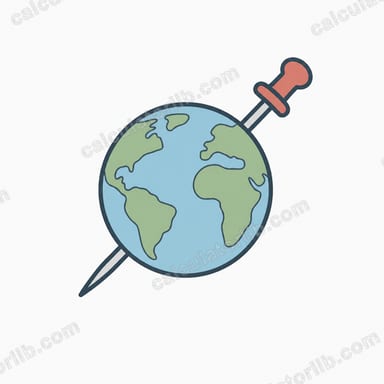
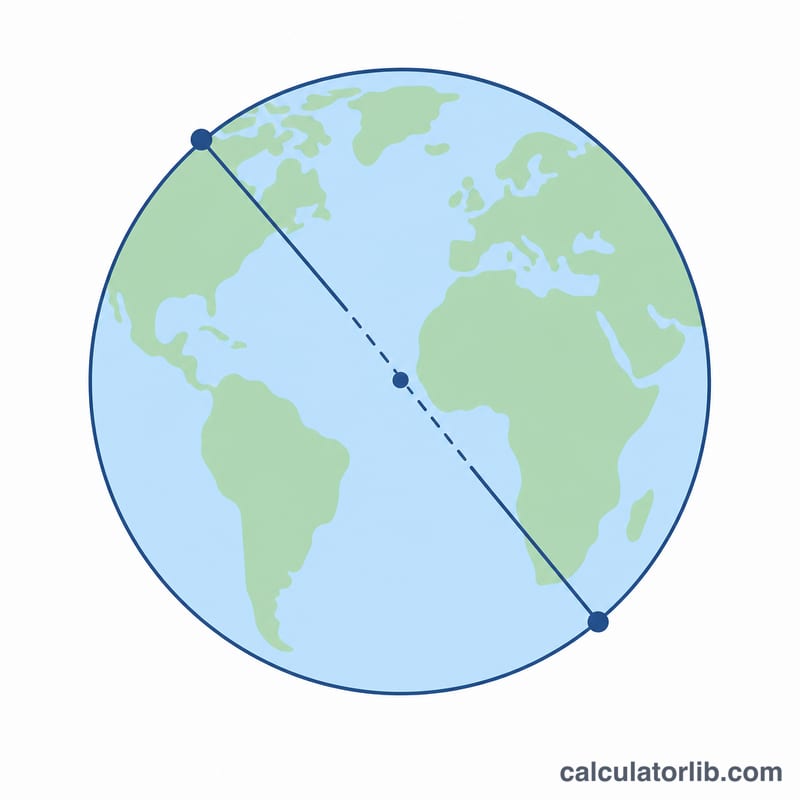
An antipode is the point on the Earth's surface that is diametrically opposite to a given location — if you could tunnel straight through the center of the planet, you would emerge at the antipode. This calculator takes any latitude and longitude and returns the coordinates of the exact opposite point on the globe.
How to Use This Calculator
Enter the latitude (between -90° and 90°, positive for North, negative for South) and the longitude (between -180° and 180°, positive for East, negative for West) of your starting location. The calculator instantly returns the antipodal latitude and longitude. Most antipodes of land actually fall in the ocean — only about 4% of the Earth's land has land on the opposite side.
The Formula Explained
The math is elegantly simple. The antipodal latitude is the negation of the original latitude: a point at 40°N maps to 40°S. The antipodal longitude is found by adding 180° and then wrapping the result back into the standard range. If the longitude exceeds 180°, subtract 360°; if it drops to -180° or below, add 360°.
$$\phi^{\prime} = -\,\text{lat} \quad\text{and}\quad \lambda^{\prime} = \left(\,\text{lon} + 180\,\right) \bmod 360 - 180$$
Worked Example
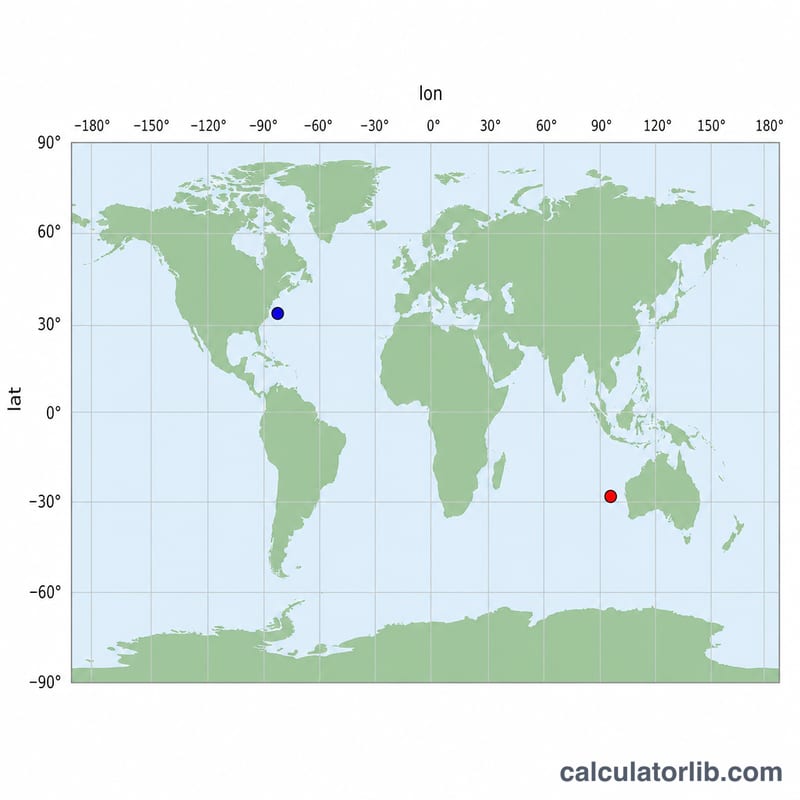
Take New York City at approximately 40.7128°, -74.0060°. The antipodal latitude is -40.7128°. For longitude, \(-74.0060 + 180 = 105.9940^{\circ}\), which is already within range. So the antipode of New York is roughly 40.7128°S, 105.9940°E — a spot in the Indian Ocean southwest of Australia.
Antipodes of Major Cities
The antipode of a point is found by flipping the sign of the latitude and shifting the longitude by 180°, wrapping the result back into the range \(-180^{\circ}\) to \(+180^{\circ}\). A famous property of the Earth is that most land has ocean on its opposite side — only about 4% of land is antipodal to other land. The table below lists the antipodes of several well-known cities.
| City | Latitude | Longitude | Antipode latitude | Antipode longitude | Antipode terrain |
|---|---|---|---|---|---|
| New York, USA | 40.71°N | 74.01°W | 40.71°S, 105.99°E | 40.71°S | Indian Ocean (SW of Australia) |
| London, UK | 51.51°N | 0.13°W | 51.51°S | 179.87°E | Pacific Ocean (SE of New Zealand) |
| Tokyo, Japan | 35.68°N | 139.69°E | 35.68°S | 40.31°W | Atlantic Ocean (off South America) |
| Sydney, Australia | 33.87°S | 151.21°E | 33.87°N | 28.79°W | North Atlantic Ocean (off Azores) |
| Beijing, China | 39.90°N | 116.41°E | 39.90°S | 63.59°W | South Atlantic Ocean (off Argentina) |
| Madrid, Spain | 40.42°N | 3.70°W | 40.42°S | 176.30°E | Pacific Ocean (near New Zealand) |
| Wellington, NZ | 41.29°S | 174.78°E | 41.29°N, 5.22°W | 5.22°W | Spain (near Madrid) — rare land-to-land |
| Buenos Aires, Argentina | 34.60°S | 58.38°W | 34.60°N | 121.62°E | China (near Shanghai) — rare land-to-land |
The straight-line distance through the Earth to an antipode equals the full diameter, about \(12{,}742\text{ km}\), while the shortest surface (great-circle) distance is roughly \(20{,}004\text{ km}\) — exactly half the Earth's circumference, and identical no matter which way you travel.
FAQ
Is everyone's antipode underwater? Usually. Because oceans cover most of the planet, the antipode of most inhabited places lands in water.
What is the antipode of the North Pole? The South Pole — latitude flips from 90° to -90°, and longitude is irrelevant at the poles.
Does this account for elevation? No. Antipodes are computed on the idealized sphere using only latitude and longitude, ignoring terrain and the Earth's slight oblateness.