
What Is the APY to APR Calculator?
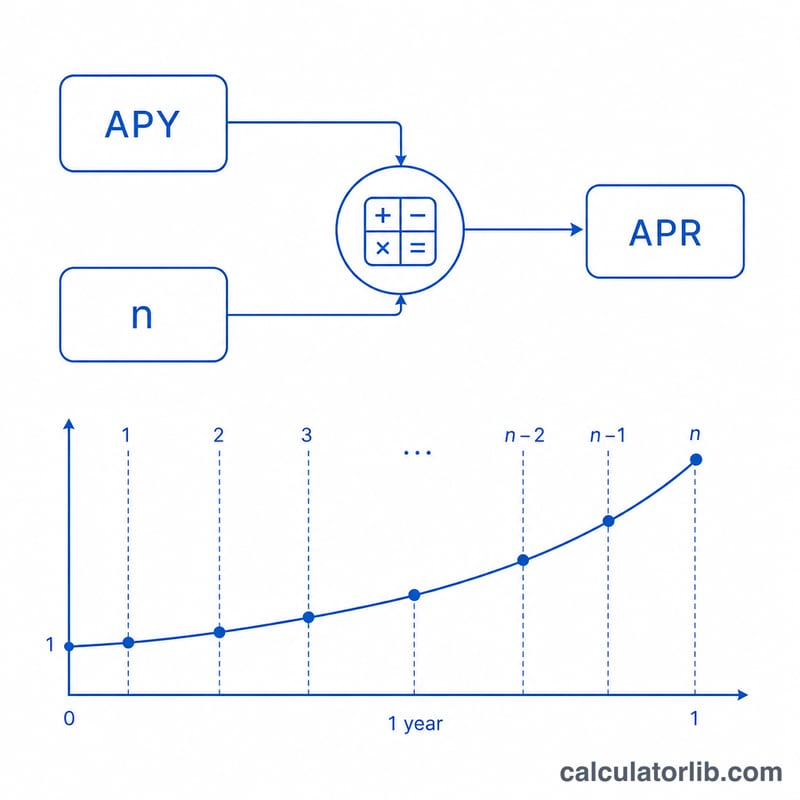
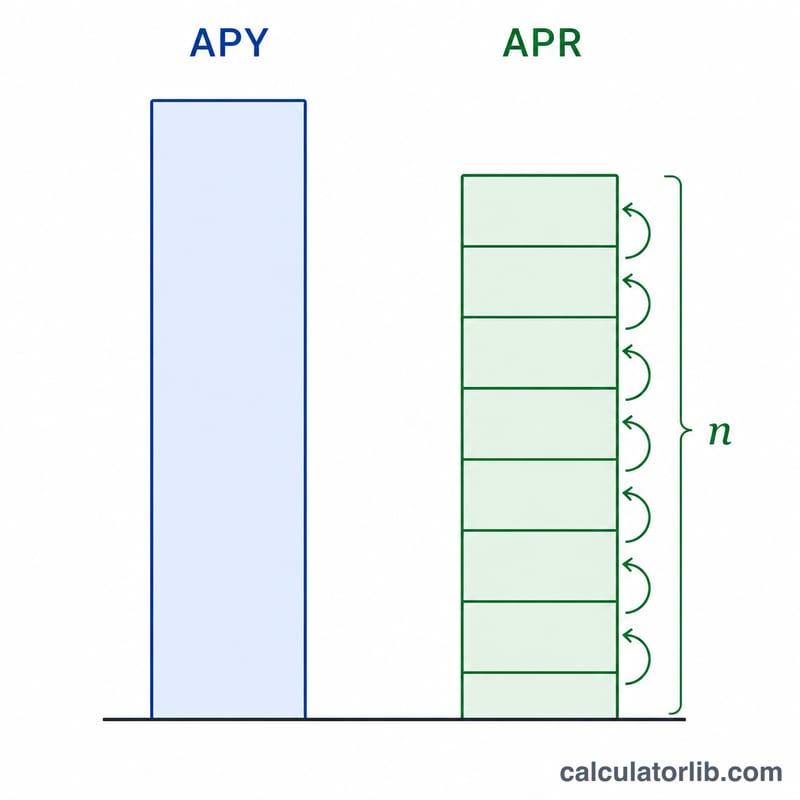
This calculator converts an Annual Percentage Yield (APY) into the equivalent Annual Percentage Rate (APR), also called the nominal annual rate. APY reflects the true return after compounding is taken into account, while APR is the stated rate before compounding. Because the two differ whenever interest compounds more than once a year, converting between them is essential for comparing savings accounts, loans, and investment products on a like-for-like basis.
How to Use It
Enter the APY as a percentage (for example, 5 for 5%) and choose how many times interest compounds per year (12 for monthly, 4 for quarterly, 365 for daily, 1 for annual). The calculator instantly returns the nominal APR that, when compounded at that frequency, produces your APY.
The Formula Explained
The conversion uses:
$$\text{APR} = \text{n} \left[ \left(1 + \frac{\text{APY}}{100}\right)^{\frac{1}{\text{n}}} - 1 \right] \times 100$$
Here n is the number of compounding periods per year and APY is expressed as a decimal. The term \((1 + \text{APY})^{1/n}\) finds the growth factor for a single period; subtracting 1 gives the periodic rate, and multiplying by \(n\) scales it back up to an annual nominal rate.
Worked Example
Suppose an account advertises a 5% APY compounded monthly (\(n = 12\)). Convert APY to a decimal: 0.05. Then $$\text{APR} = 12 \times \left((1.05)^{1/12} - 1\right) = 12 \times (1.0040741 - 1) = 12 \times 0.0040741 \approx 0.048889,$$ or about 4.8889%. So a 5% APY corresponds to roughly a 4.89% nominal APR.
APY to APR Across Compounding Frequencies
For a fixed APY, the nominal annual rate (APR) you need to achieve it falls as compounding becomes more frequent. With more compounding periods, interest earns interest more often, so a lower nominal rate produces the same effective yield. The conversion uses:
$$\text{APR} = n\left[\left(1 + \frac{\text{APY}}{100}\right)^{1/n} - 1\right] \times 100$$
The table below fixes the APY and shows the APR required at several compounding frequencies. Note how the gap between APY and APR widens at the higher rate.
| APY | n = 1 (annual) | n = 4 (quarterly) | n = 12 (monthly) | n = 52 (weekly) | n = 365 (daily) |
|---|---|---|---|---|---|
| 5.00% | 5.0000% | 4.9089% | 4.8889% | 4.8821% | 4.8794% |
| 2.00% | 2.0000% | 1.9852% | 1.9819% | 1.9807% | 1.9803% |
At 5% APY the spread between annual and daily compounding is about 0.121 percentage points, while at 2% APY it is only about 0.020 points — confirming that the APY–APR gap grows with the rate.
Key Terms
- APY (Annual Percentage Yield)
- The effective annual rate of return that accounts for the effect of compounding within the year. It is what your money actually earns or costs over a full year, expressed as a single percentage.
- APR / Nominal Rate
- The stated annual rate before compounding is applied. It is the periodic rate multiplied by the number of periods per year (\(\text{APR} = \text{periodic rate} \times n\)), so it does not by itself reflect intra-year compounding.
- Compounding Frequency (n)
- How many times per year interest is calculated and added to the balance — e.g. 1 (annual), 4 (quarterly), 12 (monthly), 52 (weekly), or 365 (daily). A higher n means more frequent compounding.
- Periodic Rate
- The interest rate applied in a single compounding period, equal to \(\text{APR} / n\). For example, a 6% APR compounded monthly has a periodic rate of 0.5% per month.
- Effective Rate
- Another name for the effective annual rate, which is identical to APY. It reflects the true annual cost or return once compounding is factored in.
- Note on regulatory / fee-inclusive APR
- The APR used in this conversion is purely the nominal interest rate from compounding. It differs from the regulatory APR disclosed on loans (e.g. under U.S. Truth in Lending), which also folds in fees, points, and other finance charges. This calculator deals only with the mathematical interest-rate relationship, not fee-inclusive disclosure figures.
FAQ
Is APR always lower than APY? Yes, whenever compounding happens more than once per year. With annual compounding (\(n = 1\)), APR and APY are equal.
Which compounding frequency should I pick? Use the frequency the financial product actually applies—monthly (12) for most savings accounts and loans, daily (365) for many credit cards.
Does APR include fees? The mathematical APR here is purely the compounding-adjusted rate. Regulatory APR for loans may also bundle in fees, which this calculator does not model.