
What is the arccos (inverse cosine) calculator?
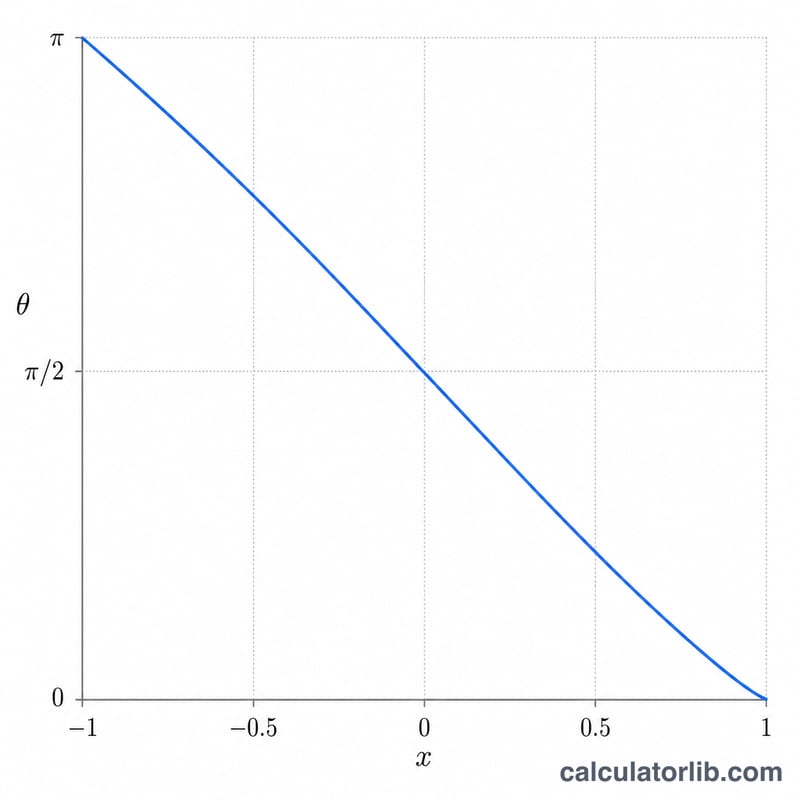
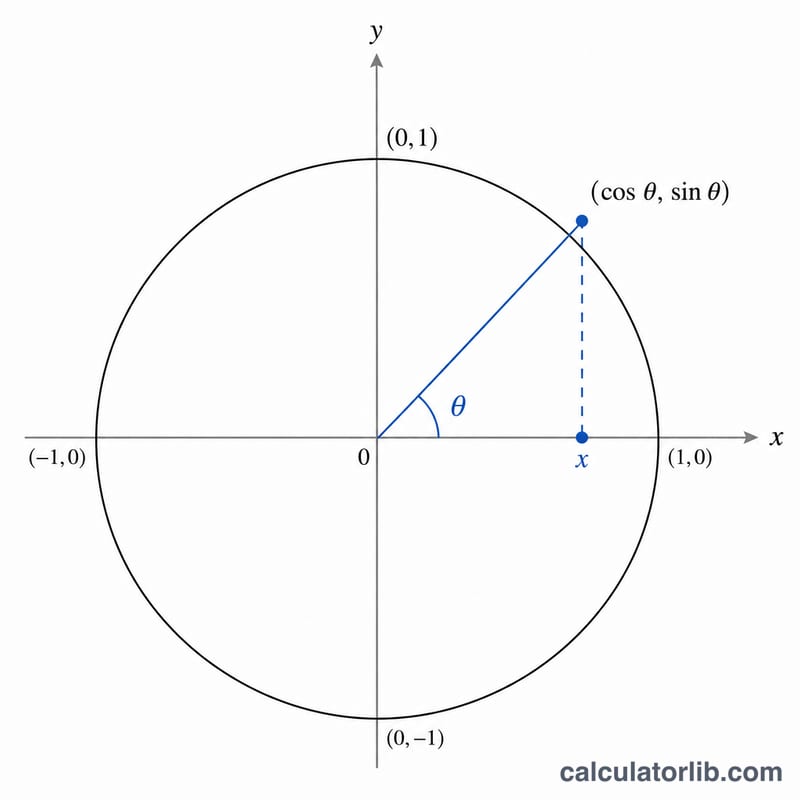
The arccosine, written \(\arccos(x)\) or \(\cos^{-1}(x)\), answers the question: "what angle has a cosine equal to x?" Because cosine only outputs values between -1 and 1, the input x must lie within that range. This calculator returns the principal angle θ in both radians and degrees, where θ falls in the range \([0, \pi]\) radians (equivalently 0° to 180°).
How to use it
Type a number between -1 and 1 into the input box and the calculator computes \(\theta = \arccos(x)\). The result is shown first in degrees in the highlighted box, with the exact radian value listed below. Values outside \([-1, 1]\) are clamped to the nearest valid endpoint since cosine cannot exceed those bounds.
The formula explained
The relationship is $$\theta = \arccos(x),$$ which is the inverse of \(x = \cos(\theta)\). To convert the radian answer to degrees, multiply by \(\frac{180}{\pi}\). For example, \(\arccos(0) = \frac{\pi}{2}\) radians = 90°, because \(\cos(90°) = 0\).
Worked example
Suppose x = 0.5. Then $$\theta = \arccos(0.5) = 1.047198 \text{ radians}.$$ Converting: \(1.047198 \times \frac{180}{\pi} \approx 60°\). This is correct because \(\cos(60°) = 0.5\).
Common arccos Values
The inverse cosine function \(\theta = \arccos(x)\) accepts inputs only in the range \(-1 \le x \le 1\) and returns a principal angle in \([0, \pi]\) radians, equivalently \([0^\circ, 180^\circ]\). The table below lists the standard reference values used throughout trigonometry, with the angle shown both as an exact fraction of \(\pi\) and in degrees.
| x | Decimal x | arccos(x) (radians) | arccos(x) (degrees) |
|---|---|---|---|
| 1 | 1.000 | \(0\) | 0° |
| \(\tfrac{\sqrt{3}}{2}\) | 0.866 | \(\tfrac{\pi}{6}\) | 30° |
| \(\tfrac{\sqrt{2}}{2}\) | 0.707 | \(\tfrac{\pi}{4}\) | 45° |
| \(\tfrac{1}{2}\) | 0.500 | \(\tfrac{\pi}{3}\) | 60° |
| 0 | 0.000 | \(\tfrac{\pi}{2}\) | 90° |
| \(-\tfrac{1}{2}\) | -0.500 | \(\tfrac{2\pi}{3}\) | 120° |
| \(-\tfrac{\sqrt{2}}{2}\) | -0.707 | \(\tfrac{3\pi}{4}\) | 135° |
| \(-\tfrac{\sqrt{3}}{2}\) | -0.866 | \(\tfrac{5\pi}{6}\) | 150° |
| -1 | -1.000 | \(\pi\) | 180° |
Notice the symmetry: \(\arccos(-x) = \pi - \arccos(x)\). For example, \(\arccos(-\tfrac{1}{2}) = \pi - \tfrac{\pi}{3} = \tfrac{2\pi}{3}\), confirming the 60° and 120° pairing in the table.
FAQ
Why must x be between -1 and 1? The cosine function never produces values outside that range, so its inverse is only defined there.
What range does the answer fall in? The principal value of arccos always lies between 0 and \(\pi\) radians (0° to 180°).
What is arccos(1) and arccos(-1)? \(\arccos(1) = 0°\) (\(\cos 0° = 1\)) and \(\arccos(-1) = 180°\) (\(\cos 180° = -1\)).