
What is a binomial coefficient?
The binomial coefficient, written C(n, k) or "n choose k", counts the number of ways to choose k items from a set of n distinct items when the order of selection does not matter. It is one of the most fundamental quantities in combinatorics and probability, appearing in Pascal's triangle, the binomial theorem, and countless counting problems.

How to use this calculator
Enter the total number of items n and the number you want to choose k. The calculator returns the exact count of combinations. If k is greater than n, the result is 0 because you cannot choose more items than exist.
The formula explained
The classic definition is:
$$\binom{n}{k} = \frac{n!}{k!\,\left(n - k\right)!}$$
Because factorials grow extremely fast, this tool uses the equivalent multiplicative form, multiplying (n−k+i)/i for i = 1…min(k, n−k). This keeps the intermediate numbers small and avoids overflow while producing the same whole-number answer.
Worked example
How many 2-card hands can be drawn from a 5-card pile? Compute $$\binom{5}{2} = \frac{5!}{2!\cdot 3!} = \frac{120}{2 \cdot 6} = \frac{120}{12} = 10.$$ So there are 10 possible pairs.
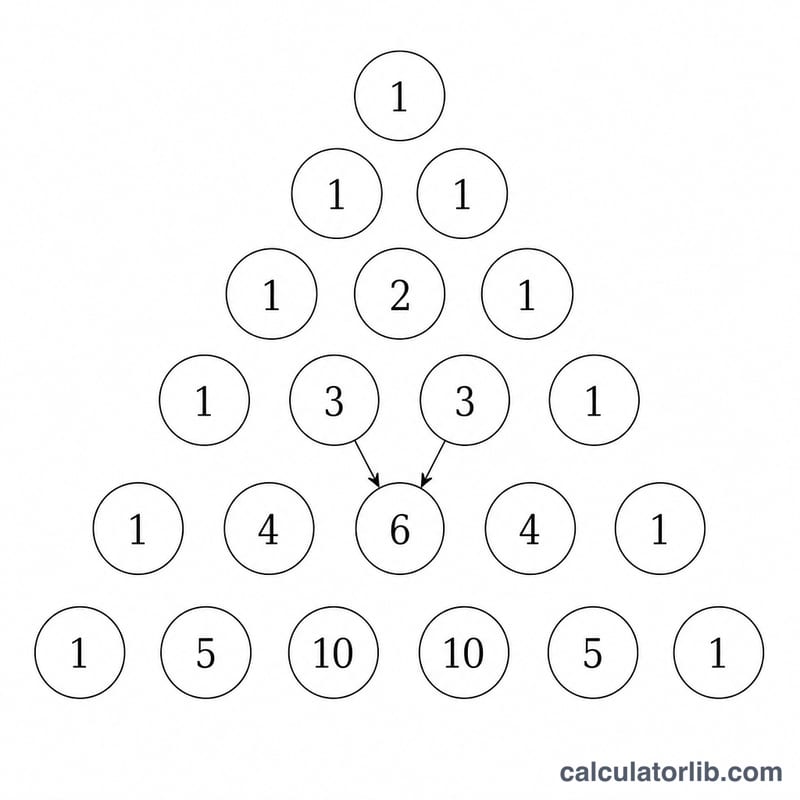
Pascal's Triangle Reference (C(n,k) for small n)
Each entry in the table is the binomial coefficient \(\binom{n}{k}\), arranged so that each row \(n\) lists the values for \(k = 0, 1, \dots, n\). This forms Pascal's triangle, where every interior entry equals the sum of the two entries diagonally above it: \(\binom{n}{k} = \binom{n-1}{k-1} + \binom{n-1}{k}\). Notice the symmetry within each row, since \(\binom{n}{k} = \binom{n}{n-k}\).
| n \ k | 0 | 1 | 2 | 3 | 4 | 5 | 6 | 7 | 8 | 9 | 10 |
|---|---|---|---|---|---|---|---|---|---|---|---|
| 0 | 1 | ||||||||||
| 1 | 1 | 1 | |||||||||
| 2 | 1 | 2 | 1 | ||||||||
| 3 | 1 | 3 | 3 | 1 | |||||||
| 4 | 1 | 4 | 6 | 4 | 1 | ||||||
| 5 | 1 | 5 | 10 | 10 | 5 | 1 | |||||
| 6 | 1 | 6 | 15 | 20 | 15 | 6 | 1 | ||||
| 7 | 1 | 7 | 21 | 35 | 35 | 21 | 7 | 1 | |||
| 8 | 1 | 8 | 28 | 56 | 70 | 56 | 28 | 8 | 1 | ||
| 9 | 1 | 9 | 36 | 84 | 126 | 126 | 84 | 36 | 9 | 1 | |
| 10 | 1 | 10 | 45 | 120 | 210 | 252 | 210 | 120 | 45 | 10 | 1 |
For example, \(\binom{10}{3} = \) 120, found at row 10, column \(k=3\). The sum of every entry in row \(n\) equals \(2^n\) (e.g. row 4: \(1+4+6+4+1 = 16 = 2^4\)).
More Worked Examples
The following examples apply the formula \(\binom{n}{k} = \dfrac{n!}{k!\,(n-k)!}\), using the multiplicative shortcut \(\binom{n}{k} = \dfrac{n(n-1)\cdots(n-k+1)}{k!}\) so that the huge factorials cancel before any large multiplication is needed.
Example 1: \(\binom{10}{3}\) — choosing 3 from 10
Keep only the top 3 falling factors of \(10!\) over \(3!\):
$$\binom{10}{3} = \frac{10 \cdot 9 \cdot 8}{3 \cdot 2 \cdot 1} = \frac{720}{6} = 120$$So there are 120 ways to choose 3 items from 10 when order does not matter.
Example 2: \(\binom{6}{6}\) — choosing all of them
Choosing every available item can be done in exactly one way. With \(k = n\), the \((n-k)!\) term becomes \(0! = 1\):
$$\binom{6}{6} = \frac{6!}{6!\,(6-6)!} = \frac{720}{720 \cdot 1} = 1$$This confirms the identity \(\binom{n}{n} = \binom{n}{0} = \) 1.
Example 3: \(\binom{49}{6}\) — a 6-from-49 lottery
The number of distinct unordered 6-number tickets from a pool of 49 uses the multiplicative shortcut with the six largest falling factors:
$$\binom{49}{6} = \frac{49 \cdot 48 \cdot 47 \cdot 46 \cdot 45 \cdot 44}{6!}$$The numerator is \(49 \cdot 48 \cdot 47 \cdot 46 \cdot 45 \cdot 44 = 10{,}068{,}347{,}520\), and the denominator is \(6! = 720\):
$$\binom{49}{6} = \frac{10{,}068{,}347{,}520}{720} = 13{,}983{,}816$$So a single ticket has a 1-in-13,983,816 chance of matching all six numbers. If you instead wanted ordered draws, you would use permutations \(P(49,6) = \binom{49}{6}\cdot 6!\) — but for a typical lottery only the combination matters.
FAQ
What is C(n, 0)? Always 1 — there is exactly one way to choose nothing.
Is C(n, k) the same as C(n, n−k)? Yes, the binomial coefficient is symmetric: choosing k to keep is the same as choosing n−k to leave out.
What's the difference between combinations and permutations? Combinations ignore order; permutations count order. The permutation count is \(\binom{n}{k} \times k!\).