

What is the Bunk Calculator?
The Classes You Can Skip Calculator — popularly called a "bunk calculator" — tells you exactly how many lectures you can miss while still meeting your institution's minimum attendance requirement (commonly 75%). Many colleges bar students from exams if attendance falls below a set percentage, so knowing your buffer helps you plan days off without risking a detention or shortage.
How to use it
Enter three numbers: the classes you have attended so far, the total classes held to date, and your required attendance percentage. The calculator returns how many future classes you can skip while staying at or above the threshold, plus your current attendance percentage. If you're already short, it shows how many classes you must attend in a row to recover.
The formula explained
If you skip a class, your total still goes up by one but your attended count does not. To stay above the required fraction \(p\) you need \(\text{attended} \geq p \times \text{total}\). Solving for the number of skips you can afford from now gives:
$$\text{Skippable} = \left\lfloor \frac{\text{Attended} - p \cdot \text{Total}}{p} \right\rfloor \qquad p = \frac{\text{Required \%}}{100}$$, where \(A\) is classes attended, \(T\) is total classes, and \(p = \text{required\%} \div 100\). The floor rounds down because you can only skip whole classes.
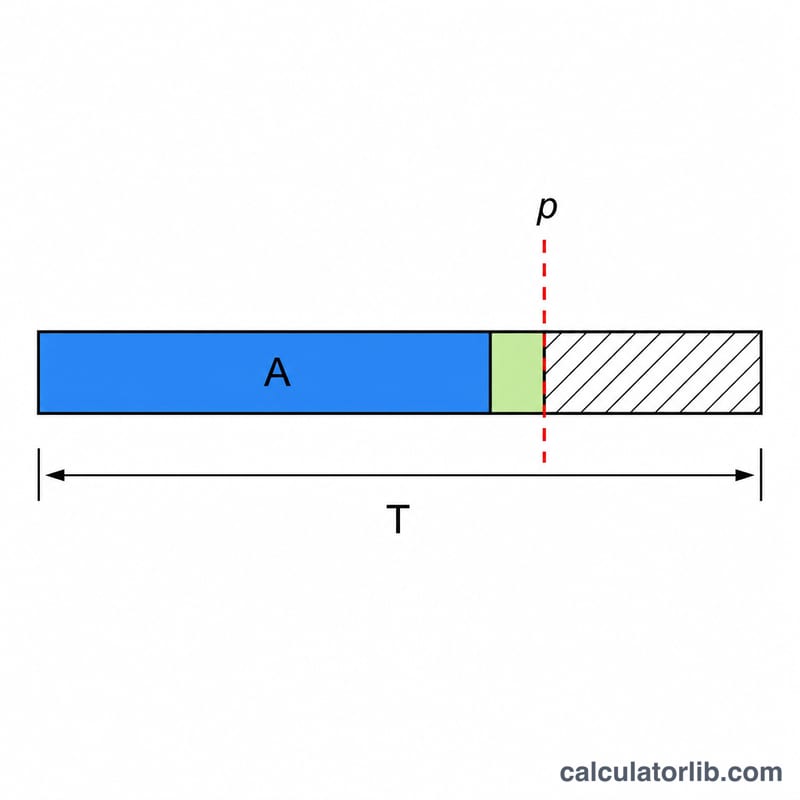
Worked example
Suppose you've attended 45 of 50 classes and need 75% (\(p = 0.75\)). Then $$A - p \cdot T = 45 - 0.75 \times 50 = 45 - 37.5 = 7.5.$$ Dividing by \(p\): $$7.5 / 0.75 = 10.$$ \(\lfloor 10 \rfloor = \) 10. You can skip up to 10 more classes and still hold exactly 75% (45 of 60). Your current attendance is \(45/50 = 90\%\).
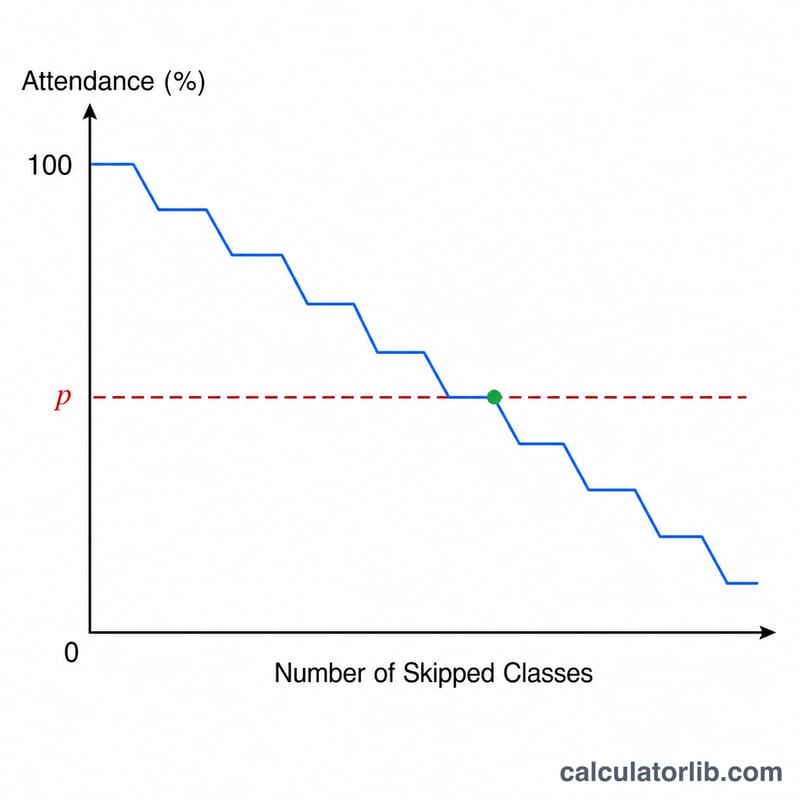
Skippable Classes Across Different Scenarios
The number of classes you can safely skip depends on three things: how many you have already attended, how many total sessions have been held, and the minimum attendance percentage your institution enforces. The table below works several realistic cases. "Skippable" is the count of future classes you can miss while still ending at or above the required percentage; a negative figure means you are already below the threshold and must instead attend more before you can skip anything.
| Attended / Total | Required % | Current % | Skippable Classes | Status |
|---|---|---|---|---|
| 45 / 50 | 75% | 90.0% | 10 | Comfortably above |
| 30 / 40 | 80% | 75.0% | 0 | Already short |
| 60 / 80 | 75% | 75.0% | 0 | Exactly at limit |
| 38 / 50 | 75% | 76.0% | 0 | Just above |
| 90 / 100 | 75% | 90.0% | 20 | Comfortably above |
Note how 60/80 sits exactly on the line: skipping even one more class would drop it below 75%, so the skippable count is zero. For 30/40 at 80% the current percentage is already under the requirement, so the tool reports zero skippable and you would need to attend extra classes to recover.
How to Calculate Skippable Classes by Hand
Let \(A\) be classes attended, \(T\) be total classes held, and \(R\) be the required percentage. The goal is to find the largest number of additional classes you can miss while keeping attendance at or above \(R\).
- Convert the required percentage to a fraction. Divide by 100: \[ p = \frac{R}{100}. \] For a 75% rule, \(p = 0.75\).
- Find the minimum attendance the rule demands so far. Multiply \(p\) by the total classes: \(p \cdot T\). For \(A = 45,\; T = 50,\; p = 0.75\): \(0.75 \times 50 = 37.5\).
- Subtract that from your attended count. This is your surplus of attended classes above the bare minimum: \(A - p\cdot T = 45 - 37.5 = 7.5\).
- Divide the surplus by \(p\). Each future skipped class adds 1 to the total but 0 to attended, so each skip "costs" \(p\) of surplus: \[ \frac{A - p\cdot T}{p} = \frac{7.5}{0.75} = 10. \]
- Take the floor. Round down to a whole class, since you cannot skip a fraction of a session: \[ \text{Skippable} = \left\lfloor 10 \right\rfloor = 10. \] So with 45 of 50 attended at a 75% rule you can miss up to 10 more classes.
You can confirm: skipping all 10 gives \(45\) attended out of \(50 + 10 = 60\) total, which is \(45/60 = 75.0\%\) — exactly on the line.
The Already-Short Case (Recovery)
If \(A - p\cdot T\) is negative, the formula yields a negative number, meaning you are already below the requirement and can skip nothing. Instead, work out how many classes you must attend in a row to recover. Let \(x\) be the number of additional classes you both attend and that are added to the total. Require:
$$\frac{A + x}{T + x} \ge p \quad\Longrightarrow\quad x \ge \frac{p\cdot T - A}{1 - p}.$$
For \(A = 30,\; T = 40,\; R = 80\;(p = 0.8)\): \[ x \ge \frac{0.8\times 40 - 30}{1 - 0.8} = \frac{32 - 30}{0.2} = \frac{2}{0.2} = 10. \] You would need to attend the next 10 classes without missing any to climb back to 80% (then \(40/50 = 80\%\)). Always round this recovery figure up to the next whole class.
FAQ
What if the result is negative? A negative value means you're already below the requirement, so you can't skip any — the tool then shows how many classes you must attend consecutively to recover.
Does skipping add to total classes? Yes — this model assumes every class is conducted whether you attend or not, which is the standard college rule.
Is 75% always the cutoff? No, you set the percentage yourself; many universities use 75%, but some use 80% or 85%.