
What is a BPM Delay Time Calculator?
This tool converts a song tempo, measured in beats per minute (BPM), into delay and reverb times in milliseconds (ms) for every common note value. Setting your delay or reverb pre-delay to a tempo-synced value makes echoes fall musically on the beat instead of clashing with it — a core trick in mixing, sound design, and live performance.
How to use it
Enter your project tempo in BPM and read the table. The hero number is the quarter-note delay (one beat). The table breaks down whole, half, quarter, eighth, sixteenth, and thirty-second notes, plus dotted and triplet variants for the quarter and eighth — the values you will most often dial into a delay plugin.
The formula explained
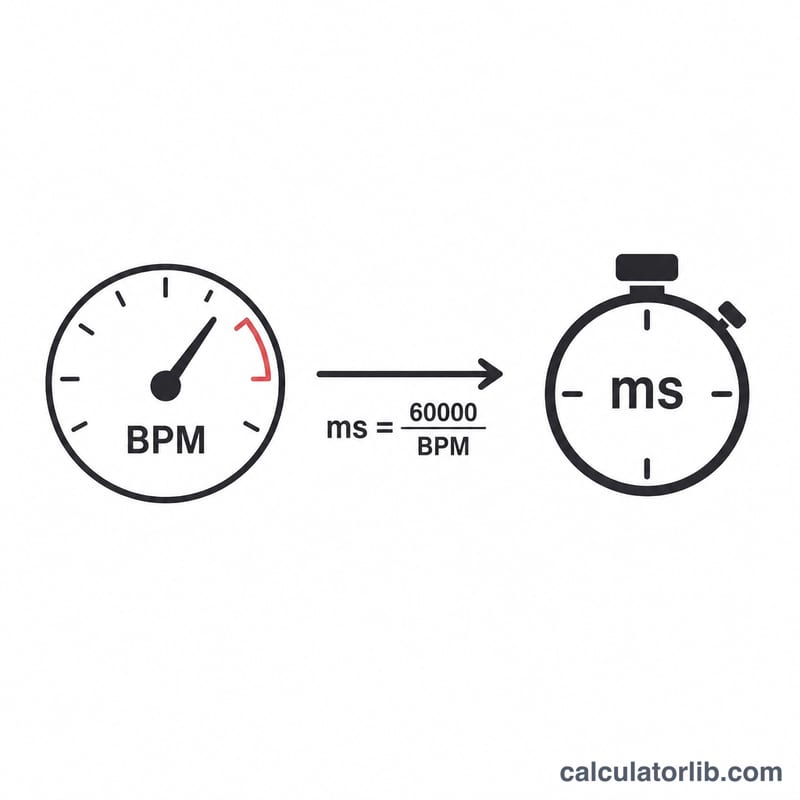
One minute is 60,000 milliseconds, and a quarter note equals one beat, so the milliseconds per beat is:
$$t = \frac{60000}{\text{BPM}}$$
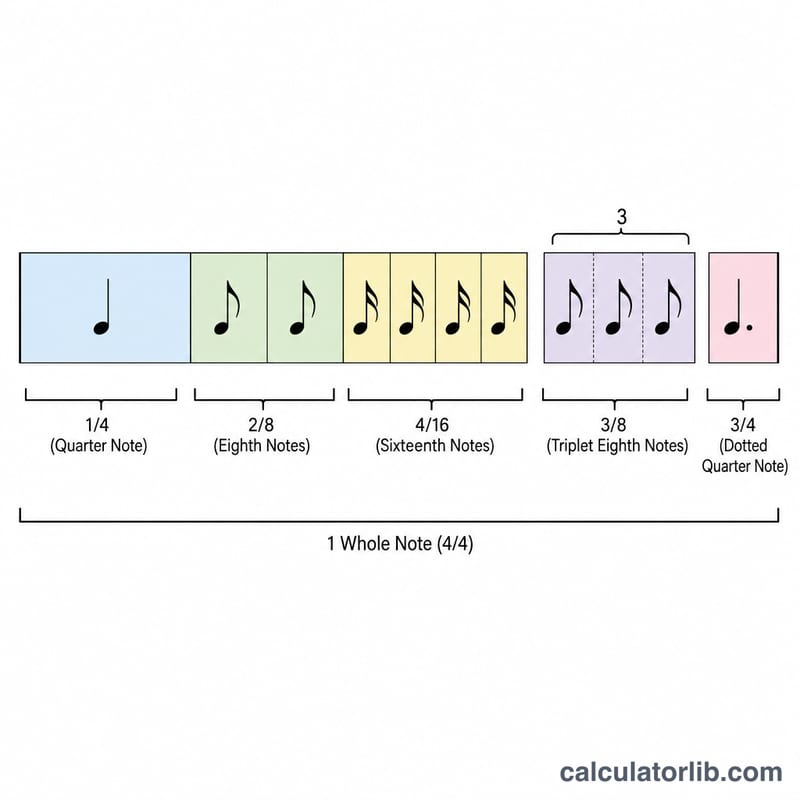
Every other note value scales from this: a half note is \(2t\), an eighth is \(t/2\), and a sixteenth is \(t/4\). A dotted note lasts 1.5 times as long (\(t_{\text{dotted}} = 1.5\,t\)), while a triplet fits three notes in the space of two (\(t_{\text{triplet}} = \tfrac{2}{3}\,t\)).
Worked example
At 120 BPM the quarter-note delay is:
$$t = \frac{60000}{120} = 500\,\text{ms}$$
So an eighth note is \(500/2 = 250\,\text{ms}\), a dotted eighth is \(250 \times 1.5 = 375\,\text{ms}\), and an eighth triplet is \(250 \times \tfrac{2}{3} \approx 166.7\,\text{ms}\).
Delay Times at Common Tempos
The quarter-note delay time is the fundamental building block: it equals one beat, found with \(t = \frac{60000}{\text{BPM}}\). Every other value is a multiple of that beat. The table below lists delay times in milliseconds (rounded to one decimal place) for the most common production and DJ tempos. Use these to dial in synced delays, slap-back echoes, and pre-delay on reverbs.
| BPM | 1/4 note (\(t\)) | Dotted 1/8 (0.75\(t\)) | 1/8 note (0.5\(t\)) | 1/8 triplet (0.333\(t\)) | 1/16 note (0.25\(t\)) |
|---|---|---|---|---|---|
| 70 | 857.1 | 642.9 | 428.6 | 285.7 | 214.3 |
| 80 | 750.0 | 562.5 | 375.0 | 250.0 | 187.5 |
| 90 | 666.7 | 500.0 | 333.3 | 222.2 | 166.7 |
| 100 | 600.0 | 450.0 | 300.0 | 200.0 | 150.0 |
| 110 | 545.5 | 409.1 | 272.7 | 181.8 | 136.4 |
| 120 | 500.0 | 375.0 | 250.0 | 166.7 | 125.0 |
| 128 | 468.8 | 351.6 | 234.4 | 156.3 | 117.2 |
| 140 | 428.6 | 321.4 | 214.3 | 142.9 | 107.1 |
| 160 | 375.0 | 281.3 | 187.5 | 125.0 | 93.8 |
| 174 | 344.8 | 258.6 | 172.4 | 114.9 | 86.2 |
If you only know the song's tempo by ear, you can derive the BPM from a tap count first with the BPM Calculator, then return here for the millisecond values.
Note Value Multipliers Reference
Every delay time is the quarter-note beat length \(t = \frac{60000}{\text{BPM}}\) multiplied by a note-value factor \(M\). A dotted note adds half its own length again, so it equals \(1.5\times\) the plain note. A triplet fits three notes in the space of two, so it equals \(\tfrac{2}{3}\approx 0.667\times\) the plain note. The table lists \(M\) for each value relative to the quarter note.
| Note value | Multiplier \(M\) | Delay expression |
|---|---|---|
| Whole note | 4 | \(4t\) |
| Dotted half | 3 | \(3t\) |
| Half note | 2 | \(2t\) |
| Half triplet | 1.333 | \(\tfrac{4}{3}t\) |
| Dotted quarter | 1.5 | \(1.5t\) |
| Quarter note | 1 | \(t\) |
| Quarter triplet | 0.667 | \(\tfrac{2}{3}t\) |
| Dotted eighth | 0.75 | \(0.75t\) |
| Eighth note | 0.5 | \(0.5t\) |
| Eighth triplet | 0.333 | \(\tfrac{1}{3}t\) |
| Dotted sixteenth | 0.375 | \(0.375t\) |
| Sixteenth note | 0.25 | \(0.25t\) |
| Sixteenth triplet | 0.167 | \(\tfrac{1}{6}t\) |
| Thirty-second note | 0.125 | \(0.125t\) |
Worked example. At 128 BPM the beat length is \(t = \frac{60000}{128} = 468.75\text{ ms}\). A dotted-eighth delay — a classic for syncopated, bouncing echoes — is \(0.75 \times 468.75 = 351.6\text{ ms}\), while the eighth triplet is \(\tfrac{1}{3}\times 468.75 = 156.3\text{ ms}\). For longer note values such as half and whole notes, the Delay and Reverb Time Calculator covers the same math for reverb pre-delay and tail settings.
FAQ
Why use a dotted delay? The classic dotted-eighth delay (popularized by guitar and synth leads) creates a rhythmic, syncopated echo that drives a groove without muddying the downbeat.
Should I sync reverb too? Yes — setting reverb pre-delay or decay to a note value keeps the tail breathing with the track instead of smearing across bars.
Does this work for any tempo? Any positive BPM works; the calculation is purely mathematical and instrument-agnostic.