What the CPC Calculator Does
The CPC Calculator works out your cost per click — the average amount you pay each time someone clicks one of your ads. It's a universal metric used across Google Ads, Meta (Facebook and Instagram), LinkedIn, Microsoft Advertising and any other pay-per-click platform, so it isn't tied to a single country or currency. Whatever currency you spend in, just enter the numbers and the result comes back in that same currency.
How to Use It
There are only two inputs:
- Total Ad Spend – the total amount of money you spent on the campaign, ad set or time period you want to measure.
- Number of Clicks – the total clicks those ads received over the same period.
Enter both values and the calculator instantly divides spend by clicks. If you enter zero clicks, the result is simply 0 — you can't divide by zero, so the tool returns nothing rather than an error.
The Formula Explained
The calculation is straightforward:
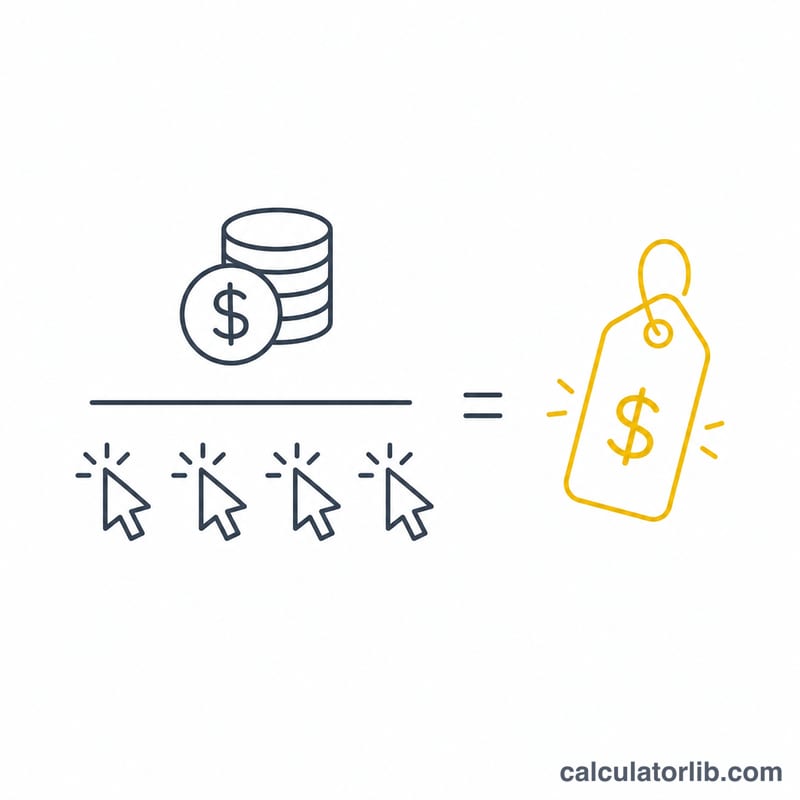
CPC = Ad Cost ÷ Clicks
The tool reads your spend as a decimal number and your clicks as a whole number, then divides one by the other only when clicks are greater than zero. The answer tells you, on average, what each click cost you.
Worked Example
Suppose you ran a campaign with a total ad spend of $450 that generated 1,200 clicks:
- CPC = 450 ÷ 1,200
- CPC = $0.375 per click
That means each visit cost you just under 38 cents. If a competing campaign costs $0.60 per click, the first one is delivering traffic far more efficiently — assuming the click quality is comparable.
Interpreting Your CPC Result
The number this calculator returns is an average cost per click over the period and the set of clicks you entered:
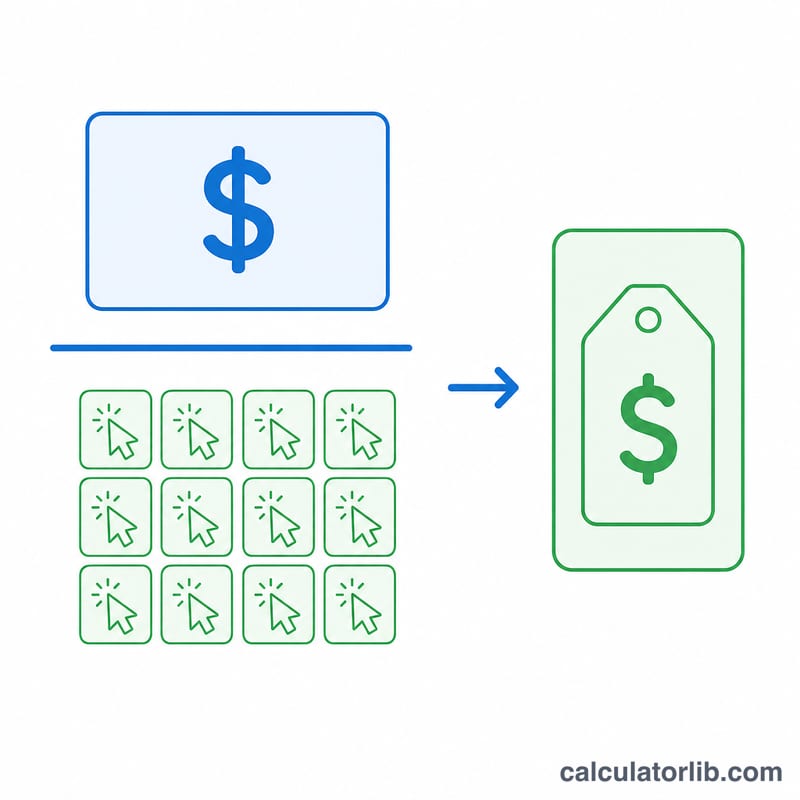
$$\text{CPC} = \frac{\text{Total Ad Spend}}{\text{Number of Clicks}}$$
It is not your bid. On auction-based platforms your maximum CPC bid is a ceiling you are willing to pay, while the price you actually pay per click is set by the auction and is usually lower. An average also hides its own spread: a $0.80 average CPC can come from thousands of $0.15 clicks on broad, low-intent queries plus a handful of $6 clicks on your highest-intent keywords. Segment by campaign, ad group, keyword, device and placement before drawing conclusions from a single blended figure.
CPC only means something next to conversion data
A click has no inherent value — what it costs is only interpretable against what it produces. Two relationships do most of the work:
$$\text{CPA} = \frac{\text{CPC}}{\text{Conversion Rate}} \qquad \text{Break-even CPC} = \text{Value per Conversion} \times \text{Conversion Rate}$$
Example: if you spent $1,200 and received 1,500 clicks, your CPC is $0.80. At a 4% conversion rate that is a cost per acquisition of \(\$0.80 \div 0.04 = \$20\). If each conversion is worth $30 in gross profit, your break-even CPC is \(\$30 \times 0.04 = \$1.20\) — so $0.80 leaves margin. Change the conversion rate to 2% and the break-even CPC falls to $0.60, and the same $0.80 click is now sold at a loss. Nothing about the CPC itself changed.
Cheaper clicks are not automatically better clicks
CPC can almost always be pushed down — by bidding on broader terms, loosening match types, adding low-cost placements or expanding into cheaper geographies. If those clicks convert at a lower rate or bring lower-value customers, the cheaper traffic produces a worse CPA and worse return. A campaign at $2.50 CPC converting at 8% (CPA $31.25) outperforms one at $0.25 CPC converting at 0.4% (CPA $62.50). Judge the click by its downstream outcome, not its sticker price.
What moves CPC
- Platform and format — search, social, display, retail media and video networks price clicks very differently.
- Auction competition — more advertisers bidding on the same query or audience raises clearing prices.
- Commercial intent of the keyword — terms close to a purchase decision cost more than informational ones.
- Match type and targeting breadth — exact/narrow targeting typically costs more per click than broad.
- Ad relevance and quality signals — most search platforms reward higher expected click-through rate and landing-page relevance with a lower price for the same position.
- Device, placement and geography — mobile vs. desktop, feed vs. sidebar, and country or city-level markets all price separately.
- Seasonality and day-parting — peak retail periods, product launches and election or event windows raise competition temporarily.
Because of this, there is no universal "good" CPC, and published benchmark averages are usually specific to one platform, one industry and one country — check the source before comparing your number to them.
Treat CPC as a diagnostic, not a verdict
A rising CPC is a prompt to ask why: new competitors, a shift in the keyword mix, a drop in click-through rate, a broken landing page, or simply a seasonal peak. A falling CPC is equally ambiguous — it may mean improved relevance, or it may mean your traffic mix drifted toward cheaper, less-qualified queries. Read CPC alongside impressions, CTR, conversion rate, CPA and ROAS before changing bids or budgets. This section is general marketing information, not financial or professional advice.
CPC Across Different Spend and Click Scenarios
The scenarios below show how the same arithmetic produces very different costs per click depending on how much traffic a budget buys. All rows use the same currency, and every CPC is simply spend ÷ clicks.
| Scenario | Ad Spend | Clicks | CPC | Notes |
|---|---|---|---|---|
| Small local campaign | $450 | 1,200 | $0.375 | Baseline. Modest budget buying a healthy volume of clicks. |
| Same spend, half the traffic | $450 | 600 | $0.75 | Budget unchanged, clicks halved — CPC doubles. Often caused by tighter targeting, more competition or a drop in click-through rate. |
| Mid-size search campaign | $1,000 | 2,500 | $0.40 | Larger budget at a similar price per click; scale alone does not change CPC. |
| High-competition sector | $5,000 | 1,000 | $5.00 | Expensive clicks typical of crowded high-value auctions. Only sustainable if value per conversion is high enough. |
| Broad, low-competition reach | $200 | 4,000 | $0.05 | Very cheap traffic. Check conversion rate before celebrating — low CPC often accompanies low intent. |
Worked check on the last row: \(\text{CPC} = \frac{\$200}{4{,}000} = \$0.05\). Note that rows 1 and 2 have identical spend; only the click volume differs, which is the whole story behind the CPC change. Comparing campaigns by CPC is only meaningful when the currency, platform and measurement window are the same.
Key Terms and Metrics Explained
| Term | Definition and formula |
|---|---|
| CPC (Cost Per Click) | The average amount paid for one click: \(\text{CPC} = \dfrac{\text{Ad Spend}}{\text{Clicks}}\). A backward-looking average of prices actually paid, not a bid you set. |
| Ad Spend | Total money charged by the ad platform for the campaign and period being measured. For a like-for-like CPC, use the same date range, currency and account scope as the click count, and be consistent about whether agency fees and taxes are included. |
| Click | A recorded interaction where a user selects your ad and is sent to your destination. Platforms filter out traffic they judge invalid, so billed clicks can be lower than raw clicks and usually differ from sessions reported by your web analytics. |
| Impression | One serving of your ad. Definitions of a countable (or "viewable") impression vary by platform, so impression-based metrics are not always directly comparable across networks. |
| CTR (Click-Through Rate) | Share of impressions that produced a click: \(\text{CTR} = \dfrac{\text{Clicks}}{\text{Impressions}} \times 100\%\). A measure of how compelling and relevant the ad is to the audience shown it. |
| CPM (Cost Per Mille) | Cost per thousand impressions: \(\text{CPM} = \dfrac{\text{Ad Spend}}{\text{Impressions}} \times 1{,}000\). Related to CPC by \(\text{CPC} = \dfrac{\text{CPM}}{\text{CTR} \times 1{,}000}\) when CTR is expressed as a decimal. |
| CPA / Cost per Conversion | Average cost of one desired action: \(\text{CPA} = \dfrac{\text{Ad Spend}}{\text{Conversions}}\), equivalently \(\text{CPC} \div \text{Conversion Rate}\). Usually the metric that matters more than CPC. |
| Conversion Rate | Share of clicks that complete the tracked action: \(\text{CR} = \dfrac{\text{Conversions}}{\text{Clicks}} \times 100\%\). Depends heavily on what you count as a conversion (purchase, lead form, call, sign-up). |
| ROAS (Return on Ad Spend) | Revenue generated per unit of spend: \(\text{ROAS} = \dfrac{\text{Revenue}}{\text{Ad Spend}}\). A ROAS of 4 means $4 of revenue per $1 spent — revenue, not profit, so it ignores cost of goods and overhead. |
| Max CPC bid vs. actual CPC | The max CPC bid is the highest price you authorise for a click; the actual CPC is what the auction charges, typically only enough to hold your position against the next competitor. Actual CPC is normally at or below the max bid, so raising a bid does not automatically raise the price you pay. |
| Quality / Relevance Score | A platform-assigned estimate of how relevant your ad, keyword and landing page are to the user. Higher scores generally improve ad rank and lower the price paid per click. Scoring is proprietary and differs between platforms — treat it as a directional diagnostic, not an absolute grade. |
| Ad Auction | The real-time process run each time an ad slot is available. Competing ads are ranked using a combination of bid and quality/relevance signals, and the winner is charged a price derived from the competition below it rather than its own bid. |
| Negative Keyword | A term you exclude so your ad does not show for it (e.g. adding "free" or "jobs" to a paid product campaign). Negatives cut wasted clicks, which typically raises average CPC while lowering CPA — a useful reminder that a rising CPC is not always bad news. |
Frequently Asked Questions
What is a good CPC? It varies hugely by industry, platform and keyword competitiveness. Cheap, broad keywords might cost a few cents, while competitive sectors like insurance or legal can run several dollars per click. Compare your CPC against your own past campaigns and your conversion value rather than a fixed benchmark.
How can I lower my CPC? Improve ad relevance and quality scores, refine your targeting, test new ad creative, add negative keywords, and pause underperforming placements. Higher relevance often earns cheaper clicks on auction-based platforms.
Is CPC the same as CPM? No. CPC charges you per click, while CPM charges per 1,000 impressions. Use CPC when you care about driving traffic and actions; CPM suits awareness campaigns measured by views.