
What is the Stock Solution Preparation Calculator?
This calculator tells you exactly how many grams of a solute you need to weigh out to prepare a solution of a desired molar concentration (molarity). It is a staple of chemistry labs, classrooms, and biotech workflows where accurate, reproducible solutions matter. Enter your target molarity, the final volume of solution you want to make, and the molar mass of the compound, and it returns the required mass and the number of moles.
How to use it
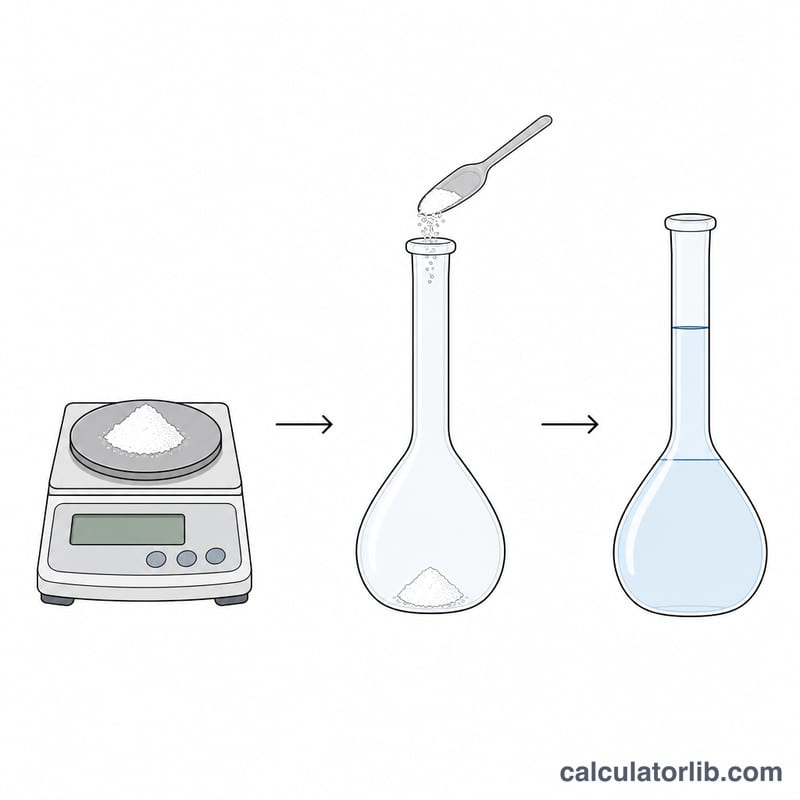
1. Enter the desired molar concentration in mol/L (molarity). 2. Enter the final volume of solution you intend to prepare, in liters. 3. Enter the molar mass of the solute in g/mol — you can find this on the reagent bottle or by summing the atomic masses. The result shows the mass of solute to dissolve, then dilute up to the final volume.
The formula explained
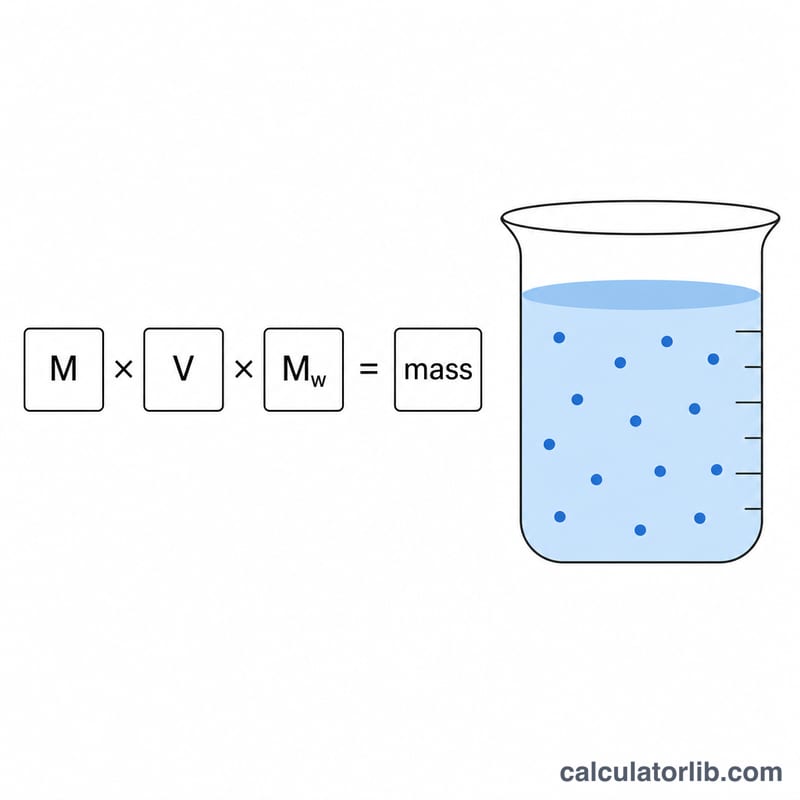
The relationship comes from the definition of molarity: \( \text{moles} = \text{molarity} \times \text{volume} \), and \( \text{mass} = \text{moles} \times \text{molar mass} \). Combined, this gives $$ \text{mass} = M \times V \times M_{w} $$ Make sure your volume is in liters and molar mass in g/mol so the units of mass come out in grams.
Worked example
To prepare 0.5 L of a 2 mol/L sodium chloride (NaCl, molar mass 58.44 g/mol) solution: $$ \text{mass} = 2 \times 0.5 \times 58.44 = 58.44\ \text{g} $$ Dissolve 58.44 g of NaCl in some water, then top up to a final volume of exactly 0.5 L.
FAQ
Do I add water to a final volume or add a fixed volume of water? Dissolve the solute and bring the solution up to the final volume (volumetric), not add the full volume of water — solutes change the total volume.
What units should I use? Molarity in mol/L, volume in liters, molar mass in g/mol. The result is in grams.
Can I use this for dilutions? This calculator finds mass from a solid solute. For diluting an existing stock, use the \( C_1 V_1 = C_2 V_2 \) dilution relationship instead.