
What Is Percent Yield?
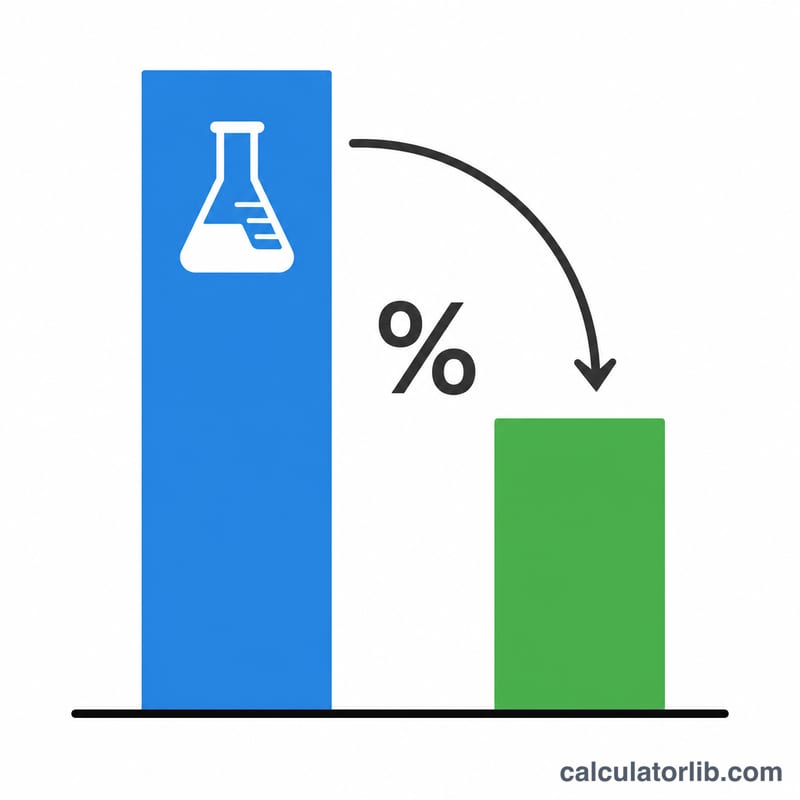
Percent yield measures how efficient a chemical reaction is by comparing the amount of product you actually obtained (the actual yield) with the maximum amount the reaction could produce in theory (the theoretical yield). Because real reactions lose product to side reactions, incomplete conversion, and handling losses, the percent yield is almost always less than 100%.
How to Use This Calculator
Enter the actual yield — the mass (or moles) of product you measured in the lab — and the theoretical yield — the amount predicted by stoichiometry from the limiting reagent. Both values must use the same units. The calculator returns the percent yield instantly.
The Formula Explained
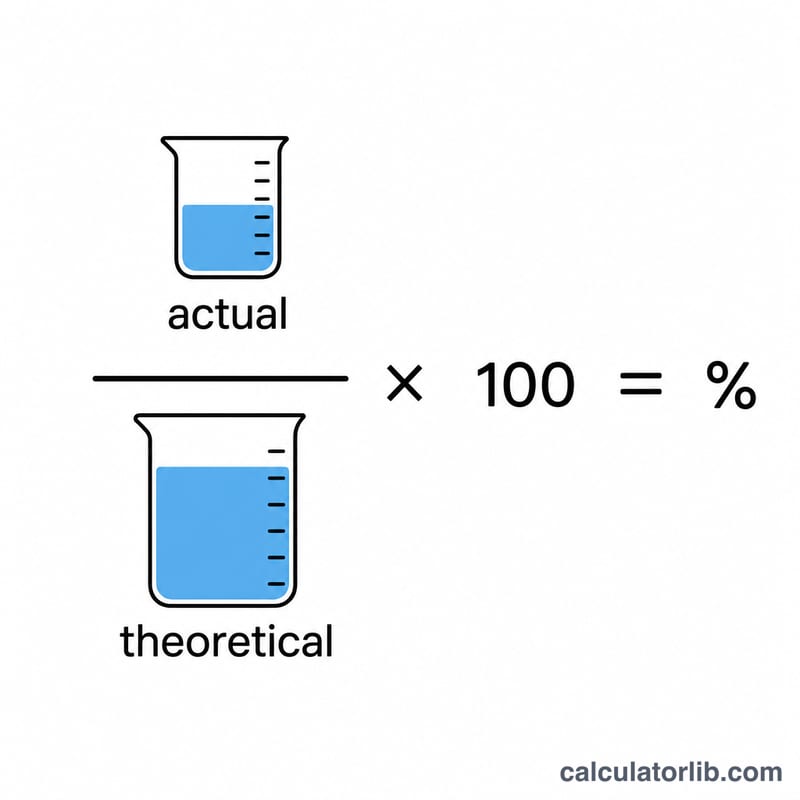
The relationship is simply:
$$\text{Percent Yield} = \frac{\text{Actual Yield}}{\text{Theoretical Yield}} \times 100\%$$
The ratio of actual to theoretical gives a fraction of the maximum possible; multiplying by 100 converts it to a percentage. Make sure both yields are expressed in identical units (grams, moles, etc.) so the units cancel.
Worked Example
Suppose a reaction is predicted to make 10 g of product (theoretical yield) but you recover only 8.5 g (actual yield). Then:
$$\text{\% yield} = \frac{8.5}{10} \times 100 = \mathbf{85\%}$$
This means your reaction was 85% efficient relative to the ideal stoichiometric maximum.
FAQ
Can percent yield be over 100%? In principle no. A result above 100% usually means the product is impure or still wet (contains solvent or unreacted starting material), inflating the measured mass.
How do I find the theoretical yield? Use stoichiometry: identify the limiting reagent, convert its mass to moles, apply the mole ratio from the balanced equation, then convert back to mass of product.
What is a good percent yield? It varies by reaction, but yields above 90% are considered excellent, 70–90% good, and below 50% often indicates significant losses or an inefficient process.