What the Exposure Calculator Does
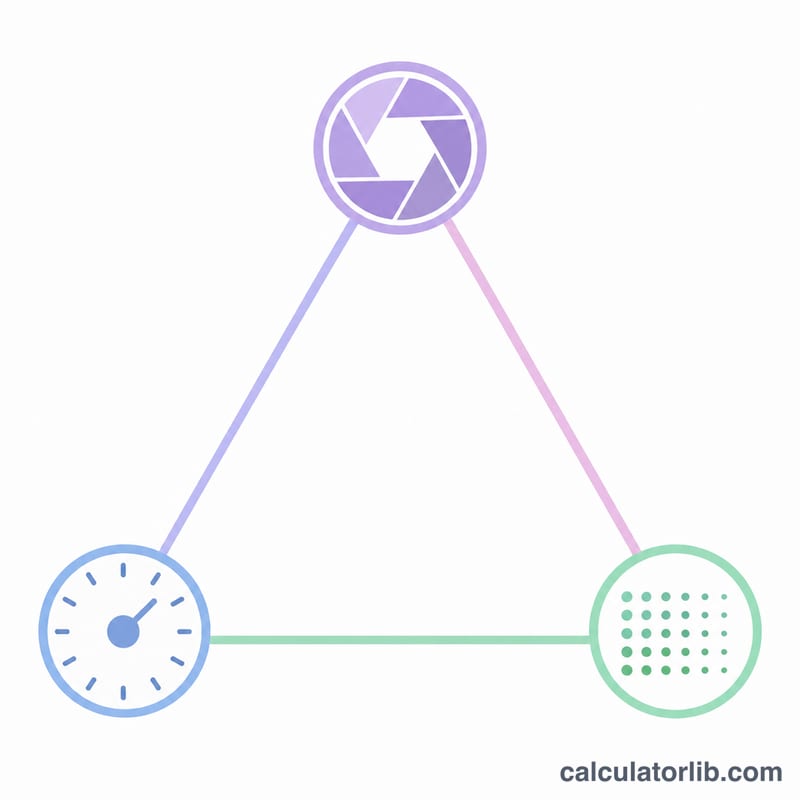
The Exposure Calculator works out the Exposure Value (EV) for a given camera setting. EV is a single number that summarises how much light a particular combination of aperture, shutter speed and ISO captures. Photographers use it to compare settings, balance the exposure triangle and judge whether a scene falls into low, normal or bright light. The tool is universal — it uses the standard photographic EV definition and works with any camera brand or country.
The Three Inputs
- Aperture (f-number): the lens opening, e.g. 2.8, 5.6 or 16. Higher numbers mean a smaller opening and less light.
- Shutter Speed (seconds): how long the sensor is exposed, entered in seconds (e.g. 0.004 for 1/250s, or 1 for one second).
- ISO: the sensor sensitivity, e.g. 100, 400 or 1600. Higher ISO captures more light but adds noise.
The Formula Explained
The calculator uses the standard EV equation, normalised to ISO 100:
$$\text{EV} = \log_{2}\!\left(\frac{\text{Aperture}^{2}}{\text{Shutter Speed (s)}}\right) - \log_{2}\!\left(\frac{\text{ISO}}{100}\right)$$
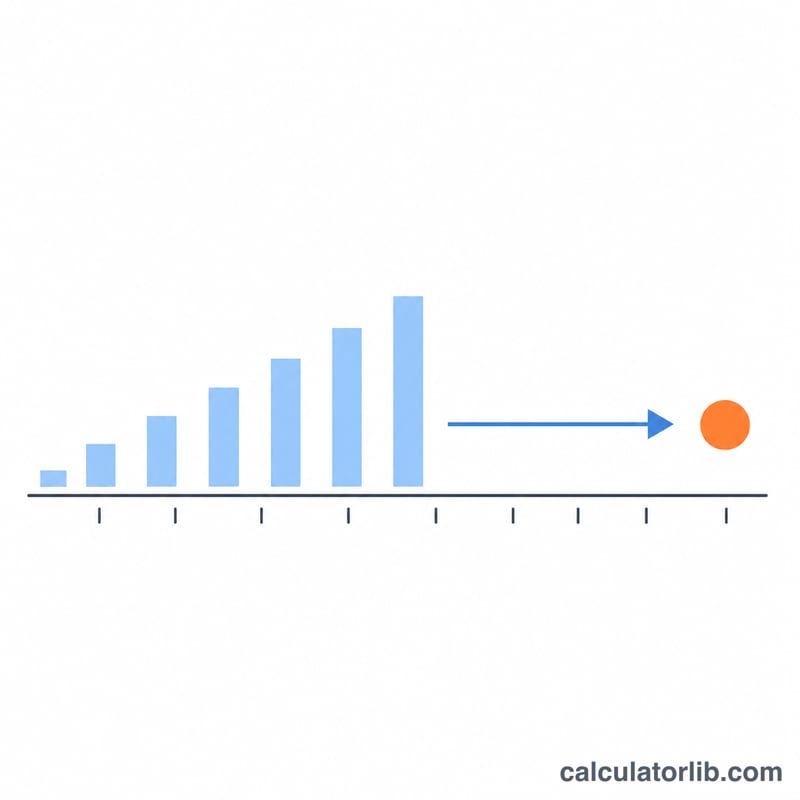
Here N is the aperture (f-number), t is the shutter speed in seconds, and ISO is your sensitivity setting. The first term gives the EV at ISO 100; the second term shifts it for higher or lower ISO. The result is then classified: under 8 is "Low Light", 8 to 13 is "Normal Light", and above 13 is "Bright Light". The value is also clamped between −6 and 20 to position a marker on a visual scale.
Worked Example
Suppose you shoot at f/8, 1/250s (0.004 seconds) and ISO 100:
- \(N^{2} / t = 64 / 0.004 = 16{,}000\)
- \(\log_{2}(16{,}000) \approx 13.97\)
- \(\log_{2}(100 / 100) = 0\)
- \(\text{EV} \approx 13.97\) → classified as Bright Light
This matches a typical sunny daytime exposure.
Standard EV Values for Common Lighting Conditions
Exposure Value (EV) is a base-2 scale: each whole number is one stop, so EV 15 is exactly twice as much light as EV 14. The values below are the classic light-meter reference figures used in photography worldwide, and all of them assume ISO 100. If you meter at a different sensitivity, the scene brightness has not changed — but the EV this calculator reports will shift by \(\log_{2}\!\left(\frac{\text{ISO}}{100}\right)\) stops, i.e. −1 EV per doubling of ISO.
| Lighting condition | EV (ISO 100) | Band in this calculator |
|---|---|---|
| Bright sun on sand or snow (high reflectance) | 16 | Bright (above 13) |
| Bright daylight, distinct shadows — the “Sunny 16” condition | 15 | Bright (above 13) |
| Hazy sun, soft-edged shadows | 14 | Bright (above 13) |
| Cloudy bright, no shadows | 13 | Normal (8–13) |
| Overcast | 12 | Normal (8–13) |
| Open shade or heavy overcast | 11 | Normal (8–13) |
| Sunset / just after sundown (front-lit subject) | 9 to 10 | Normal (8–13) |
| City street at night, bright neon or shop windows | 8 to 9 | Normal (8–13) |
| Bright indoor lighting, stage or arena lighting | 8 | Normal (lower edge, 8) |
| Typical home interior at night | 5 to 7 | Low Light (under 8) |
| Floodlit buildings, monuments, fountains | 5 | Low Light (under 8) |
| Candlelit scene, close subject | 4 | Low Light (under 8) |
| Landscape lit only by a full moon | −3 to −2 | Low Light (under 8) |
The three bands — Low Light below EV 8, Normal from EV 8 to 13, and Bright above EV 13 — are this tool's own plain-language grouping, not a formal photographic standard. They are a quick sanity check: if you meter a sunlit street and the calculator returns a Low Light EV, you have almost certainly entered the shutter speed as a fraction (1/250) instead of as decimal seconds (0.004).
Quick check against the table: a candlelit scene shot at f/2 for 1/4 s (0.25 s) at ISO 100 gives \(\log_{2}\!\left(\frac{2^{2}}{0.25}\right) - \log_{2}\!\left(\frac{100}{100}\right) = \log_{2}(16) - 0 = \) 4 EV, matching the candlelight row exactly.
Shutter Speed Fractions to Decimal Seconds
Cameras display fast shutter speeds as fractions (1/250), but this calculator needs decimal seconds. The conversion rule is simply:
$$\text{Decimal seconds} = \frac{1}{\text{denominator shown on the camera}}$$So 1/250 s becomes \(1 \div 250 = 0.004\). Speeds of one second or longer (often shown as 1", 2", 30") are entered as the plain number.
| Displayed on camera | Decimal seconds to enter |
|---|---|
| 1/8000 | 0.000125 |
| 1/4000 | 0.00025 |
| 1/2000 | 0.0005 |
| 1/1000 | 0.001 |
| 1/500 | 0.002 |
| 1/250 | 0.004 |
| 1/125 | 0.008 |
| 1/60 | 0.0167 |
| 1/30 | 0.0333 |
| 1/15 | 0.0667 |
| 1/8 | 0.125 |
| 1/4 | 0.25 |
| 1/2 | 0.5 |
| 1" (1 second) | 1 |
| 2" | 2 |
| 4" | 4 |
| 8" | 8 |
| 30" | 30 |
The values for 1/60, 1/30 and 1/15 are rounded to four decimals (the exact values are 0.01666…, 0.03333… and 0.06666…); the rounding shifts EV by well under 0.01 stop, which is invisible in practice. Note also that camera markings are nominal: the “1/8000” and “1/125” settings are really 1/8192 and 1/128 in the underlying power-of-two scale, which is why a metered EV can land a few hundredths off a whole number.
Full-stop aperture and ISO steps
The standard full-stop f-numbers are 1.4, 2, 2.8, 4, 5.6, 8, 11, 16, 22 — each step is a factor of \(\sqrt{2}\) in f-number, which halves or doubles the light and therefore changes EV by exactly 1. The standard full-stop ISO steps are 100, 200, 400, 800, 1600, 3200; each doubling of ISO lowers the reported EV by exactly 1, because the sensor needs half as much light for the same result. Shutter-speed rows in the table above also step in halves and doubles, so moving one row is likewise one whole EV.
Worked check with all three at once — f/8, 1/4 s (0.25 s), ISO 100:
$$\text{EV} = \log_{2}\!\left(\frac{8^{2}}{0.25}\right) - \log_{2}\!\left(\frac{100}{100}\right) = \log_{2}(256) - \log_{2}(1) = 8 - 0 = 8$$That gives EV 8. Now raise the sensitivity one full stop to ISO 200 and keep the same aperture and shutter speed: the second term becomes \(\log_{2}(2) = 1\), so the result drops to EV 7 — one full stop lower, exactly as the ISO rule predicts.
Frequently Asked Questions
Does a higher EV mean more or less light? A higher EV corresponds to a brighter scene. Bright sunlight is often around EV 15, while dim indoor light may be EV 5 or lower.
How do I enter a shutter speed like 1/500? Convert it to a decimal in seconds: \(1 \div 500 = 0.002\). Enter 0.002 in the shutter speed field.
Why does ISO affect the EV? The formula normalises to ISO 100. Raising the ISO effectively makes the sensor "see" more light, so the calculator subtracts \(\log_{2}(\text{ISO}/100)\), lowering the EV needed for a correct exposure.