
What Is Total Dynamic Head?
Total Dynamic Head (TDH) is the total equivalent height that a pump must raise a fluid, accounting for elevation, friction, and velocity effects. It is the single most important number for selecting the right pump and matching it to a system curve. TDH is expressed in meters (or feet) of fluid column and combines three independent components into one value.
How to Use This Calculator
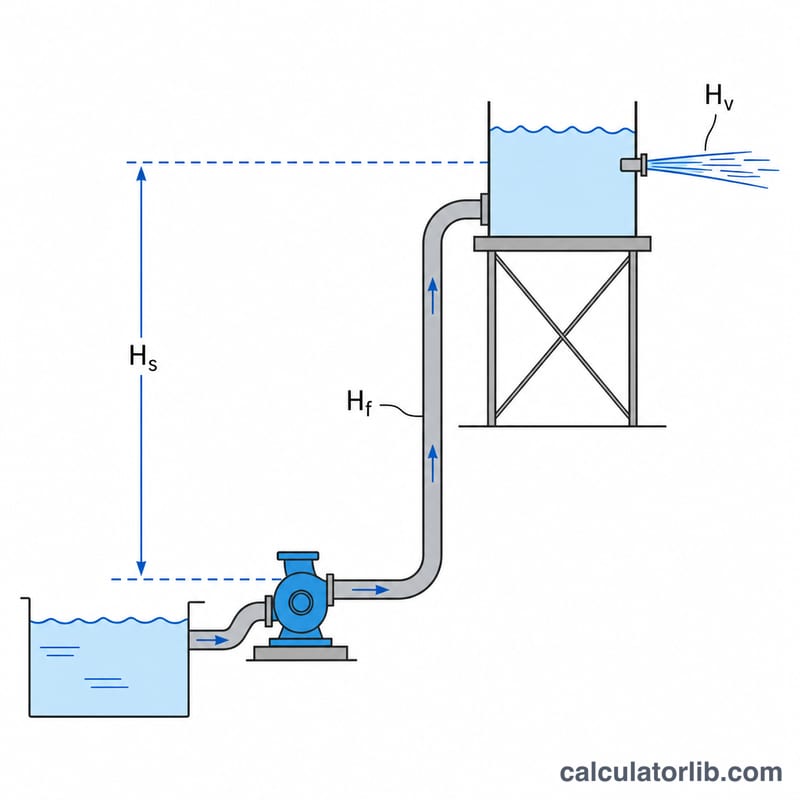
Enter the three head components in meters: the static head (vertical lift between source and discharge), the friction head loss (pressure drop through pipe, fittings, and valves expressed as head), and the velocity head (kinetic energy of the moving fluid). The calculator instantly adds them to return TDH. Use consistent units throughout — if you work in feet, simply enter all values in feet and read TDH in feet.
The Formula Explained
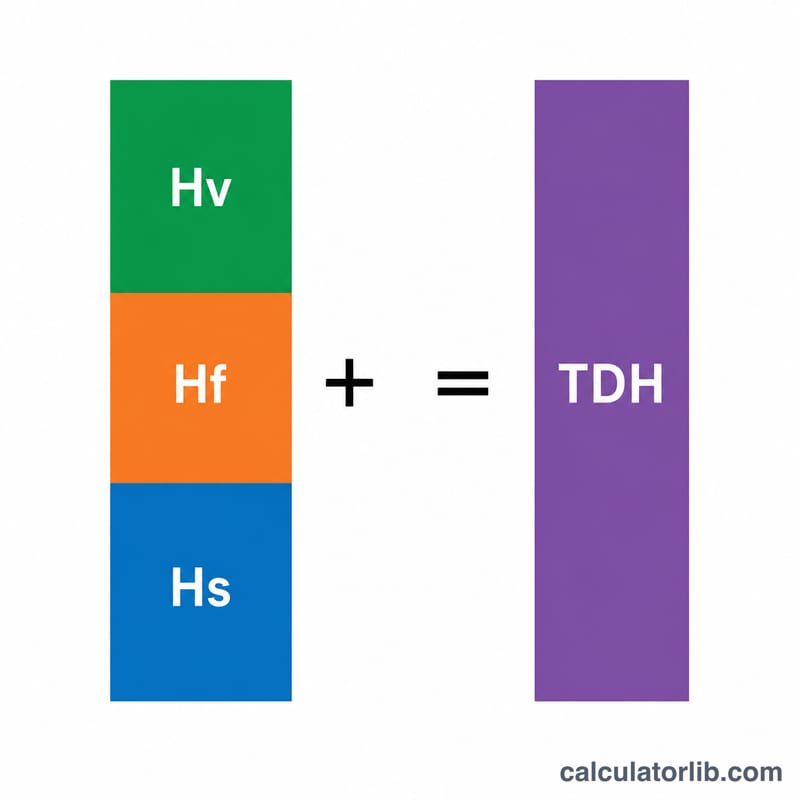
$$\text{TDH} = H_s + H_f + H_v$$ The static head \(H_s\) is the difference in liquid surface elevation. The friction head \(H_f\) is normally found from the Darcy-Weisbach or Hazen-Williams equations and reflects energy lost to pipe wall drag and minor losses. The velocity head \(H_v\) equals \(v^2 / (2g)\); at typical pipe velocities it is small but should not be ignored for high-flow systems.
Worked Example
Suppose a pump lifts water 20 m (static head), the piping causes 5 m of friction loss, and the discharge velocity head is 1.5 m. Then $$\text{TDH} = 20 + 5 + 1.5 = 26.5 \text{ m}$$ You would select a pump capable of delivering the required flow rate at 26.5 m of head.
FAQ
Does TDH depend on the fluid? Head in meters is independent of fluid density, but the equivalent pressure and required power do depend on density. Friction loss also varies with viscosity.
Is suction lift included? Yes — static head should reflect the net elevation change including any suction lift below the pump.
Can I ignore velocity head? For low-velocity systems it is often negligible, but include it for accuracy, especially in high-flow or large-diameter applications.