
What Is Velocity Head?
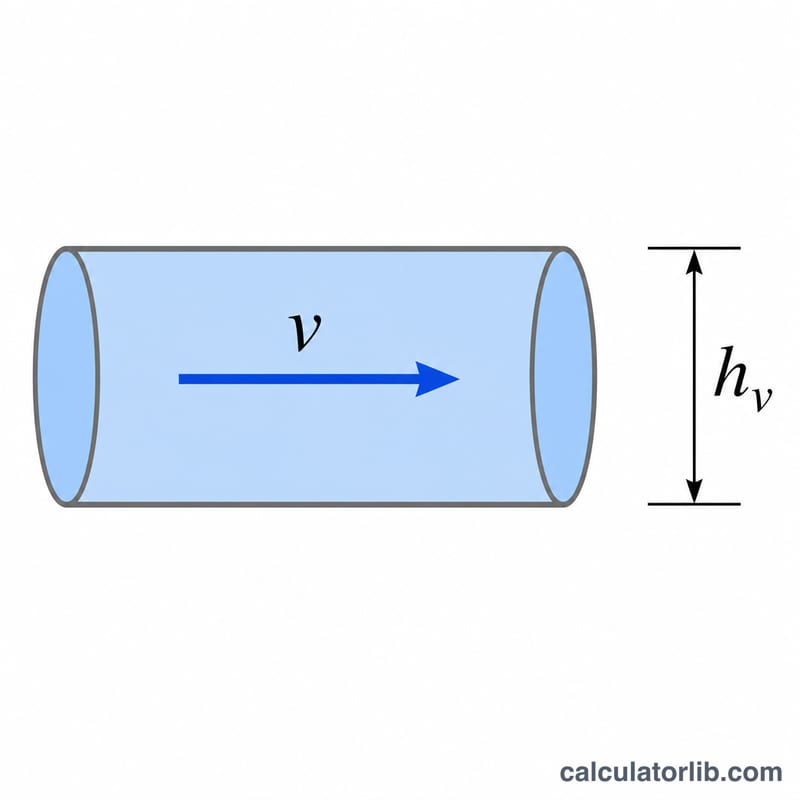
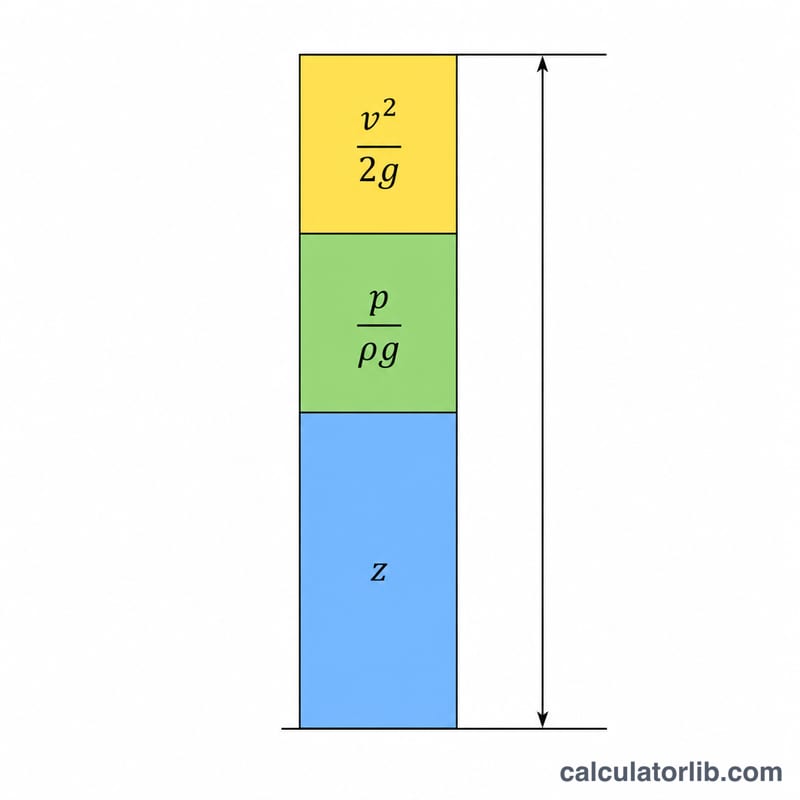
Velocity head is the portion of a fluid's total energy that is due to its motion, expressed as an equivalent height of a fluid column. It is one of the three terms in the Bernoulli equation, alongside pressure head and elevation head. Velocity head tells engineers how much of the flow energy is kinetic, which is essential when sizing pipes, analyzing pump systems, and estimating minor and major head losses.
How to Use This Calculator
Enter the flow velocity of the fluid in meters per second and the gravitational acceleration (default 9.81 m/s² on Earth). The calculator instantly returns the velocity head in meters of fluid column. Because velocity head depends only on velocity and gravity, the result is independent of the fluid's density.
The Formula Explained
The velocity head equation is:
$$h_v = \frac{v^{2}}{2g}$$
Here \(v\) is the average flow velocity and \(g\) is gravitational acceleration. Squaring the velocity means head rises rapidly as flow speeds up: doubling the velocity quadruples the velocity head. The \(2g\) denominator converts kinetic energy per unit weight into a length unit.
Worked Example
Suppose water flows through a pipe at 3 m/s on Earth (g = 9.81 m/s²). Then $$h_v = \frac{3^{2}}{2 \times 9.81} = \frac{9}{19.62} = 0.4587 \text{ meters}.$$ The flowing water carries kinetic energy equivalent to a 0.46 m tall column of fluid.
FAQ
Does fluid type affect velocity head? No. Velocity head depends only on velocity and gravity, so water, oil, and air at the same speed have the same velocity head in meters of their own column.
What units does the result use? Meters of fluid column when velocity is in m/s and g in m/s². For US units, use ft/s and 32.174 ft/s² to get feet.
Why does velocity head matter? It is used in the Bernoulli equation and in computing minor losses (fittings, valves) where loss is often a coefficient times the velocity head.