
What it is
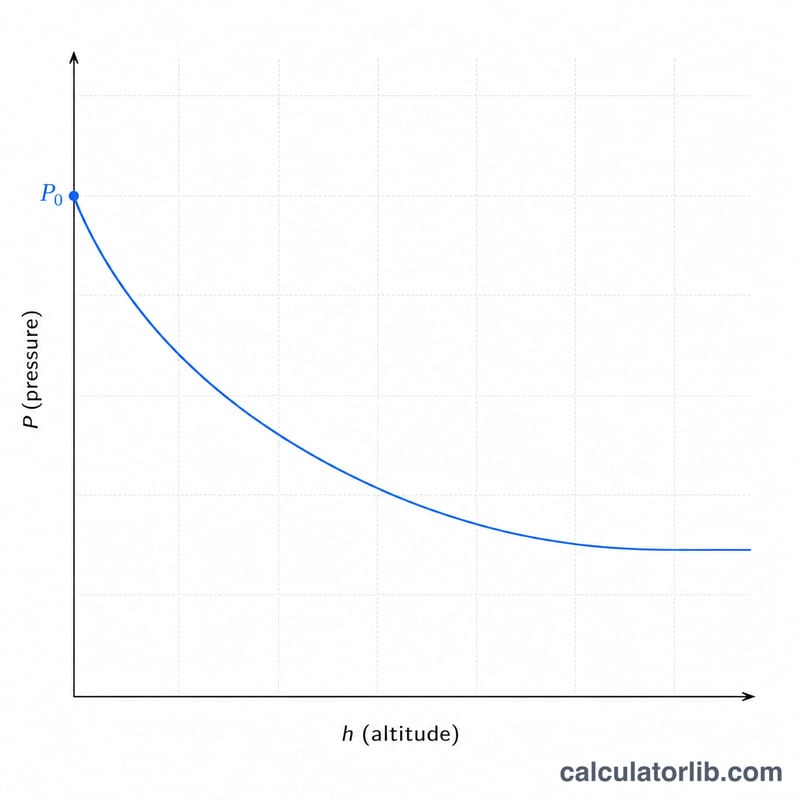
This calculator estimates atmospheric pressure at a given altitude using the barometric formula for the troposphere. It models how air pressure decreases with height assuming a standard temperature lapse rate of 0.0065 K per meter. The tool is useful in meteorology, aviation, hiking, and engineering wherever pressure-altitude relationships matter.
How to use it
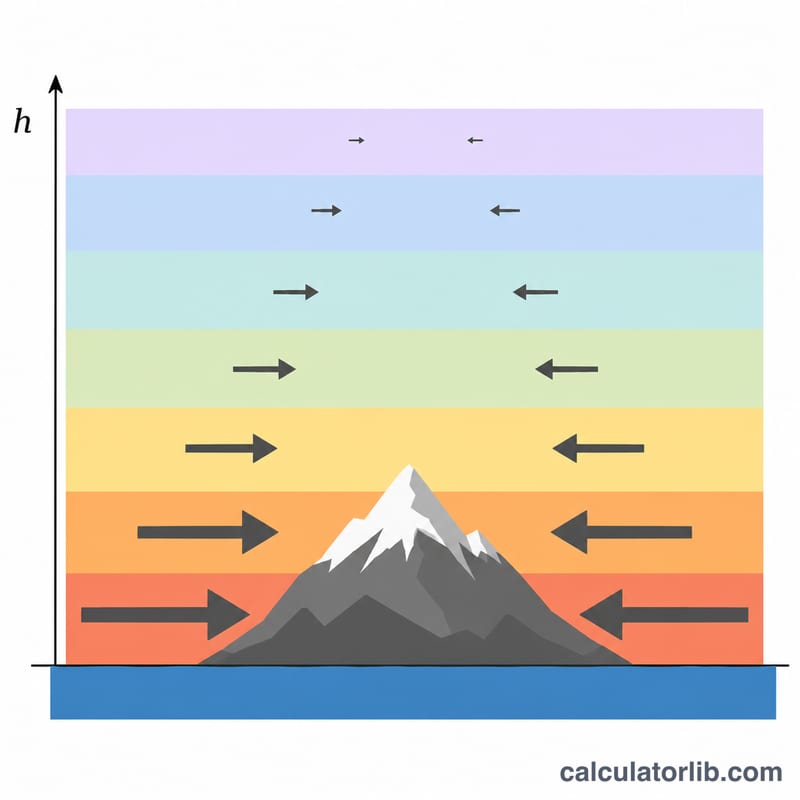
Enter the sea-level pressure P0 (the standard value is 1013.25 hPa), the altitude h in meters, and the sea-level temperature T0 in kelvin (standard atmosphere is 288.15 K). The calculator returns the pressure at altitude, the pressure drop from sea level, and the percentage of sea-level pressure remaining.
The formula explained
The relationship is $$P = P_0 \left(1 - \frac{0.0065\,h}{T_0}\right)^{5.255}$$ The term \(0.0065\) is the standard lapse rate in K/m, and the exponent \(5.255\) comes from the ratio of gravitational acceleration to the product of the lapse rate and the specific gas constant for dry air. As altitude increases, the base shrinks below 1 and the pressure falls.
Worked example
For P0 = 1013.25 hPa, h = 1000 m, T0 = 288.15 K: the base is $$1 - \frac{0.0065(1000)}{288.15} = 1 - 0.022558 = 0.977442$$ Raising to the 5.255 power gives \(0.886963\), so $$P = 1013.25 \times 0.886963 = 898.75 \text{ hPa}$$ The drop from sea level is $$\Delta P = 1013.25 - 898.75 = 114.50 \text{ hPa}$$
Constants Used in the Barometric Formula
The barometric (ISA) formula relies on a set of standard physical constants. The exponent 5.255 is not arbitrary — it is derived from gravity, the molar mass of air, the gas constant, and the lapse rate.
| Symbol | Quantity | Standard value |
|---|---|---|
| \(P_0\) | Sea-level standard pressure | 1013.25 hPa (101325 Pa) |
| \(T_0\) | Sea-level standard temperature | 288.15 K (15 °C) |
| \(L\) | Temperature lapse rate | 0.0065 K/m |
| \(g\) | Gravitational acceleration | 9.80665 m/s² |
| \(M\) | Molar mass of dry air | 0.0289644 kg/mol |
| \(R\) | Universal gas constant | 8.31446 J/(mol·K) |
| \(\frac{gM}{RL}\) | Derived exponent | 5.255 |
The exponent is computed as:
$$\frac{gM}{RL} = \frac{9.80665 \times 0.0289644}{8.31446 \times 0.0065} = 5.255$$Because the formula uses \(T_0\) in kelvin, remember that 15 °C = 288.15 K. Substituting a different sea-level temperature (for a warmer or colder air mass) changes the result, which is why the field \(T_0\) is adjustable.
FAQ
Why 5.255? It is \(g M /(R L)\) for dry air under the International Standard Atmosphere, where \(g\) is gravity, \(M\) molar mass of air, \(R\) the gas constant, and \(L\) the lapse rate.
Is this accurate above the troposphere? No. The formula is valid up to about 11 km; above the tropopause temperature stops decreasing linearly and a different model is needed.
Can I use feet? Convert to meters first (1 foot = 0.3048 m), since the lapse rate constant assumes meters.