
What Is Percent Dissociation?
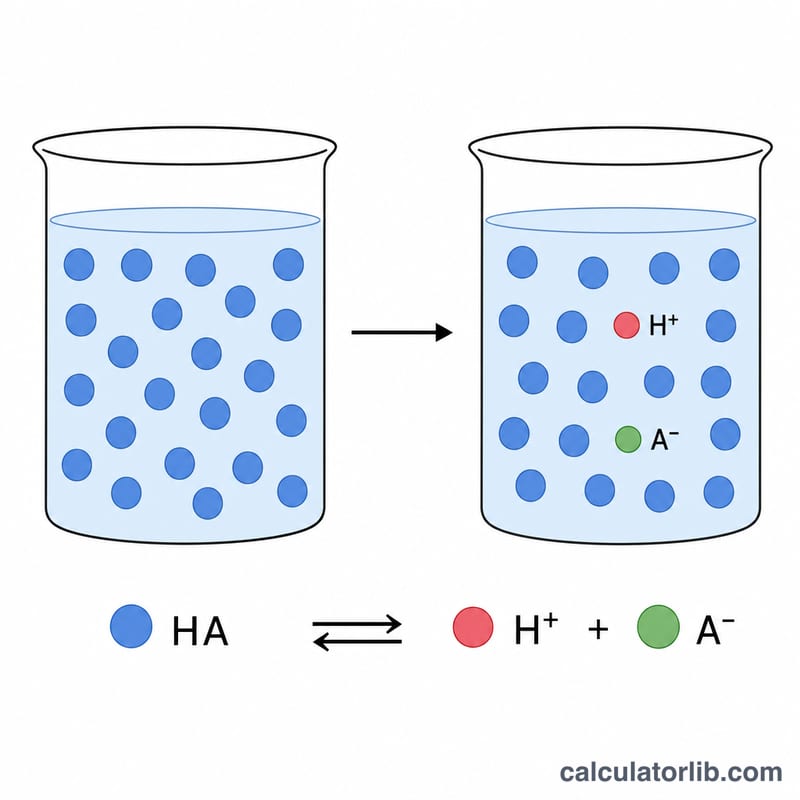
Percent dissociation (also called percent ionization) measures how much of a weak acid actually breaks apart into ions in solution. Unlike strong acids, which ionize completely, weak acids reach an equilibrium where only a fraction of the molecules release their hydrogen ions. This calculator determines that fraction directly from the solution's measured pH and the initial (analytical) concentration of the acid.
How to Use It
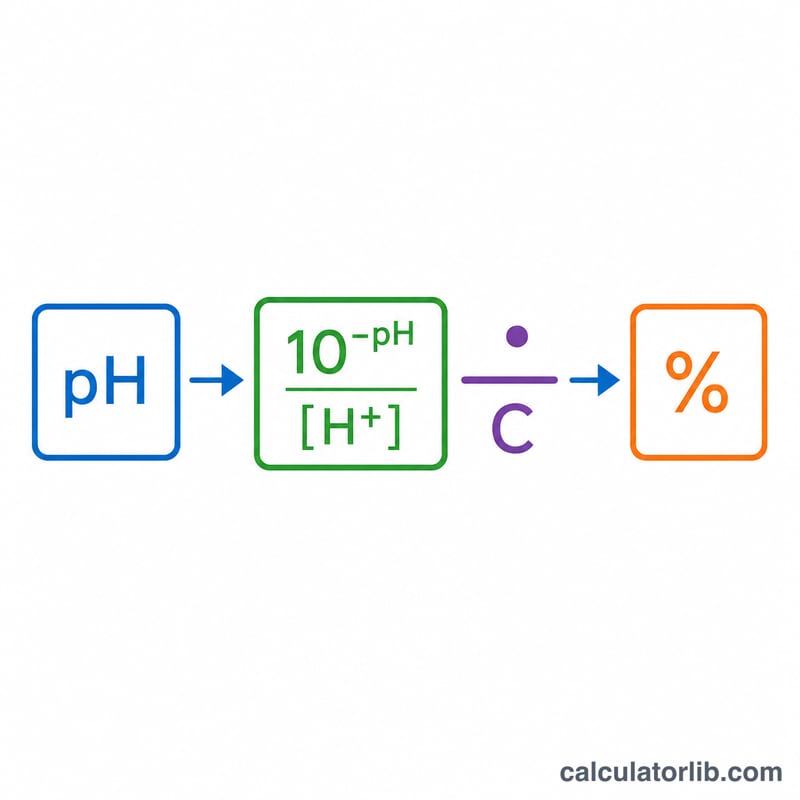
Enter the measured pH of the solution and the initial concentration of the acid in moles per liter (mol/L). The calculator first converts the pH into the hydrogen-ion concentration, then divides by the initial concentration and multiplies by 100 to give the percent dissociation.
The Formula Explained
For a monoprotic weak acid HA → H+ + A−, the equilibrium hydrogen-ion concentration equals the amount of acid that dissociated. Since \([\text{H}^+] = 10^{-\text{pH}}\), the percent dissociation is simply \([\text{H}^+]\) divided by the starting concentration \(C\), scaled to a percentage: $$\text{\% Dissociation} = \frac{10^{-\text{pH}}}{\text{C (mol/L)}} \times 100$$ This assumes water autoionization is negligible and that the acid is the only significant proton source.
Worked Example
Suppose a 0.10 mol/L acetic acid solution has a pH of 2.87. Then \([\text{H}^+] = 10^{-2.87} \approx 0.001349 \text{ mol/L}\). $$\text{\% Dissociation} = \frac{0.001349}{0.10} \times 100 \approx 1.35\%$$ Only about 1.3% of the acetic acid molecules have ionized — consistent with it being a weak acid.
FAQ
Does this work for strong acids? For an ideal strong acid the result should be close to 100% if the pH was measured accurately, but the equation is really intended for weak acids where dissociation is partial.
Why might I get over 100%? That usually means the entered pH and concentration are inconsistent, or the acid is essentially fully dissociated. Double-check your inputs.
Does temperature matter? Yes — pH and equilibrium constants are temperature dependent, so use the pH measured at the temperature of interest (typically 25°C).