What Is the Price per Pound Calculator?
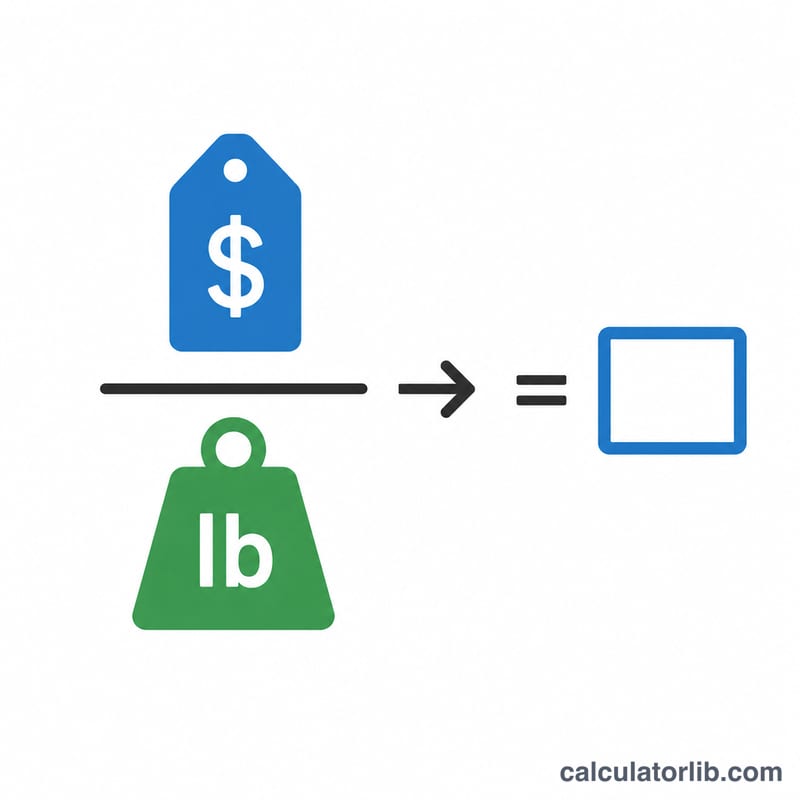
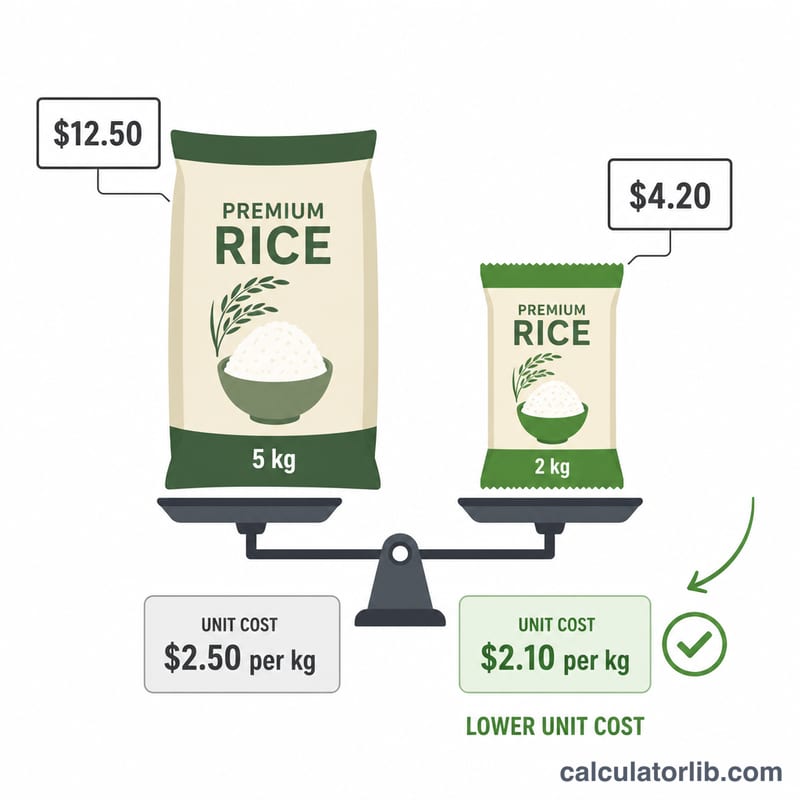
The Price per Pound Calculator works out the unit cost of an item sold by weight. By dividing the total price you paid by the total number of pounds, you get a single, comparable number: how much each pound costs. This makes it easy to compare bulk packages, deli items, produce, and meat regardless of how they are packaged or priced.
How to Use It
Enter the total price you paid (or the listed price) and the total weight in pounds. The calculator instantly returns the price per pound, plus a handy price per ounce. Use it in a store to decide whether the family-size pack is really cheaper than the small one.
The Formula Explained
The math is simple division:
$$\text{Price per Pound} = \frac{\text{Total Price (\$)}}{\text{Total Weight (lb)}}$$
If a value is in ounces, convert to pounds first (16 ounces = 1 pound). The price per ounce is just the price per pound divided by 16:
$$\text{Price per Ounce} = \frac{1}{16}\cdot\frac{\text{Total Price (\$)}}{\text{Total Weight (lb)}}$$
Worked Example
Suppose a 2.5 lb bag of coffee costs $20. Then the price per pound is $$\$20 \div 2.5 = \$8.00 \text{ per pound}$$ The price per ounce is $$\$8.00 \div 16 = \$0.50 \text{ per ounce}$$ A competing 1.75 lb bag at $15 would be \(\$8.57/\text{lb}\) — slightly more expensive per pound, so the larger bag is the better value.
Weight Unit Conversion Table
Price per pound is only meaningful once every weight is expressed in the same unit. The factors below are the standard avoirdupois (commercial) weight relationships used in the United States and in international trade. The pound is defined exactly as 0.45359237 kg, so the gram and ounce figures below are rounded from that exact definition.
| Unit | Equals in pounds (lb) | Notes |
|---|---|---|
| 1 pound (lb) | 1 lb | = 16 oz exactly |
| 1 ounce (oz) | 0.0625 lb | = 28.3495 g |
| 1 pound (lb) | — | = 453.592 g (453.59237 g exactly) |
| 1 kilogram (kg) | 2.20462 lb | = 1000 g |
| 1 gram (g) | 0.00220462 lb | = 0.035274 oz |
| 100 grams | 0.220462 lb | common EU shelf-tag basis |
| 1 stone | 14 lb | British imperial unit |
| 1 short ton | 2000 lb | US ton; = 907.185 kg |
| 1 metric tonne (t) | 2204.62 lb | = 1000 kg |
| 1 long ton | 2240 lb | British imperial ton |
Converting a price per unit into a price per pound
Because price is money divided by weight, the conversion factor is applied in the opposite direction to the weight factor: to go from price per ounce to price per pound you multiply by 16, but to go from price per kilogram to price per pound you divide by 2.20462.
| Given price | Operation | Numeric example |
|---|---|---|
| Price per ounce | × 16 | $0.65/oz × 16 = $10.40/lb |
| Price per kilogram | ÷ 2.20462 | $6.00/kg ÷ 2.20462 = $2.72/lb |
| Price per 100 g | × 4.53592 | $1.20/100 g × 4.53592 = $5.44/lb |
| Price per gram | × 453.592 | $0.012/g × 453.592 = $5.44/lb |
| Price per stone | ÷ 14 | $42.00/stone ÷ 14 = $3.00/lb |
| Price per short ton | ÷ 2000 | $320.00/ton ÷ 2000 = $0.16/lb |
The underlying relationship is always the same:
$$\text{Price per Pound} = \frac{\text{Total Price}}{\text{Total Weight in Pounds}}$$So a 750 g package costing $8.40 is \(750 \times 0.00220462 = 1.6535\) lb, giving \(8.40 \div 1.6535 = 5.08\) dollars per pound.
Unit Cost Comparison Across Package Sizes
The table below shows realistic shelf scenarios with mixed units. Every row is converted to pounds first, then divided, so you can check the arithmetic yourself. Prices are illustrative examples, not current retail prices, and the ounces here are weight ounces (oz), not fluid ounces.
| Item / package | Total price | Weight as labeled | Weight in lb | Price per lb | Price per oz | Best value in category |
|---|---|---|---|---|---|---|
| Whole-bean coffee, single bag | $9.99 | 12 oz | 0.75 | $13.32 | $0.833 | No |
| Whole-bean coffee, bulk bag | $20.00 | 2.5 lb | 2.5 | $8.00 | $0.500 | Yes (coffee) |
| Long-grain rice, metric bag | $4.50 | 1 kg | 2.2046 | $2.04 | $0.128 | No |
| Long-grain rice, 5 lb bag | $9.95 | 5 lb | 5.0 | $1.99 | $0.124 | Yes (rice) |
| Deli turkey, sliced to order | $11.70 | 1.3 lb | 1.3 | $9.00 | $0.563 | Yes (turkey) |
| Pre-packed sliced turkey | $6.99 | 12 oz | 0.75 | $9.32 | $0.583 | No |
| Cheese snack packs, multipack | $14.40 | 6 × 8 oz (48 oz) | 3.0 | $4.80 | $0.300 | Yes (cheese) |
| Cheese snack pack, single | $2.79 | 8 oz | 0.5 | $5.58 | $0.349 | No |
How two of the rows are calculated
12 oz coffee bag — convert the ounces to pounds first, since \(12 \div 16 = 0.75\) lb:
$$\text{Price per Pound} = \frac{\$9.99}{0.75\ \text{lb}} = \$13.32\ \text{per lb}$$Cheese multipack — multiply out the pack count before dividing, since \(6 \times 8 = 48\) oz \(= 3\) lb:
$$\text{Price per Pound} = \frac{\$14.40}{3\ \text{lb}} = \$4.80\ \text{per lb}$$1 kg rice bag — the metric weight is converted with the standard factor \(1\ \text{kg} = 2.20462\ \text{lb}\):
$$\text{Price per Pound} = \frac{\$4.50}{2.20462\ \text{lb}} = \$2.04\ \text{per lb}$$Two patterns stand out. The bulk coffee bag costs about 40% less per pound than the small bag ($8.00 against $13.32), which is the typical direction but not a rule — promotions and loyalty pricing regularly make a small package the cheaper one per pound. And the imported 1 kg rice bag looks smaller and cheaper on the shelf at $4.50, yet costs more per pound than the $9.95 five-pound bag; only the conversion to a common unit makes that visible.
Interpreting Your Price per Pound
A price per pound is a single number, but it answers only a narrow question: how much money you pay for one pound of whatever is inside that package, as the package is labeled. Several things determine whether two such numbers can honestly be compared.
- Compare like with like. Price per pound is only comparable between items of the same product type and a comparable quality, grade or specification. Ground chuck against ground sirloin, store-brand against single-origin coffee, or USDA Choice against USDA Select beef are different products, and the cheaper pound may simply be a different thing. Within one product at one grade, the comparison is reliable; across grades it is a budgeting figure, not a verdict.
- Labeled net weight is not always the weight you eat. Net weight excludes the packaging, but it can still include liquid or additives. Water-packed or brine-packed canned goods are often sold with both a net weight and a declared drained weight, and the drained weight is the one that matters for cost per pound of food. Frozen fish and shrimp carry a protective ice glaze, which is not supposed to be counted in the declared net weight but does make the package feel heavier than the product inside. Marinated, brined or injected meats may contain added solution that is part of the labeled weight. Where a drained or de-glazed weight is available, run the calculation on that figure.
- Bone-in versus boneless changes the edible yield. A bone-in cut, a whole chicken, shell-on shrimp or a rind-on cheese all include mass you will not eat. Trim loss, fat rendered off, and peel or pit removal reduce the yield further, and cooking loss reduces it again. A bone-in cut at a visibly lower price per pound can end up costing more per pound of edible, cooked food than a boneless cut. If you need that comparison, divide the price per pound by the expected yield fraction for that specific cut rather than relying on a generic figure.
- Normalize the shelf tag before trusting it. In the United States, unit-price shelf tags are regulated at the state level under state weights-and-measures laws, many of which follow the model regulation in NIST Handbook 130; requirements and the permitted unit are not uniform across all states, and tags may be stated per pound, per ounce, or per 100 grams. Other jurisdictions differ again — EU and UK rules generally express unit price per kilogram or per 100 g. Two tags in the same aisle can therefore use different bases, so convert them to one unit (the second table above) before deciding which is cheaper.
- Cheaper per pound is not cheaper if you do not use it. The saving from a bulk package is only realized on the portion you actually consume. Perishable goods that spoil, items that go stale after opening, products needing freezer or pantry space you do not have, and quantities larger than your household will finish all erode or erase the per-pound advantage. The honest comparison is cost per pound used, and a partially discarded bulk pack can be the more expensive choice.
Practically: convert everything to one unit, compare within a single product and grade, prefer drained or boneless weight when you can get it, and weigh the per-pound figure against how much you will realistically use. If two options land within a few percent of each other, the difference is usually smaller than the normal week-to-week variation in retail pricing and not worth optimizing.
This tool performs a cost comparison only. It is general information to help you normalize prices, not purchasing, dietary or financial advice, and it does not account for taxes, deposits, loyalty discounts, shipping or local price differences.
FAQ
How do I compare items in different units? Convert everything to the same unit. To go from kilograms to pounds, multiply kg by 2.20462; for ounces, divide by 16.
Does the calculator include tax? No. Enter the pre-tax price for a true unit comparison, or include tax consistently across items.
What if I only know the price per ounce? Multiply the price per ounce by 16 to get the price per pound.