
What is a 45-45-90 Triangle?
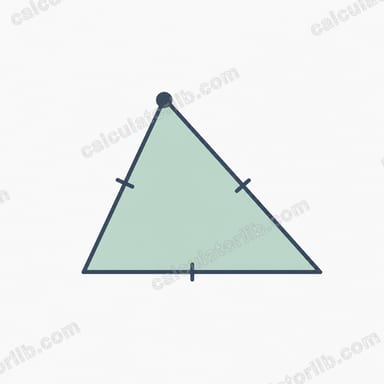
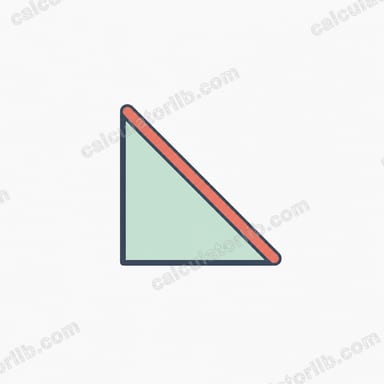
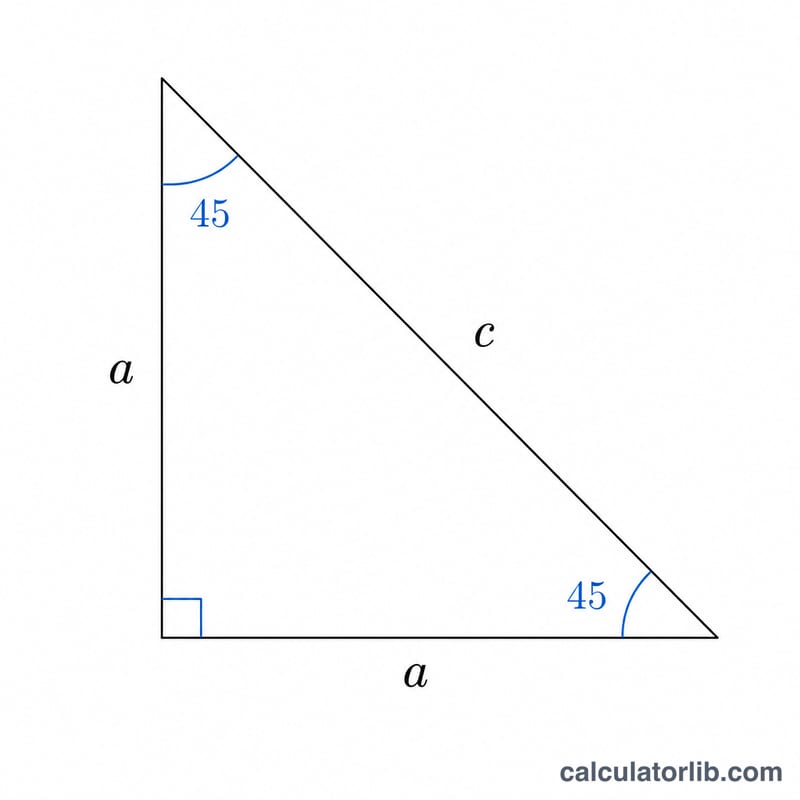
A 45-45-90 triangle is a special right triangle whose angles measure 45°, 45°, and 90°. Because the two non-right angles are equal, it is also an isosceles right triangle — the two legs (the sides adjacent to the right angle) are the same length. The hypotenuse is the longest side, opposite the 90° angle. This calculator finds the length of each leg when you already know the hypotenuse.
How to Use This Calculator
Enter the length of the hypotenuse in any unit you like (cm, inches, meters — the result comes back in the same unit). The tool instantly returns the length of each equal leg, plus the triangle's area and perimeter. Both legs are identical, so a single value applies to both.
The Formula Explained
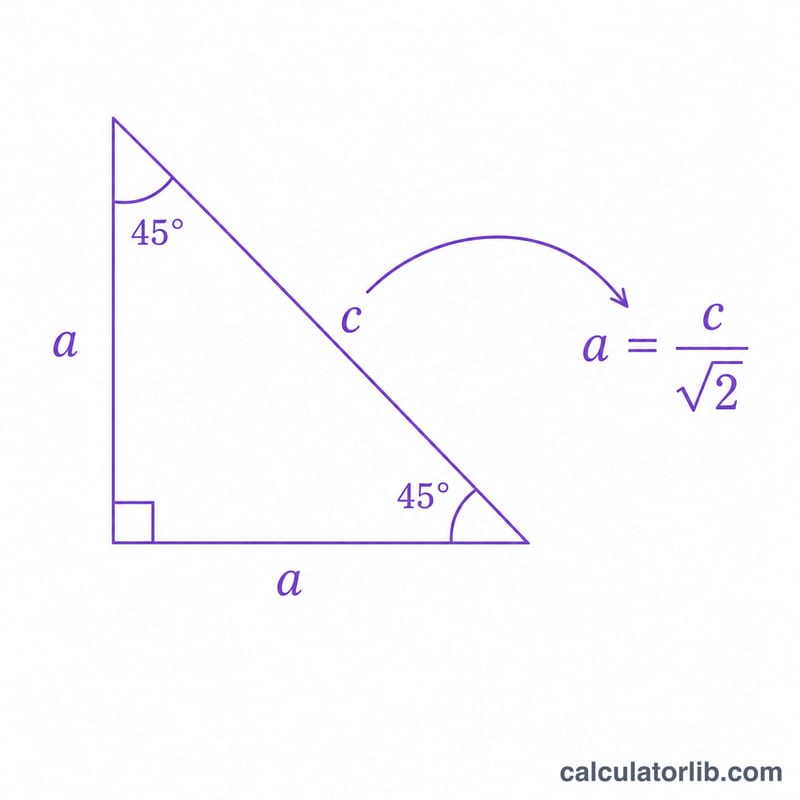
In a 45-45-90 triangle the sides are always in the ratio 1 : 1 : \(\sqrt{2}\). If the leg is a, the hypotenuse is \(a\sqrt{2}\). Rearranging gives the leg directly from the hypotenuse c:
$$\text{leg} = \dfrac{c}{\sqrt{2}}$$, which can also be written as $$\text{leg} = \dfrac{c\sqrt{2}}{2}$$ after rationalizing the denominator. The area is then $$A = \dfrac{\text{leg}^2}{2}$$ and the perimeter is \(2\cdot\text{leg} + c\).
Worked Example
Suppose the hypotenuse is 10. Then $$\text{leg} = \dfrac{10}{\sqrt{2}} \approx \dfrac{10}{1.41421} \approx 7.0711.$$ The area is $$\dfrac{7.0711^2}{2} \approx \dfrac{50}{2} = 25,$$ and the perimeter is \(2 \times 7.0711 + 10 \approx 24.1421\).
Leg Length for Common Hypotenuse Values
In a 45-45-90 right isosceles triangle, the two legs are equal and each is found from the hypotenuse using \(\text{leg} = \frac{c}{\sqrt{2}}\). Once the leg is known, the area is \(\frac{\text{leg}^2}{2}\) and the perimeter is \(2\,\text{leg} + c\). The table below applies these formulas to several common hypotenuse values, with results rounded to two decimal places.
| Hypotenuse \(c\) | Leg \(= c/\sqrt{2}\) | Area \(= \text{leg}^2/2\) | Perimeter \(= 2\,\text{leg} + c\) |
|---|---|---|---|
| 1 | 0.71 | 0.25 | 2.41 |
| 2 | 1.41 | 1.00 | 4.83 |
| 5 | 3.54 | 6.25 | 12.07 |
| 10 | 7.07 | 25.00 | 24.14 |
| 14.14 | 10.00 | 50.00 | 34.14 |
| 20 | 14.14 | 100.00 | 48.28 |
| 100 | 70.71 | 2500.00 | 241.42 |
Notice that when the hypotenuse is about 14.14 (which equals \(10\sqrt{2}\)), the legs come out to exactly 10, illustrating how the \(\sqrt{2}\) factor links the leg and hypotenuse. Each leg is roughly 70.7% of the hypotenuse, so doubling the hypotenuse doubles the leg and quadruples the area.
FAQ
Are both legs really equal? Yes. Because the two acute angles are both 45°, the sides opposite them are equal, making the triangle isosceles.
Why divide by \(\sqrt{2}\) instead of multiplying? The hypotenuse is the longest side and equals a leg times \(\sqrt{2}\), so to go backward from the hypotenuse to a leg you divide by \(\sqrt{2}\).
Does the unit matter? No. The leg comes out in whatever unit you entered for the hypotenuse, since the calculation is a pure ratio.