
What Is the 70/20/10 Rule?
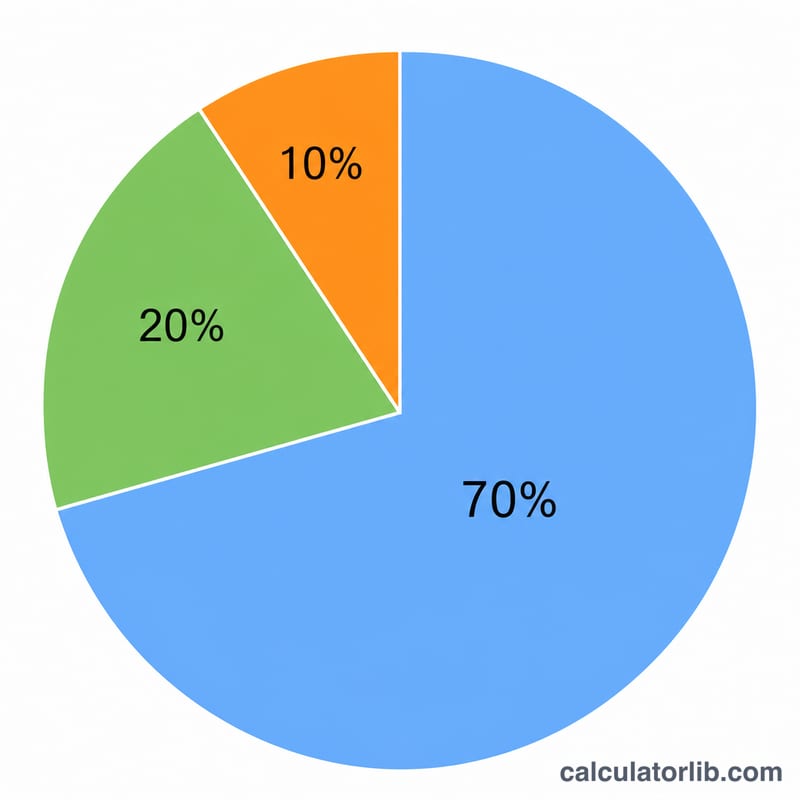
The 70/20/10 rule is a simple budgeting framework that divides your take-home income into three parts: 70% for needs (housing, food, utilities, transport and other essentials), 20% for savings or investments, and 10% for wants or extra debt payments. It is a stricter cousin of the popular 50/30/20 rule, prioritizing essentials while keeping discretionary spending tight.
How to Use This Calculator
Enter your monthly take-home (after-tax) income and the calculator instantly shows how much belongs in each bucket. Use the amounts as monthly spending targets. You can run it weekly, monthly or annually — just enter income for that period and every result scales accordingly.
The Formula Explained
Each bucket is a fixed fraction of income:
$$\text{Needs} = \text{Income} \times 0.70$$$$\text{Savings} = \text{Income} \times 0.20$$$$\text{Wants/Debt} = \text{Income} \times 0.10$$The three shares always add back to 100% of your income, so nothing is left unassigned.
Worked Example
Suppose your monthly take-home income is $5,000. Needs = \(5{,}000 \times 0.70 = \$3{,}500\). Savings = \(5{,}000 \times 0.20 = \$1{,}000\). Wants/Debt = \(5{,}000 \times 0.10 = \$500\). The three amounts total exactly $5,000.
70/20/10 Split at Different Income Levels
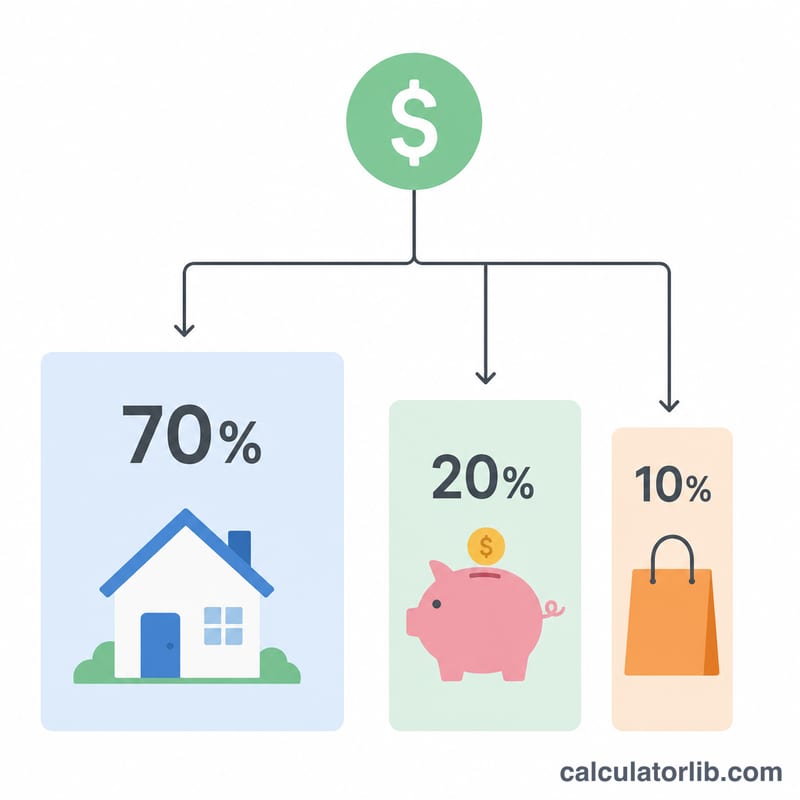
The 70/20/10 rule divides your monthly take-home income into three buckets: 70% for needs (housing, food, utilities, transportation, insurance), 20% for savings (emergency fund, retirement, investments), and 10% for wants or debt repayment (dining out, hobbies, or extra payments toward loans). The table below shows the dollar amount each bucket receives across a range of common monthly incomes.
| Monthly Income | Needs (70%) | Savings (20%) | Wants/Debt (10%) |
|---|---|---|---|
| $2,000 | $1,400 | $400 | $200 |
| $3,000 | $2,100 | $600 | $300 |
| $4,000 | $2,800 | $800 | $400 |
| $5,000 | $3,500 | $1,000 | $500 |
| $7,500 | $5,250 | $1,500 | $750 |
| $10,000 | $7,000 | $2,000 | $1,000 |
Each amount scales linearly with income, so doubling your income doubles every bucket while preserving the same proportions. If your needs consistently exceed 70% of your income, you may find a softer split such as the 50/30/20 budget easier to follow; the 70/20/10 rule works best when essential expenses are well controlled and you want to prioritize building savings.
FAQ
Should I use gross or net income? Use net (take-home) income after taxes, since that is the money you actually control.
Where does extra debt payoff go? Aggressive debt payoff usually comes from the 10% wants bucket, though some people borrow from savings to clear high-interest debt faster.
Is 70/20/10 better than 50/30/20? Not universally. 70/20/10 fits higher cost-of-living areas where needs eat more of the budget, while 50/30/20 allows more lifestyle spending. Pick the one that matches your reality.