
What is the Air Density Calculator?
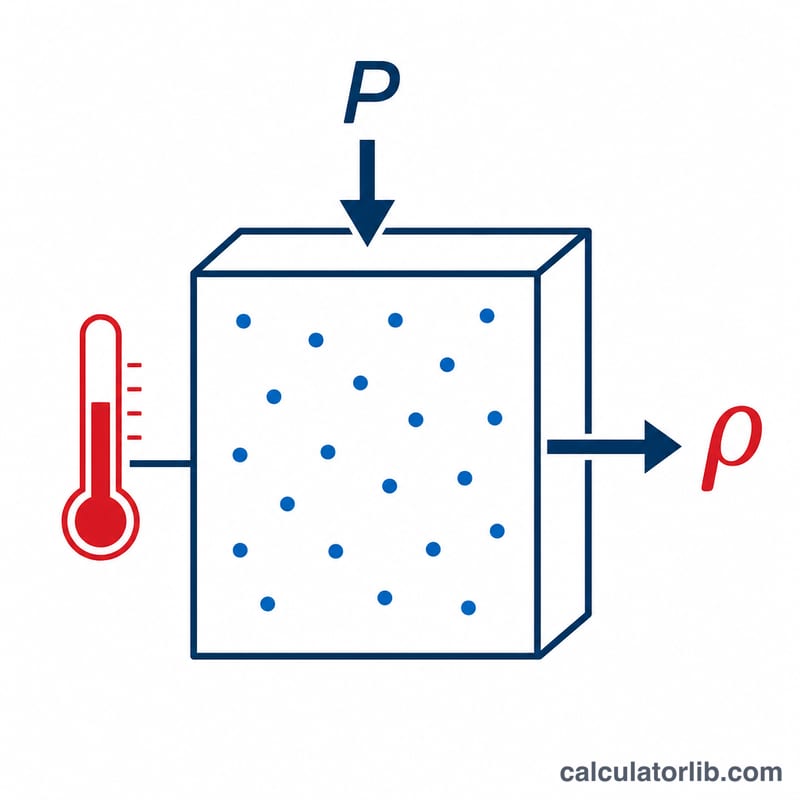
This calculator finds the density of a gas (by default dry air) from its absolute pressure and temperature using the ideal gas law. Air density matters in aerodynamics, HVAC sizing, engine tuning, drone and aircraft performance, and meteorology. Because warm, low-pressure air is less dense, it directly affects lift, drag, and combustion efficiency.
How to use it
Enter the absolute pressure in pascals (sea-level standard is 101325 Pa), the temperature in degrees Celsius, and the specific gas constant. For dry air use \(R = 287.058\) J/kg·K. The tool converts your temperature to kelvin and returns the density in kilograms per cubic metre.
The formula explained
The ideal gas law rearranges to $$\rho = \dfrac{P}{R \cdot T},$$ where \(\rho\) is density (kg/m³), \(P\) is absolute pressure (Pa), \(R\) is the specific gas constant for the gas (J/kg·K), and \(T\) is absolute temperature (K). Note \(R\) here is the specific gas constant (universal constant divided by molar mass), not the universal \(8.314\) value. Temperature must be in kelvin: $$T = t_{C} + 273.15.$$
Worked example
At standard sea level: \(P = 101325\) Pa, \(t = 15\) °C so \(T = 288.15\) K, \(R = 287.058\) J/kg·K. $$\rho = \frac{101325}{287.058 \times 288.15} = \frac{101325}{82716.27} \approx 1.225 \ \text{kg/m}^3$$ — the ISA standard sea-level air density.
Constants & Reference Values
The following constants are used in air-density and ideal-gas calculations. The specific gas constant of a substance equals the universal gas constant divided by its molar mass: \(R_{\text{specific}} = R_u / M\).
| Quantity | Symbol | Value | Notes |
|---|---|---|---|
| Specific gas constant, dry air | \(R_{\text{dry}}\) | 287.058 J/(kg·K) | Default for ρ = P/(R·T) |
| Specific gas constant, water vapor | \(R_{\text{v}}\) | 461.495 J/(kg·K) | Used for moist-air corrections |
| Universal gas constant | \(R_u\) | 8.314 J/(mol·K) | 8.314462618 J/(mol·K) exact |
| ISA sea-level pressure | \(P_0\) | 101325 Pa | = 1013.25 hPa = 1 atm |
| ISA sea-level temperature | \(T_0\) | 288.15 K | = 15.00 °C |
| ISA sea-level air density | \(\rho_0\) | 1.225 kg/m³ | Dry air at \(P_0, T_0\) |
| Celsius–Kelvin offset | — | 0 °C = 273.15 K | \(T_K = T_{°C} + 273.15\) |
Temperature must be in kelvin for the ideal gas law. To convert, add 273.15 to a Celsius reading — for example 20 °C becomes 293.15 K (see the Celsius to Kelvin converter). Using the dry-air constant gives a slight overestimate of density in humid conditions, since water vapor is less dense than dry air; for precise moist-air work the vapor partial pressure should be handled separately with \(R_{\text{v}}\).
FAQ
Why does air density drop with altitude? Both pressure and (usually) temperature fall with altitude, and lower pressure dominates, so density decreases.
Does humidity change density? Yes. Moist air is slightly less dense than dry air because water vapor is lighter than the nitrogen/oxygen it displaces. For high accuracy, use the gas constant for moist air or split partial pressures.
What pressure should I enter? Use absolute (not gauge) pressure. Gauge pressure plus atmospheric pressure equals absolute pressure.