
What Is the Angle of Repose?
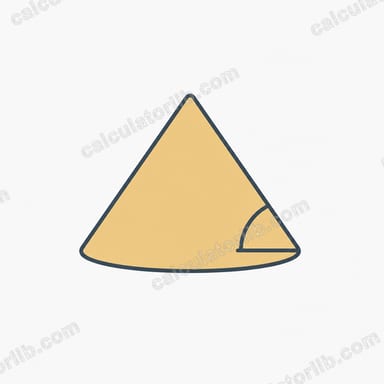
The angle of repose is the steepest angle, measured from the horizontal, at which a pile of loose, granular material remains stable without sliding. It is a key property in soil mechanics, bulk-material handling, civil engineering and even baking. Sand, gravel, grain, powders and many other materials each form a characteristic cone whose slope reveals their flow behaviour.
How to Use This Calculator
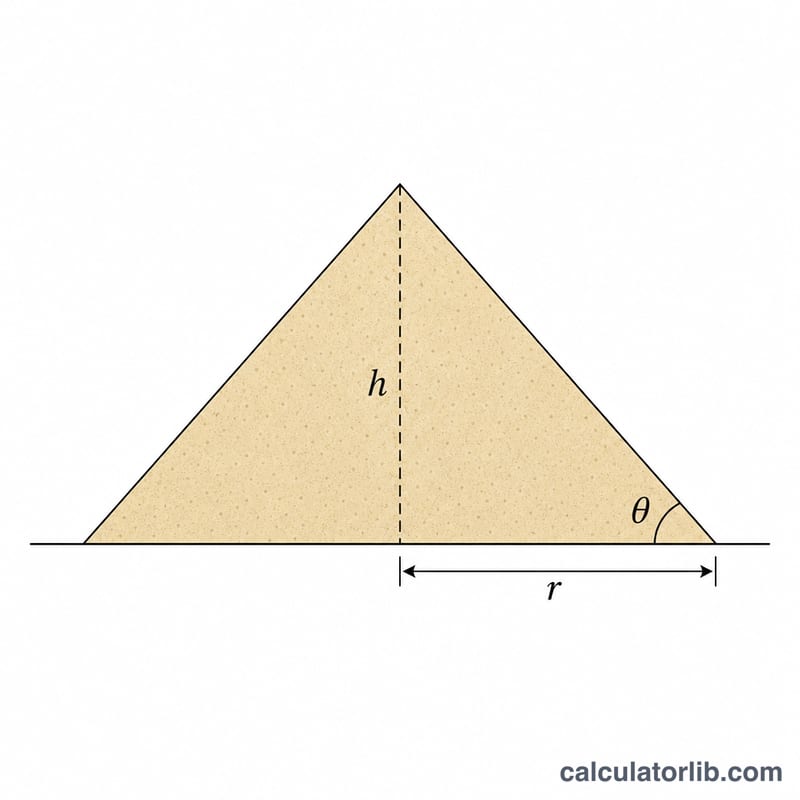
Pour the material onto a flat surface to form a cone, then measure two things: the vertical height of the pile (h) and the radius of its circular base (r). Enter both values in the same units (cm, m, inches — it doesn't matter as long as they match) and the calculator returns the angle in degrees and radians instantly.
The Formula Explained
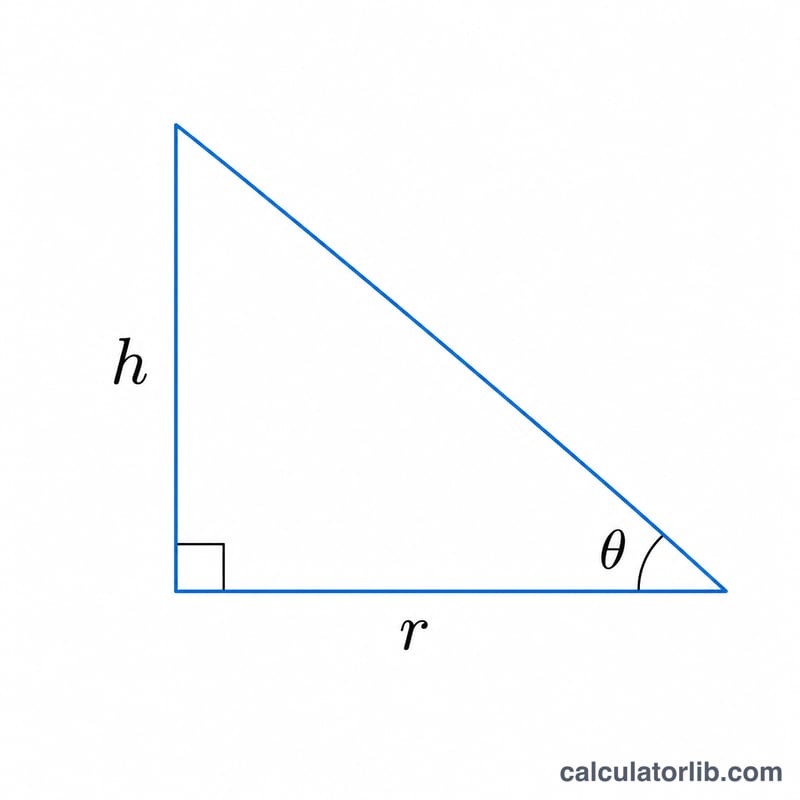
A symmetrical conical pile forms a right triangle between its apex, centre and edge. The pile height is the opposite side and the base radius is the adjacent side, so the slope angle is:
$$\theta = \arctan\left(\frac{h}{r}\right)$$
The arctangent converts the height-to-radius ratio into an angle. A taller, narrower cone gives a larger angle; a flatter, wider cone gives a smaller one. Because the formula uses a ratio, the choice of length unit cancels out.
Worked Example
Suppose a sand pile is 5 cm tall with a base radius of 10 cm. Then $$\theta = \arctan\left(\frac{5}{10}\right) = \arctan(0.5) \approx 26.57°.$$ This is typical for dry sand, which usually rests between about 30° and 35° depending on grain shape and moisture.
Typical Angle of Repose by Material
The angle of repose is the steepest angle, measured from the horizontal, at which a heaped granular material remains stable without sliding. It depends strongly on particle size, shape, surface roughness, moisture content and how the pile was formed, so the values below are documented ranges rather than fixed constants. Use them as a sanity check against the angle you compute from a measured pile height and base radius.
| Material | Typical Angle of Repose (degrees) |
|---|---|
| Dry sand | 30–35° |
| Wet sand | 40–45° |
| Gravel (rounded) | 30–38° |
| Crushed stone (angular) | 38–45° |
| Wheat | 23–28° |
| Corn (shelled) | 20–28° |
| Flour | 40–45° |
| Cement (Portland, dry) | 30–40° |
| Coal (bituminous) | 35–45° |
| Dry clay (powder) | 40–45° |
| Snow (dry) | ~38° |
For example, a cone of dry sand piled to a height of 0.30 m over a base radius of 0.50 m gives \(\theta=\arctan(0.30/0.50)\approx\) 30.96°, which sits right at the lower edge of the dry-sand range and confirms a free-flowing, low-cohesion pile.
FAQ
What is a typical angle of repose? Dry sand is around 34°, gravel near 45°, and dry wheat about 27°. Wetter or stickier materials hold steeper slopes.
Does the unit matter? No. Since the formula divides height by radius, any consistent length unit gives the same angle.
Why does a larger angle mean poorer flow? A higher angle of repose indicates more inter-particle friction and cohesion, so the material is more resistant to flowing freely.