
What Is Angular Acceleration?
Angular acceleration (\(\alpha\)) measures how quickly an object's rotational speed changes. It is the rotational analog of linear acceleration: where linear acceleration describes change in straight-line velocity, angular acceleration describes change in angular velocity (\(\omega\)). It is expressed in radians per second squared (rad/s²) and is a key quantity in rotational dynamics, from spinning wheels and motors to gears and planetary motion.
How to Use This Calculator
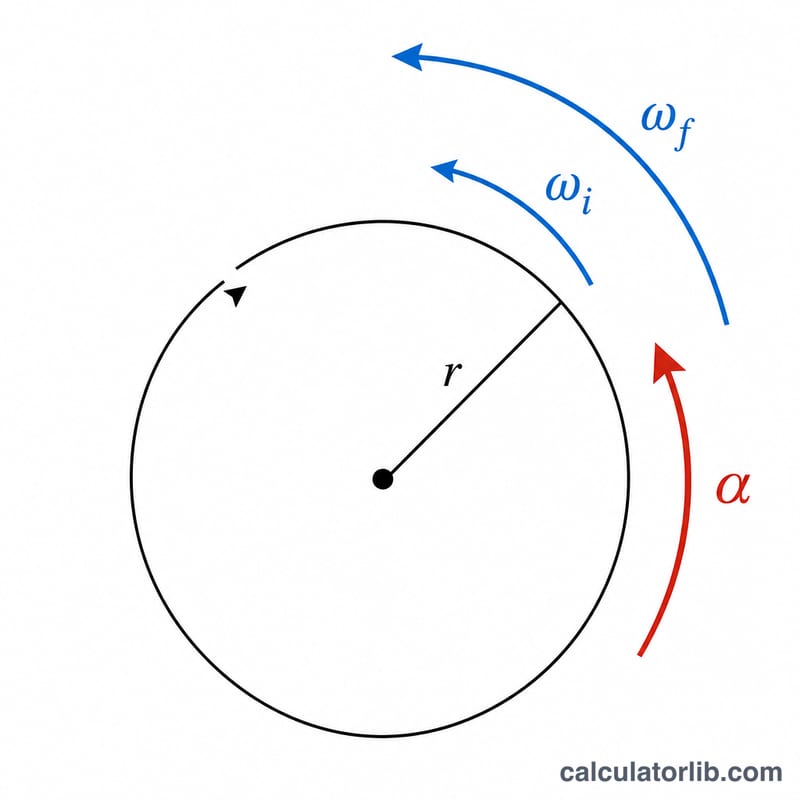
Enter three values: the initial angular velocity (\(\omega_i\)), the final angular velocity (\(\omega_f\)), and the time (\(t\)) over which the change occurs. All angular velocities should be in radians per second and time in seconds. The calculator returns the average angular acceleration along with the total change in angular velocity. A negative result means the object is decelerating (slowing its rotation).
The Formula Explained
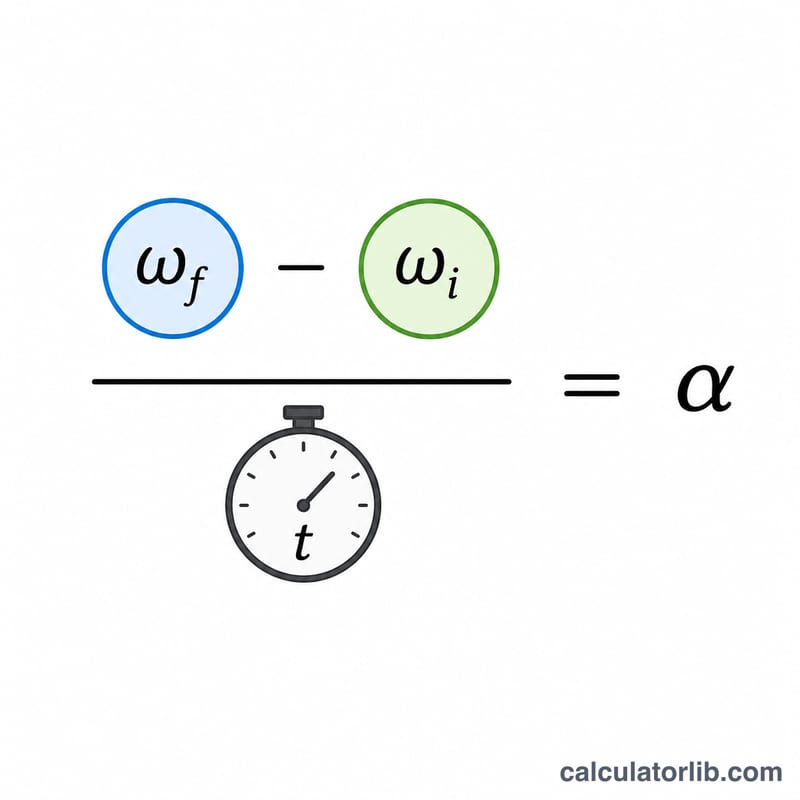
The equation is $$\alpha = \frac{\omega_f - \omega_i}{t}$$ Subtract the initial angular velocity from the final angular velocity to get the change (\(\Delta\omega\)), then divide by the elapsed time. This yields the average rate at which rotation speeds up or slows down. If you have angular velocity in revolutions per minute (RPM), convert it to rad/s first by multiplying by \(2\pi/60\).
Worked Example
A flywheel speeds up from 0 rad/s to 20 rad/s in 4 seconds. The change is \(\Delta\omega = 20 - 0 = 20\) rad/s. Dividing by time: $$\alpha = \frac{20}{4} = 5 \text{ rad/s}^2$$ The flywheel accelerates at 5 radians per second squared.
Key Terms & Variables
- Angular acceleration (\(\alpha\), rad/s²) — the rate of change of angular velocity with time. A positive value means the rotation is speeding up; a negative value means it is slowing down (deceleration).
- Initial angular velocity (\(\omega_i\), rad/s) — the rotational speed at the start of the time interval.
- Final angular velocity (\(\omega_f\), rad/s) — the rotational speed at the end of the time interval.
- Change in angular velocity (\(\Delta\omega\), rad/s) — the difference \(\Delta\omega = \omega_f - \omega_i\); the numerator of the angular acceleration formula.
- Time (\(t\), s) — the duration over which the change in angular velocity occurs.
- Radian — the SI unit of angle. One full revolution equals \(2\pi\) radians (≈6.2832 rad), so the radian is dimensionless and angular acceleration carries units of 1/s² written as rad/s².
The defining relationship is \(\alpha = \dfrac{\omega_f - \omega_i}{t}\), valid for constant (average) angular acceleration over the interval.
More Worked Examples
Example 1 — A decelerating wheel
A flywheel slows from \(\omega_i = 30\) rad/s to \(\omega_f = 10\) rad/s over \(t = 5\) s. Substituting into the formula:
$$\alpha = \frac{10 - 30}{5} = \frac{-20}{5} = -4\ \text{rad/s}^2$$The result is -4 rad/s². The negative sign confirms the wheel is decelerating.
Example 2 — Starting from an RPM value
A motor spinning at 120 RPM is brought to a complete stop in 8 s. First convert the initial speed to rad/s:
$$\omega_i = 120\times\frac{2\pi}{60} = 120\times0.10472 = 12.566\ \text{rad/s}$$With \(\omega_f = 0\) and \(t = 8\) s:
$$\alpha = \frac{0 - 12.566}{8} = \frac{-12.566}{8} = -1.5708\ \text{rad/s}^2$$So the angular acceleration is -1.5708 rad/s². Always convert RPM (or deg/s) to rad/s before applying the formula so the result is in proper SI units.
FAQ
What units does this use? Angular velocities are in radians per second (rad/s) and time in seconds (s), giving acceleration in rad/s².
Can the result be negative? Yes. A negative angular acceleration indicates the object is slowing its rotation (angular deceleration).
How do I convert RPM to rad/s? Multiply RPM by \(2\pi/60 \approx 0.10472\). For example, 60 RPM = 6.283 rad/s.