
What is the APRI?
The AST to Platelet Ratio Index (APRI) is a simple, noninvasive score used to estimate the degree of liver fibrosis and the likelihood of cirrhosis, most often in patients with chronic hepatitis C and other chronic liver diseases. Because it relies only on two routinely measured blood values — aspartate aminotransferase (AST) and platelet count — it offers a low-cost alternative to liver biopsy for risk stratification.
How to use this calculator
Enter the patient's AST value (U/L), the laboratory's upper limit of normal for AST (commonly around 40 U/L, but use your own lab's reference value), and the platelet count expressed in 109/L. The calculator returns the APRI score along with a quick interpretation band.
The formula explained
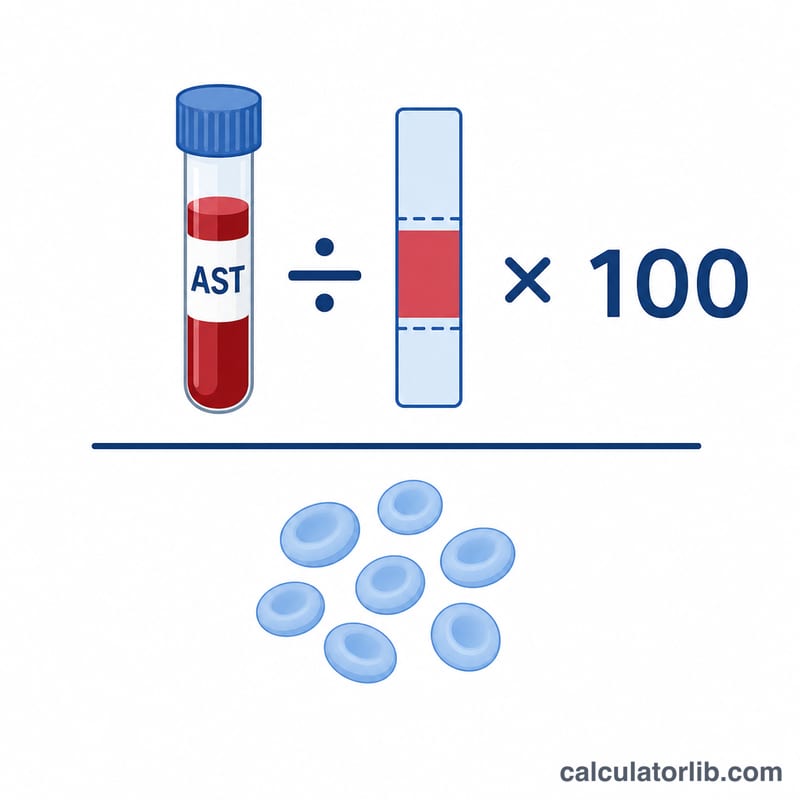
$$\text{APRI} = \frac{\left(\dfrac{\text{AST}}{\text{AST ULN}}\right) \times 100}{\text{Platelets}}$$ The AST is first normalized against its upper limit so that the index works regardless of the assay used, multiplied by 100, then divided by the platelet count. A falling platelet count combined with a rising AST drives the score upward, reflecting progressing fibrosis and portal hypertension.
Worked example
Suppose AST is 80 U/L, the lab's AST upper limit of normal is 40 U/L, and the platelet count is 150 × 109/L. Then $$\left(\frac{80}{40}\right) \times 100 = 200,$$ and \(200 \div 150 = 1.33\). An APRI of 1.33 falls in the indeterminate range, suggesting further evaluation may be warranted.
APRI Cutoff Thresholds and Their Meaning
The AST to Platelet Ratio Index (APRI) is a noninvasive score that uses two routinely available blood tests to estimate the probability of liver fibrosis and cirrhosis. It is calculated as:
$$\text{APRI} = \frac{\left(\dfrac{\text{AST}}{\text{AST ULN}}\right) \times 100}{\text{Platelet count}\ (10^9/\text{L})}$$
For example, an AST of 80 U/L with an AST upper limit of normal of 40 U/L and a platelet count of 150 \(\times 10^9/\text{L}\) gives an APRI of 1.33, which falls in the indeterminate range.
| APRI value | Primary interpretation | Outcome assessed |
|---|---|---|
| ≤ 0.5 | Significant fibrosis unlikely | METAVIR F2+ (rule-out) |
| 0.5 – 1.5 | Indeterminate | Fibrosis neither confirmed nor excluded |
| ≥ 1.5 | Significant fibrosis likely | METAVIR F2+ (rule-in) |
| ≥ 1.0 | Cirrhosis likely (higher-sensitivity cutoff) | METAVIR F4 — WHO HCV guidance |
| ≥ 2.0 | Cirrhosis likely (higher-specificity cutoff) | METAVIR F4 — WHO HCV guidance |
The World Health Organization hepatitis C guidance has cited an APRI > 1.0 as a cutoff suggesting cirrhosis where transient elastography is unavailable, with > 2.0 used for greater specificity. These thresholds were validated chiefly in chronic hepatitis C virus (HCV) infection, and performance differs in other liver diseases.
Interpreting Your APRI Score
APRI sorts patients into bands rather than giving a precise fibrosis stage. The bands reflect the probability that significant fibrosis (METAVIR F2 or higher) or cirrhosis (METAVIR F4) is present.
- APRI ≤ 0.5: Significant fibrosis is unlikely. A low value has reasonably good negative predictive value for ruling out advanced fibrosis in chronic HCV, meaning most patients below this cutoff do not have significant fibrosis.
- APRI 0.5 – 1.5: Indeterminate. The score neither rules fibrosis in nor out, and a substantial fraction of patients fall here. Further evaluation — such as elastography, FIB-4, or biopsy — is typically needed.
- APRI ≥ 1.5: Significant fibrosis is likely. A high value has better specificity for advanced fibrosis but does not confirm a stage on its own.
- APRI ≥ 1.0 to ≥ 2.0: Increasing likelihood of cirrhosis (F4). The 1.0 cutoff favors sensitivity (catching more true cases) while 2.0 favors specificity (fewer false positives).
In published meta-analyses for chronic HCV, APRI showed moderate diagnostic accuracy: higher cutoffs increase specificity at the cost of sensitivity, so many true cases of fibrosis are missed when only a high threshold is used. Because APRI was validated mainly in hepatitis C, its accuracy is lower in conditions such as nonalcoholic fatty liver disease, hepatitis B, or alcohol-related liver disease, and transient elevations in AST or platelet count (for example from acute illness) can distort the score.
APRI is a screening aid, not a diagnosis. Indeterminate values do not exclude or confirm fibrosis. This is general educational information and not medical advice; only a qualified clinician can interpret your APRI result alongside your full clinical picture and decide on confirmatory testing.
Key Terms and Variables
- AST (aspartate aminotransferase)
- A liver enzyme measured in units per liter (U/L) on a blood test. Elevated levels can reflect liver cell injury and are the numerator driver of the APRI score.
- AST upper limit of normal (ULN)
- The top of the reference range for AST used by the testing laboratory (commonly around 40 U/L, but it varies by lab and assay). APRI divides the measured AST by this value, so using the correct lab-specific ULN is essential.
- Platelet count
- The number of platelets in blood, expressed in \(10^9/\text{L}\) (equivalently, thousands per microliter). Falling platelet counts often accompany advancing liver disease and portal hypertension, and a lower count raises the APRI score.
- Liver fibrosis
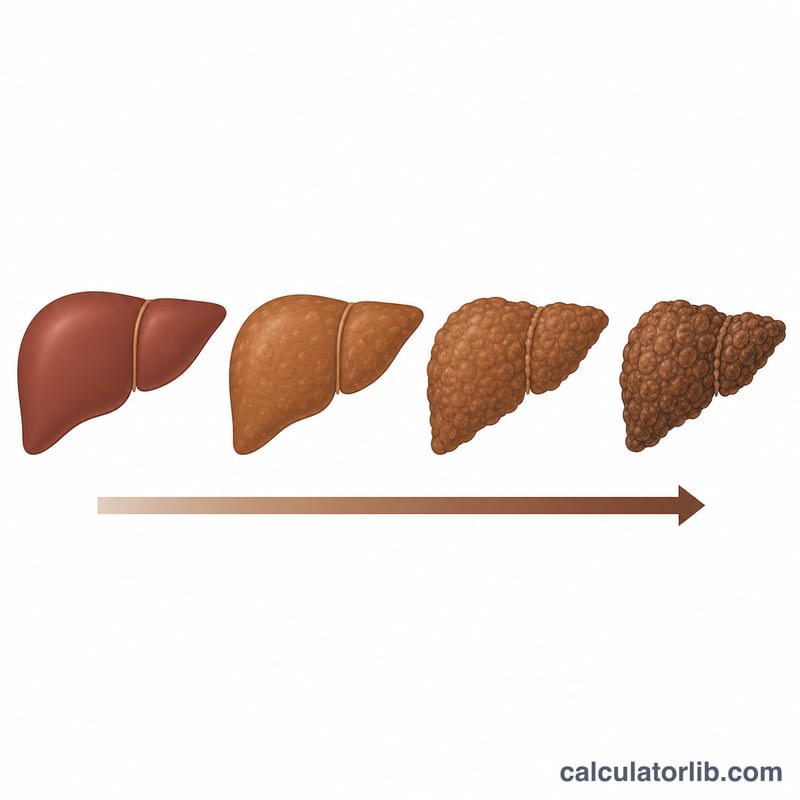
- The accumulation of scar (collagen-rich) tissue in the liver in response to chronic injury. It is staged from none (F0) to advanced.
- Cirrhosis
- The most advanced stage of fibrosis (METAVIR F4), in which extensive scarring distorts liver architecture and can impair liver function.
- Portal hypertension
- Elevated blood pressure within the portal venous system, a common consequence of cirrhosis; it contributes to a lower platelet count partly through splenic sequestration.
- METAVIR staging
- A widely used histologic system for grading liver fibrosis from F0 (no fibrosis) to F4 (cirrhosis), with F2+ denoting significant fibrosis. APRI thresholds are mapped to these stages.
- Noninvasive fibrosis marker
- A test that estimates liver fibrosis without a biopsy, using blood values (as in APRI and FIB-4) or imaging-based stiffness measurement (such as transient elastography).
FAQ
What APRI values are meaningful? A common interpretation uses APRI ≤ 0.5 to make significant fibrosis unlikely and APRI ≥ 1.5 to suggest significant fibrosis or cirrhosis; values in between are indeterminate. Some protocols use a higher cutoff (≥ 2.0) for cirrhosis.
Which AST upper limit should I use? Use the upper limit of normal reported by the laboratory that performed the test; values such as 35–40 U/L are typical but vary by assay and sex.
Can it replace a biopsy? No. APRI is a screening and risk-stratification aid. Indeterminate or concerning results should be confirmed with additional testing such as elastography or biopsy, guided by a clinician.