
What is the Area of a Pentagon Calculator?
This tool computes the area of a regular pentagon — a five-sided polygon where all sides and all interior angles are equal — directly from its side length. It also returns the perimeter and the apothem so you have a complete picture of the shape's geometry. It is a universal mathematical tool and applies anywhere.
How to use it
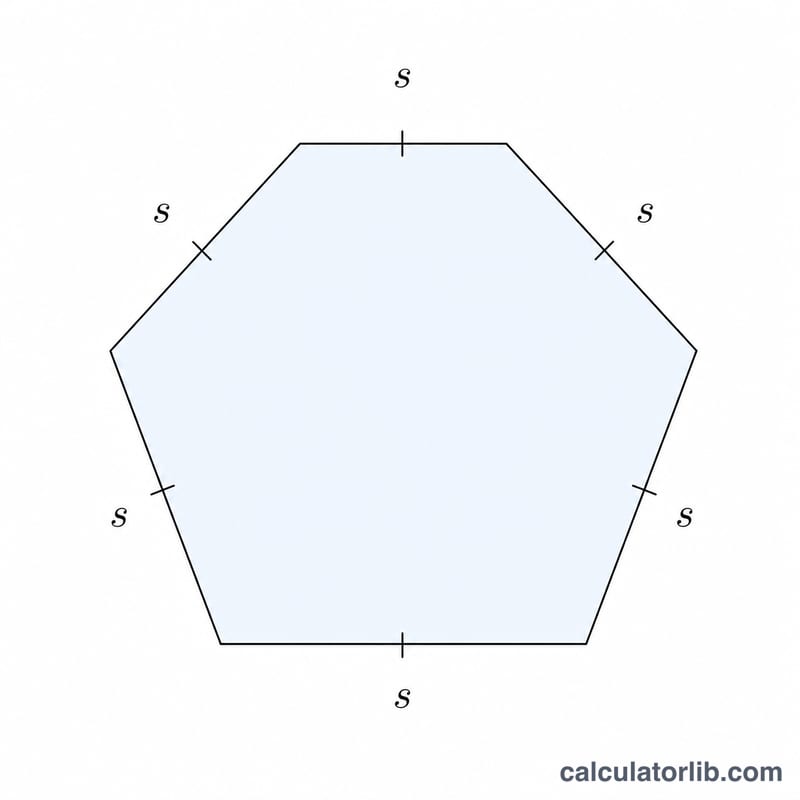
Enter the side length (s) of your pentagon in any consistent unit (cm, m, inches, etc.). The calculator returns the area in those units squared. Make sure every side of your pentagon is the same length, since this formula assumes a regular pentagon.
The formula explained
The exact area of a regular pentagon is:
$$A = \frac{1}{4}\sqrt{5\left(5 + 2\sqrt{5}\right)}\;s^{2}$$
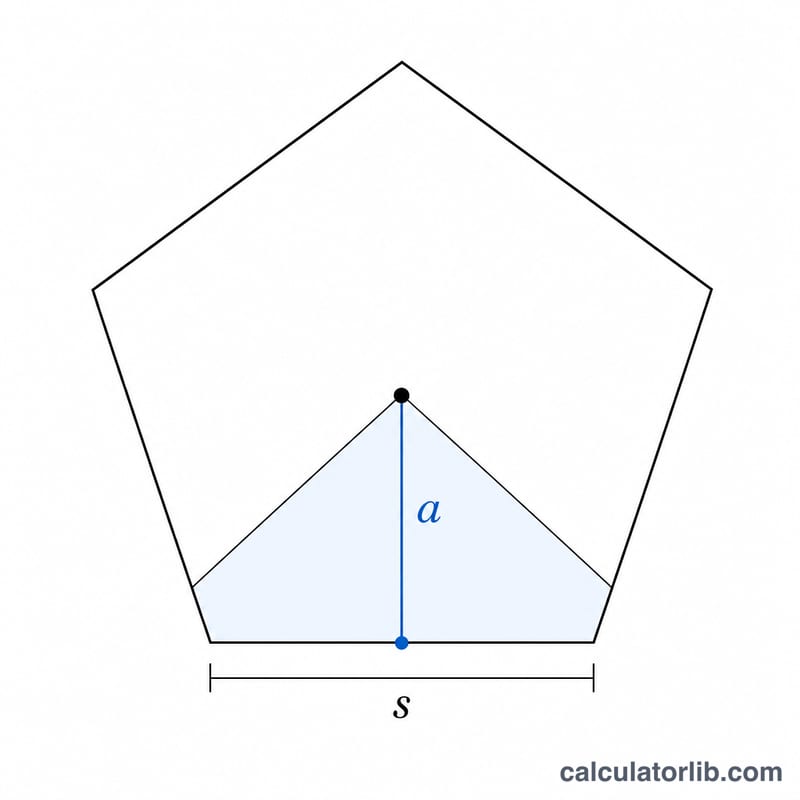
The constant factor \(\frac{1}{4}\sqrt{5\left(5 + 2\sqrt{5}\right)}\) is approximately \(1.720477\). Multiply it by the square of the side length to get the area. The apothem — the perpendicular distance from the center to a side — equals \(s / (2\cdot\tan(36°))\), and the perimeter is simply \(5\cdot s\).
Worked example
Suppose a regular pentagon has a side length of 10 units. Then:
$$A = 1.720477 \times 10^{2} = 1.720477 \times 100 \approx 172.0477 \text{ square units}$$ The perimeter is \(5 \times 10 = 50\) units, and the apothem is \(10 / (2\cdot\tan 36°) \approx 6.8819\) units.
How to Calculate a Pentagon's Area by Hand
The fastest route uses the closed-form constant. Here is the full procedure for a regular pentagon with side length \(s = 6\).
- Square the side length. \(s^2 = 6^2 = 36\).
- Multiply by the pentagon constant \(\tfrac{1}{4}\sqrt{5(5+2\sqrt5)} \approx 1.720477\): $$A = 1.720477 \times 36 \approx 61.937$$ So the area is about 61.937 square units.
- Find the perimeter separately by multiplying the side by 5: $$P = 5s = 5 \times 6 = 30.$$
- Find the apothem using \(a = \dfrac{s}{2\tan 36^\circ}\). Since \(\tan 36^\circ \approx 0.726543\): $$a = \frac{6}{2 \times 0.726543} = \frac{6}{1.453085} \approx 4.12915.$$
- Cross-check with the apothem formula. Any regular polygon also satisfies \(A = \tfrac{1}{2}\,P \cdot a\): $$A = \tfrac{1}{2} \times 30 \times 4.12915 \approx 61.937.$$ This matches step 2, confirming the result.
The identity \(A = \tfrac{1}{2}\,P \cdot a\) works for any regular polygon — it simply slices the shape into congruent triangles, each with base \(s\) and height \(a\). For a five-sided figure that gives five triangles of area \(\tfrac{1}{2} s a\), summing to \(\tfrac{1}{2}(5s)a = \tfrac{1}{2}Pa\). If you instead know a triangular wedge's base and height directly, you can verify a single wedge with the triangle area (base × height) method.
FAQ
Does this work for irregular pentagons? No. This formula only applies to regular pentagons. For irregular shapes, split them into triangles and sum the areas.
What units does it use? Whatever unit you enter for the side; the area comes out in that unit squared.
Where does the constant 1.720477 come from? It is \(\frac{1}{4}\sqrt{5\left(5 + 2\sqrt{5}\right)}\), a fixed geometric constant for all regular pentagons.