
What is the Area of an Octagon Calculator?
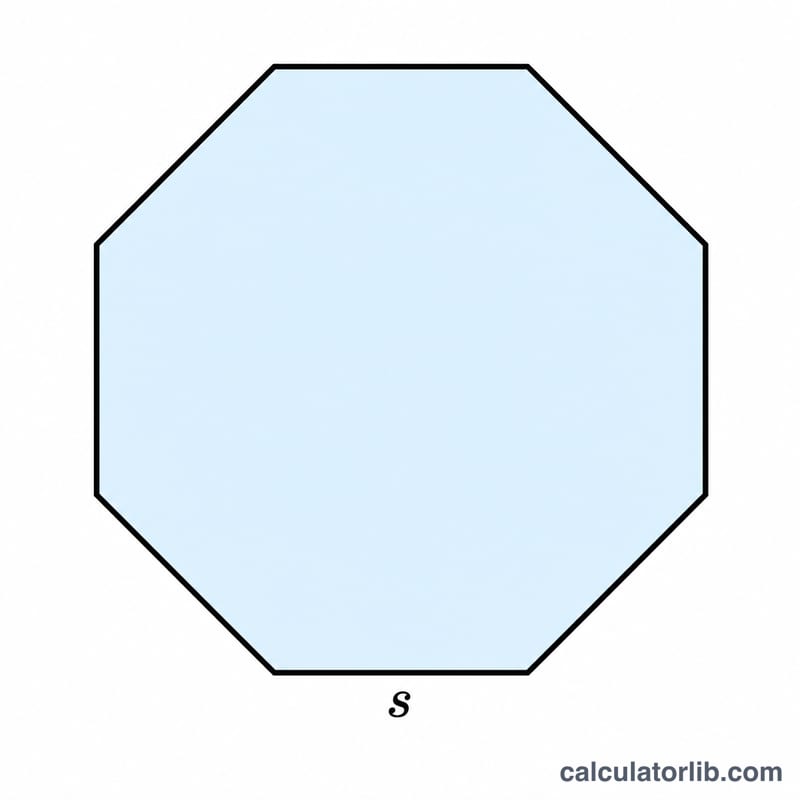
This calculator finds the area of a regular octagon — an eight-sided polygon where every side and every interior angle is equal — using only the length of one side. Regular octagons appear everywhere, from stop signs and umbrellas to floor tiles and architectural design, so quickly knowing the enclosed area is useful for crafts, construction, and geometry homework.
How to use it
Enter the length of one side (s) in whatever unit you like — centimetres, inches, metres, feet. Press calculate and the tool returns the area in those units squared, along with the perimeter. Because the formula is purely geometric it works for any unit and any positive side length.
The formula explained
The area of a regular octagon is:
$$A = 2\left(1 + \sqrt{2}\right)\cdot s^{2}$$
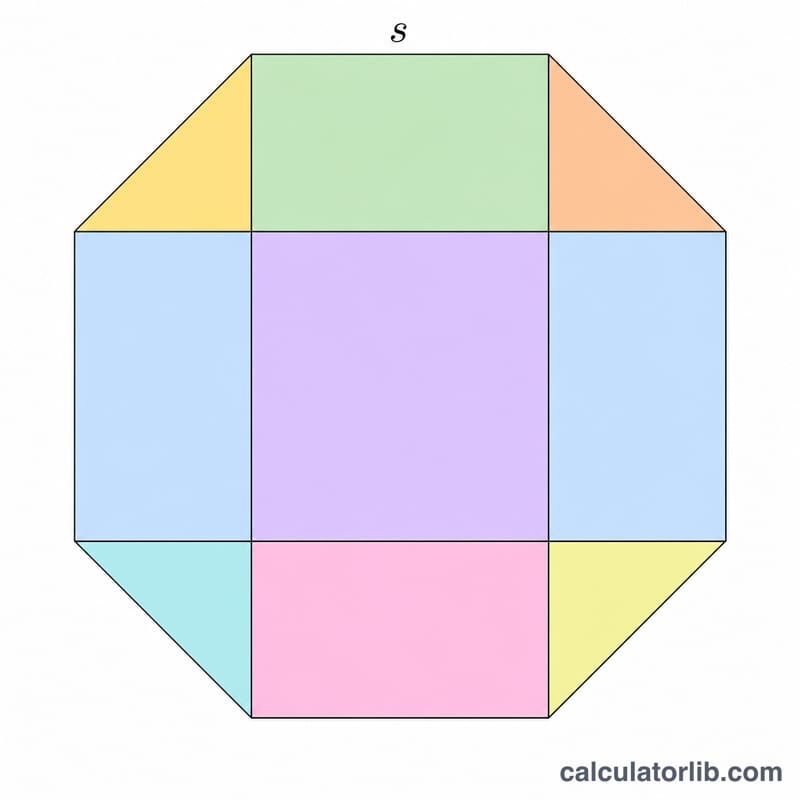
The constant \(2(1 + \sqrt{2})\) is approximately \(4.8284\). A regular octagon can be split into a central square plus four rectangles and four corner triangles; summing those pieces yields this compact expression. The perimeter is simply \(P = 8s\) since all eight sides are equal.
Worked example
Suppose each side measures 5 units. Then \(s^{2} = 25\), and $$A = 2(1 + 1.41421) \times 25 = 4.82843 \times 25 \approx 120.71 \text{ square units}$$ The perimeter is \(8 \times 5 = 40\) units.
Octagon Area for Common Side Lengths
The area of a regular octagon is found directly from its side length \(s\) using the formula \(A = 2\left(1 + \sqrt{2}\right)s^{2}\), where the constant \(2(1+\sqrt{2}) \approx 4.828427\). The perimeter is simply \(P = 8s\). The table below lists both quantities for a range of common side lengths, rounded to two decimal places. Values use consistent units — if \(s\) is in centimetres, the area is in square centimetres.
| Side \(s\) | Perimeter \(8s\) | Area \(2(1+\sqrt{2})s^{2}\) |
|---|---|---|
| 1 | 8 | 4.83 |
| 2 | 16 | 19.31 |
| 5 | 40 | 120.71 |
| 10 | 80 | 482.84 |
| 20 | 160 | 1931.37 |
| 50 | 400 | 12071.07 |
| 100 | 800 | 48284.27 |
Because area scales with the square of the side, doubling the side length multiplies the area by four — for example, going from \(s=10\) to \(s=20\) increases the area from 482.84 to 1931.37, a factor of four.
Octagon Dimension Conversions
A regular octagon can be described by several related measurements, each a fixed multiple of the side length \(s\). The width across flats \(W\) is the distance between two opposite parallel edges; the width across corners \(D\) (the circumscribed diameter) is the distance between two opposite vertices. These are given by:
$$W = s\left(1+\sqrt{2}\right), \qquad D = s\sqrt{4+2\sqrt{2}}, \qquad P = 8s$$| Quantity | Formula | Factor × \(s\) |
|---|---|---|
| Perimeter \(P\) | \(8s\) | 8 |
| Width across flats \(W\) | \(s(1+\sqrt{2})\) | 2.414214 |
| Width across corners \(D\) | \(s\sqrt{4+2\sqrt{2}}\) | 2.613126 |
| Area \(A\) | \(2(1+\sqrt{2})s^{2}\) | 4.828427 (× \(s^{2}\)) |
To convert in the other direction, divide by the factor. For instance, if you know the width across flats, the side length is \(s = W / (1+\sqrt{2}) \approx 0.414214\,W\); if you know the diameter across corners, \(s = D / \sqrt{4+2\sqrt{2}} \approx 0.382683\,D\). Once \(s\) is recovered, the area follows from \(A = 2(1+\sqrt{2})s^{2}\). As an example, a stop-sign-shaped octagon with side \(s = 30\,\text{cm}\) has a width across flats of \(72.43\,\text{cm}\), a width across corners of \(78.39\,\text{cm}\), and an area of 4345.58 cm².
FAQ
Does this work for irregular octagons? No. The formula assumes a regular octagon with all sides and angles equal. Irregular octagons must be divided into triangles and summed individually.
What units does it use? Any consistent unit — the area comes out in the square of whatever unit you enter for the side.
How do I find area from the width across flats? The width across flats W relates to the side by \(W = s(1 + \sqrt{2})\), so \(s = W / (1 + \sqrt{2})\). Convert first, then enter the side.