

What is the Arithmetic Series Sum Calculator?
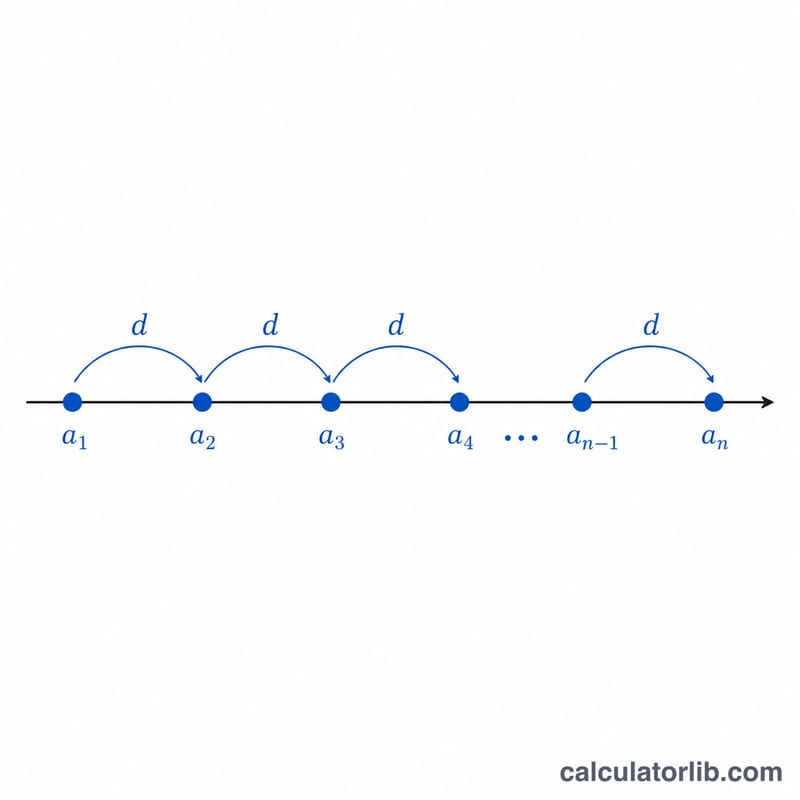
An arithmetic series is the sum of the terms of an arithmetic sequence — a list of numbers where each term increases (or decreases) by the same fixed amount, called the common difference. This calculator adds up the first n terms of such a series given the first term, the common difference, and how many terms you want to include.
How to use it
Enter the first term a₁, the common difference d (positive for increasing, negative for decreasing), and the number of terms n. The calculator returns the total sum Sₙ, the last term aₙ, and confirms the term count.
The formula explained
The sum is found with:
$$S_n = \frac{n}{2}\left(2a_1 + (n - 1)d\right)$$
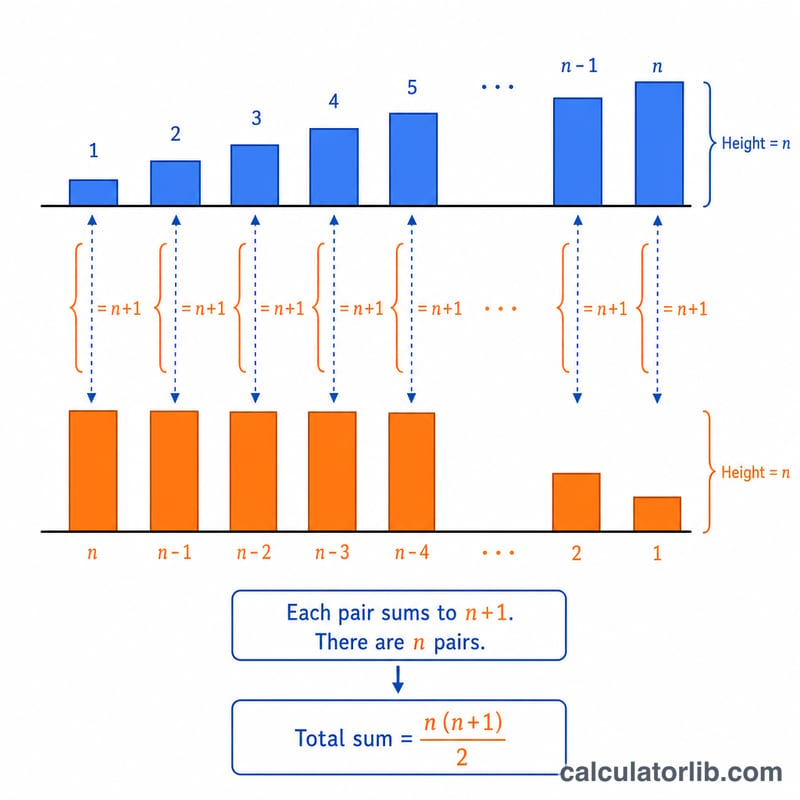
The idea behind it: pairing the first and last terms always gives the same total, and there are \(n/2\) such pairs. The last term is \(a_n = a_1 + (n - 1)d\), so an equivalent form is $$S_n = \frac{n}{2}\left(a_1 + a_n\right).$$
Worked example
Suppose \(a_1 = 2\), \(d = 3\), and \(n = 5\). The terms are 2, 5, 8, 11, 14. Using the formula: $$S_n = \frac{5}{2}\left(2\cdot 2 + (5-1)\cdot 3\right) = 2.5 \cdot (4 + 12) = 2.5 \cdot 16 = \mathbf{40}.$$ Adding directly: \(2 + 5 + 8 + 11 + 14 = 40\). ✔
More Worked Examples
The two equivalent forms of the arithmetic series sum are:
$$S_n = \frac{n}{2}\bigl(2a_1 + (n-1)d\bigr) \qquad\text{and}\qquad S_n = \frac{n}{2}\bigl(a_1 + a_n\bigr)$$The second form is convenient when you already know (or first compute) the last term \(a_n = a_1 + (n-1)d\).
Example 1 — Decreasing series with negative d
A series starts at \(a_1 = 40\), decreases by \(d = -3\) each step, and has \(n = 10\) terms.
$$S_{10} = \frac{10}{2}\bigl(2(40) + (10-1)(-3)\bigr)$$$$= 5\bigl(80 + 9(-3)\bigr) = 5(80 - 27) = 5(53) = \;$$The sum is 265. (The 10th term is \(a_{10} = 40 + 9(-3) = 13\), so the terms run 40, 37, 34, … , 13.)
Example 2 — Large-n case
Sum the first \(n = 100\) terms of the series with \(a_1 = 5\) and \(d = 4\).
$$S_{100} = \frac{100}{2}\bigl(2(5) + (100-1)(4)\bigr)$$$$= 50\bigl(10 + 99(4)\bigr) = 50(10 + 396) = 50(406) = \;$$The sum is 20300.
Example 3 — Using the \(S_n = \frac{n}{2}(a_1 + a_n)\) form
A series has \(a_1 = 7\), \(d = 5\), and \(n = 20\). First find the last term:
$$a_{20} = a_1 + (n-1)d = 7 + (20-1)(5) = 7 + 95 = 102$$Then apply the average-of-endpoints form:
$$S_{20} = \frac{20}{2}\bigl(a_1 + a_{20}\bigr) = 10(7 + 102) = 10(109) = \;$$The sum is 1090. This matches the expanded form \(\frac{20}{2}(2\cdot7 + 19\cdot5) = 10(14 + 95) = 1090\).
FAQ
What if d is 0? Every term equals \(a_1\), so the sum is simply \(n \times a_1\).
Can d be negative? Yes. A negative common difference produces a decreasing series, and the formula still works correctly.
What is the difference between a sequence and a series? A sequence is the ordered list of numbers; a series is the sum of those numbers.