
What Is the Bond Yield Calculator?
This calculator finds the current yield of a bond — the annual income it produces relative to its current market price. Current yield is one of the simplest and most widely used measures of a bond's return, helping investors compare bonds trading at different prices. It applies universally to any fixed-coupon bond regardless of country.
How to Use It
Enter three values: the bond's face value (par value, often 1,000), the coupon rate as an annual percentage, and the current bond price at which it trades in the market. The calculator multiplies face value by the coupon rate to find the annual coupon payment, then divides that by the price to express the yield as a percentage.
The Formula Explained
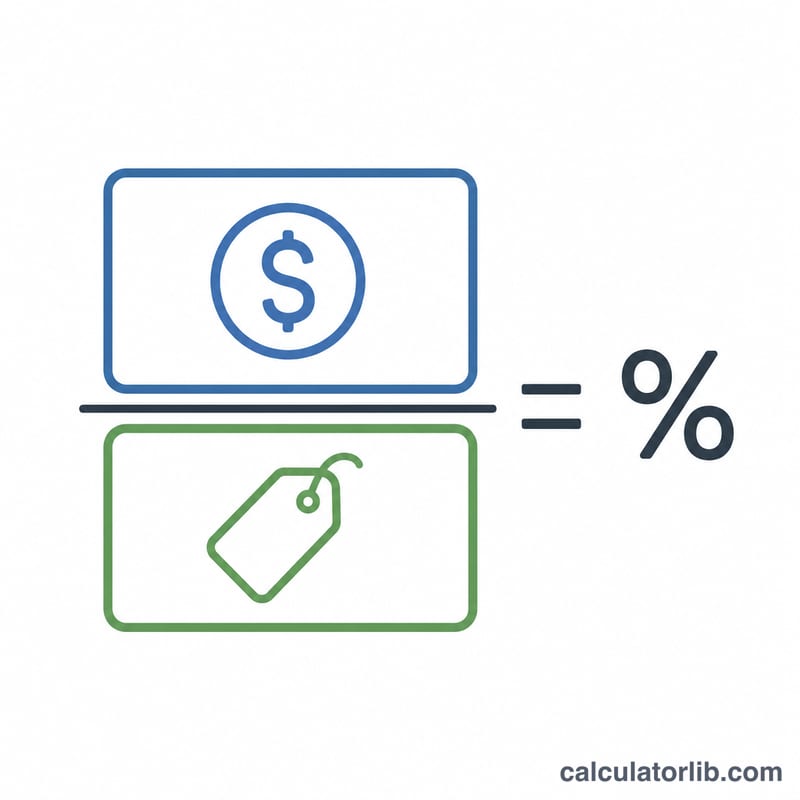
$$\text{Current Yield} = \frac{\text{Face Value} \times \dfrac{\text{Coupon Rate (\%)}}{100}}{\text{Bond Price}} \times 100$$ The annual coupon payment equals \(\text{Face Value} \times \dfrac{\text{Coupon Rate}}{100}\). When a bond trades below par, its current yield rises above the coupon rate; when it trades above par, the current yield falls below the coupon rate.
Worked Example
Consider a bond with a face value of 1,000, a coupon rate of 5%, and a market price of 950. The annual coupon payment is $$1{,}000 \times 5\% = 50.$$ The current yield is $$\frac{50}{950} \times 100 = 5.26\%.$$ Because the bond is priced below par, its yield (5.26%) exceeds the 5% coupon rate.
Current Yield Across Price Scenarios
The table below holds the face value at $1,000 and the coupon rate at 5% (an annual coupon of $50) while the market price changes. Current yield is calculated as the annual coupon dollars divided by the current market price:
$$\text{Current Yield} = \frac{\text{Face Value} \times \dfrac{\text{Coupon Rate}}{100}}{\text{Bond Price}} \times 100$$| Bond Price | Annual Coupon | Current Yield | Status |
|---|---|---|---|
| $850 | $50 | 5.88% | Discount (yield > coupon) |
| $950 | $50 | 5.26% | Discount (yield > coupon) |
| $1,000 | $50 | 5.00% | At par (yield = coupon) |
| $1,050 | $50 | 4.76% | Premium (yield < coupon) |
| $1,150 | $50 | 4.35% | Premium (yield < coupon) |
As the price falls below face value the current yield rises above the 5% coupon rate; as the price climbs above face value the yield drops below the coupon rate. At a price equal to face value, current yield exactly equals the coupon rate.
Interpreting Your Current Yield
Current yield expresses the bond's annual coupon income as a percentage of the price you actually pay. Comparing it to the stated coupon rate tells you the relationship between price and face value:
- Yield above the coupon rate — the bond is trading at a discount (its price is below face value). Because you pay less than $1,000 to receive the same $50 coupon, your income return is higher than the coupon rate.
- Yield below the coupon rate — the bond is trading at a premium (its price is above face value). You pay more than face value for the same coupon, so the income return is lower than the coupon rate.
- Yield equal to the coupon rate — the bond is trading at par (price equals face value).
An important limitation: current yield measures the income return only. It captures the coupon relative to price at a single point in time, but it ignores the capital gain or loss you would realize if you hold the bond to maturity (when it redeems at face value), and it ignores the reinvestment of coupons over time. A bond bought at a discount has an additional gain at maturity, while a premium bond has a loss — neither is reflected in current yield.
For a measure that combines coupon income with the price difference amortized to maturity, use yield to maturity (YTM). Current yield is best used as a quick income comparison, not as a complete total-return figure. This information is educational and not investment advice.
Key Bond Terms
- Face value (par value)
- The principal amount printed on the bond that the issuer repays at maturity, commonly $1,000. Coupon payments are calculated from this value.
- Coupon rate
- The fixed annual interest rate stated on the bond, expressed as a percentage of face value. A 5% coupon on a $1,000 bond pays $50 per year.
- Coupon payment
- The actual cash interest paid to the bondholder, equal to face value × coupon rate (then divided by the number of payments per year if paid more than annually).
- Bond price (market price)
- The current price at which the bond trades in the market. It can be above, below, or equal to face value and is the denominator in the current yield calculation.
- Current yield
- The annual coupon income divided by the current market price, expressed as a percentage. It measures income return relative to what you pay today.
- Yield to maturity (YTM)
- The total annualized return earned if the bond is held to maturity, accounting for coupon income, the purchase price, and the face value repaid at maturity.
- Trading at a discount
- When a bond's market price is below its face value. Its current yield is higher than its coupon rate.
- Trading at a premium
- When a bond's market price is above its face value. Its current yield is lower than its coupon rate.
FAQ
Is current yield the same as yield to maturity (YTM)? No. Current yield ignores capital gains or losses at maturity and reinvestment, while YTM accounts for them. Current yield is a quick snapshot of income return.
Why does yield rise when price falls? The coupon payment is fixed, so paying less for the same income stream means a higher percentage return.
What face value should I use? Most corporate and government bonds use a face value of 1,000, but use whatever par value applies to your specific bond.