

What is the binomial probability?
The binomial probability gives the chance of obtaining exactly k successes in a fixed number of n independent trials, where each trial succeeds with the same probability p. It applies to any "yes/no" experiment repeated under identical conditions — coin flips, free-throw attempts, defective items on a production line, or survey responses.
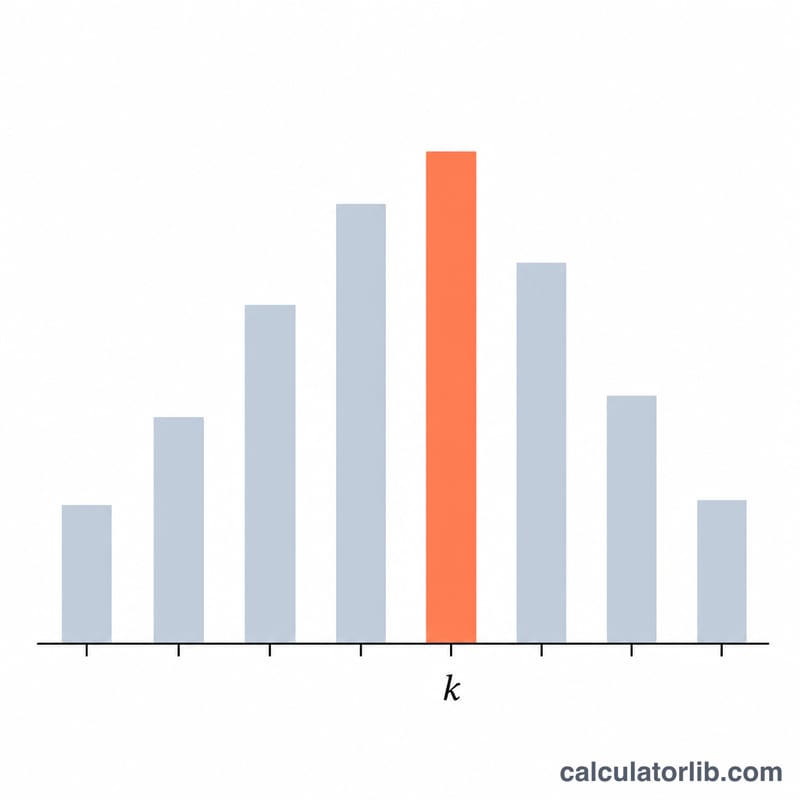
How to use this calculator
Enter the number of trials (n), the number of successes you want the probability for (k), and the per-trial success probability (p) as a decimal between 0 and 1. The calculator returns the exact probability \(P(X=k)\), the same value as a percentage, and the binomial coefficient \(C(n,k)\) used in the computation.
The formula explained
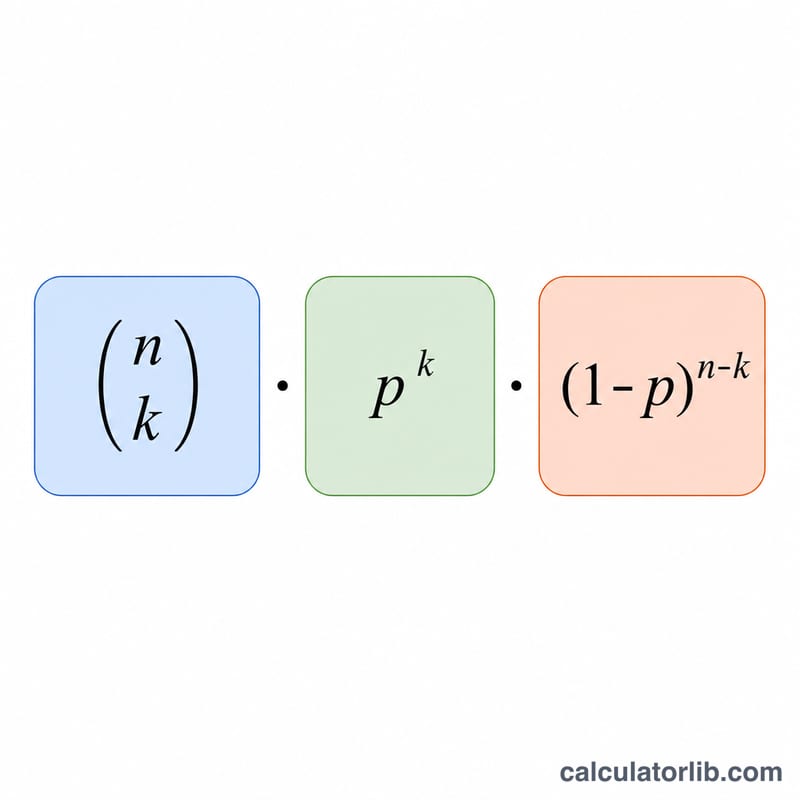
The formula $$P(X=k) = \binom{n}{k} \, p^{k} \left(1 - p\right)^{n - k}$$ has three parts. \(C(n,k)\) counts how many distinct arrangements of k successes among n trials are possible. The term \(p^{k}\) is the probability of those k successes occurring, and \((1-p)^{n-k}\) is the probability that the remaining n−k trials all fail. Multiplying them yields the total probability for that exact count.
Worked example
Flip a fair coin 10 times (n=10, p=0.5). What is the probability of exactly 4 heads (k=4)? \(C(10,4) = 210\), so $$P = 210 \times 0.5^{4} \times 0.5^{6} = 210 \times 0.5^{10} = \frac{210}{1024} \approx 0.2051$$ or about 20.51%.
How to Calculate Binomial Probability by Hand
Follow these steps to evaluate \(P(X=k) = \binom{n}{k}\,p^{k}\,(1-p)^{n-k}\) for any valid inputs.
- Verify \(k \le n\). The number of successes \(k\) cannot exceed the number of trials \(n\), and both must be non-negative integers. If \(k > n\), the probability is 0. Also confirm \(0 \le p \le 1\).
- Compute the binomial coefficient \(\binom{n}{k}\). Use \(\binom{n}{k} = \dfrac{n!}{k!\,(n-k)!}\). This counts the number of distinct ways to arrange \(k\) successes among \(n\) trials.
- Raise \(p\) to the power \(k\). Compute \(p^{k}\), the probability of \(k\) specific successes occurring.
- Raise \((1-p)\) to the power \(n-k\). Compute \((1-p)^{n-k}\), the probability of the remaining \(n-k\) trials all being failures. Recall \(q = 1-p\).
- Multiply all three factors. \(P(X=k) = \binom{n}{k} \times p^{k} \times (1-p)^{n-k}\). The result is a probability between 0 and 1.
- Convert to a percentage (optional). Multiply the probability by 100 to express it as a percent, e.g. \(0.31146 \times 100 = 31.15\%\).
Worked check: for \(n=5,\,k=3,\,p=0.5\): \(\binom{5}{3}=10\), \(0.5^{3}=0.125\), \(0.5^{2}=0.25\), so \(P = 10 \times 0.125 \times 0.25 = \) 0.3125 (31.25%).
Key Terms and Variables
| Symbol | Name | Meaning |
|---|---|---|
| \(n\) | Number of trials | The fixed total number of independent experiments or attempts. |
| \(k\) | Number of successes | The exact count of successful outcomes whose probability you want; must satisfy \(0 \le k \le n\). |
| \(p\) | Success probability | The probability that any single trial is a success; \(0 \le p \le 1\). |
| \(q\) | Failure probability | The probability of failure on a single trial, \(q = 1 - p\). |
| \(\binom{n}{k}\) | Binomial coefficient | The number of ways to choose \(k\) successes from \(n\) trials, \(\binom{n}{k} = \dfrac{n!}{k!\,(n-k)!}\); read "n choose k." |
The Four Binomial Assumptions
The binomial model is valid only when all four conditions hold:
- Fixed number of trials. The value of \(n\) is set in advance and does not change.
- Two possible outcomes. Each trial results in exactly one of two outcomes, conventionally labeled "success" and "failure."
- Constant probability. The success probability \(p\) is the same on every trial.
- Independent trials. The outcome of any one trial does not affect the outcome of any other trial.
When these hold, the count of successes \(X\) follows a binomial distribution, written \(X \sim \text{B}(n, p)\).
FAQ
Do I need p as a decimal or percent? Use a decimal: a 25% chance is entered as 0.25.
What if k is greater than n? That is impossible — you cannot have more successes than trials — so the probability is 0.
How do I find P(X ≤ k) or P(X ≥ k)? This tool gives the probability of an exact value. For cumulative probabilities, sum \(P(X=i)\) across the relevant range of i.