What this calculator does
This calculator estimates the Caf family quotient (quotient familial, QF) used by French town halls, schools and leisure services to set fees such as canteen meals or holiday centres. The QF expresses monthly household resources per Caf part. It is not the tax-office (impôts) quotient familial, which uses a different parts schedule. It suits parents who want to anticipate the bracket they will fall into before requesting an attestation.
How to use it
Fill in the fields in this order. Annual taxable resources: the household figure from your latest avis d'imposition. Social allowances: annual abattements sociaux, 0 if none. Monthly family benefits: prestations familiales received each month. Number of dependent children. Of which with a disability (it cannot exceed the number of children). Disability supplement rule: +0.5 part (national Cnaf) or +1 part (some local Cafs).
The formula
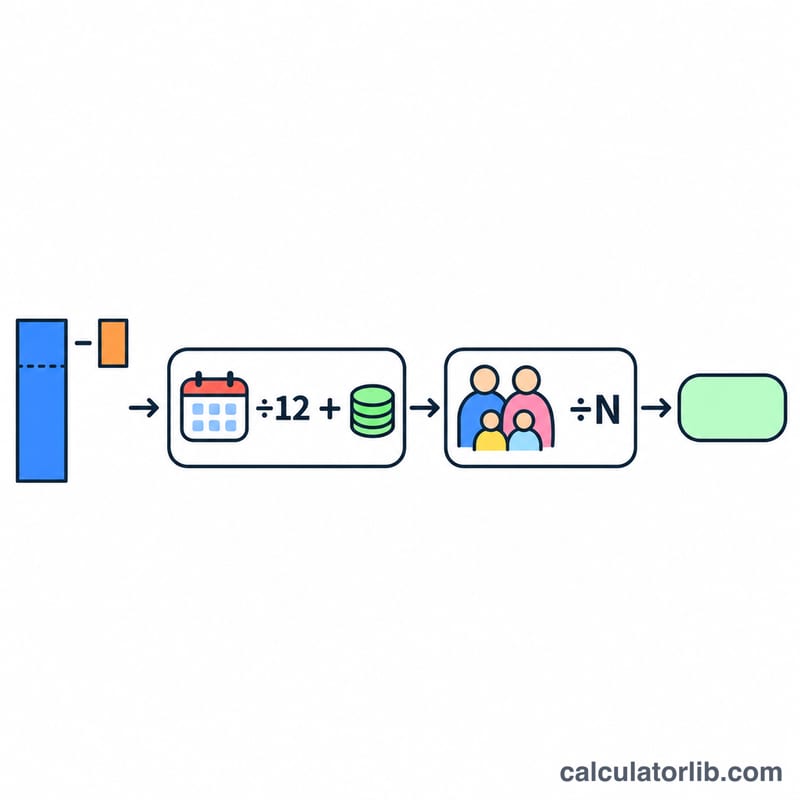
$$QF = \frac{\frac{R - A}{12} + P}{N}$$
\(R\) = annual taxable resources in euros, \(A\) = annual social allowances, \(P\) = monthly family benefits, \(N\) = total number of parts.
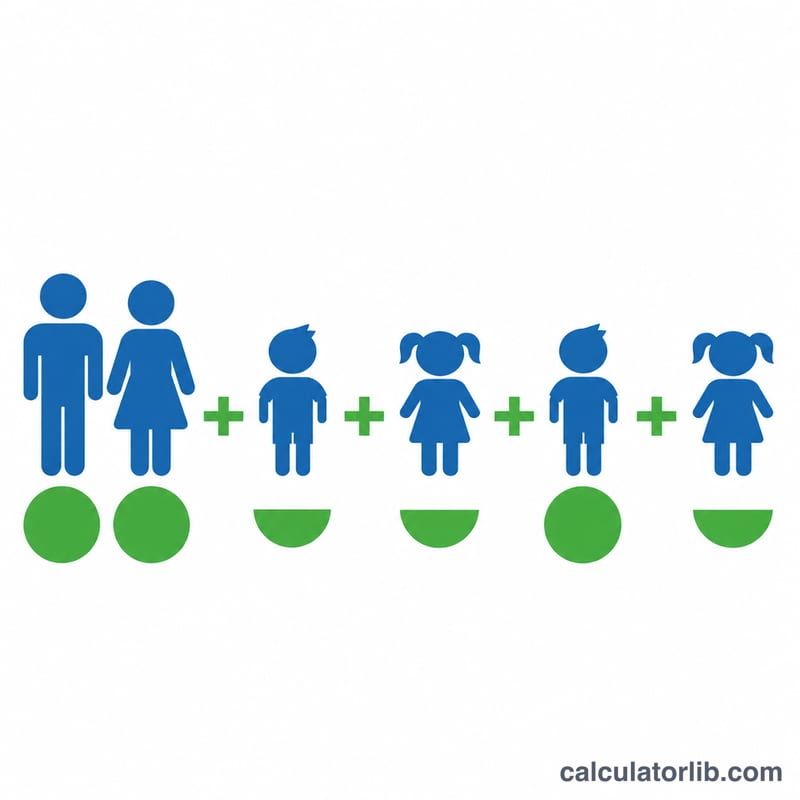
$$N = 2 + 0.5\min(k,2) + [k \ge 3] + 0.5\max(k-3,0) + s \times d$$
\(k\) = number of children, \(d\) = number of disabled children, \(s\) = 0.5 (national) or 1 (local variant). The bracket \([k \ge 3]\) equals 1 when there are three or more children, otherwise 0.
Conventions and assumptions
- Monthly benefits are added to monthly resources before dividing by the parts, following the national Cnaf description.
- The parents always count for 2 parts, whether a couple or a single person, so there is no household-type input.
- Children: 0.5 part for the 1st, 0.5 for the 2nd, 1 for the 3rd and 0.5 for each child from the 4th. The tax schedule gives 1 part from the 4th child instead.
- The disability supplement is added on top of the child rank part. The national base is 0.5 part; the Mayenne and Loire-Atlantique Caf pages show 1 part.
- Social allowances are entered by you as an annual amount and subtracted before dividing by 12. No source lists the amounts.
- The resource figure comes from your latest tax notice; no year logic is applied.
- Results are not rounded internally; display uses 2 decimals. Amounts are in euros.
Worked example
Household with annual taxable resources of 30,000 EUR, no allowances, 150 EUR of monthly benefits, 2 children, none with a disability, national rule.
$$\text{Child parts} = 0.5 \times 2 = 1,\quad N = 2 + 1 + 0 = 3$$
$$\frac{30000 - 0}{12} = 2500,\quad 2500 + 150 = 2650$$
$$QF = \frac{2650}{3} = 883.33\ \text{EUR/month}$$
Reading the result
The QF is a monthly amount per part. Local bodies compare it with their own brackets to set a rate. This is an estimate: the Caf calculates the official figure from its own file, and local Cafs may differ in details such as which benefits are counted (for example housing aid) or how the result is rounded. Use the attestation from your Caf account for formal procedures.
FAQ
Is the Caf QF the same as the tax quotient familial?
No. The Caf QF divides monthly resources by Caf parts. The tax quotient divides taxable income for the income tax calculation and uses a different parts schedule.
How many parts does a household with one child have?
2.5 parts: 2 for the parent or parents plus 0.5 for the first child. A couple and a single parent get the same parts.
Why does the third child count for more?
On the Caf schedule the third child adds 1 part, while the 4th and later children add 0.5 each.
Which disability rule should I choose?
The national Cnaf base is +0.5 part per disabled child. Choose +1 only if your local Caf states that rule.
What if allowances exceed resources?
The input is invalid: allowances cannot exceed annual taxable resources.
Sources
- Calculer mon quotient familial, Caf de la Mayenne, 2026
- Je calcule mon quotient familial, Caf de Loire-Atlantique, 2026
- Quotient familial : Caf, impôts, quelles différences ?, Caf / Cnaf (Vies de famille), 2025