What this calculator does
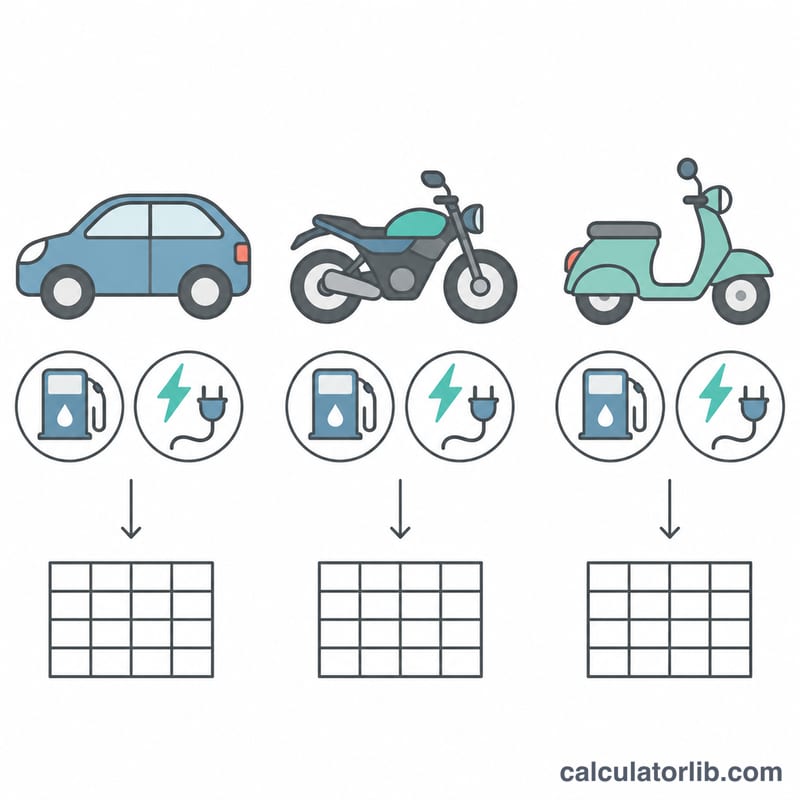
This calculator computes the French official kilometric allowance (barème kilométrique) for professional use of a personal vehicle, using the 2026 tables published by Urssaf. It covers cars, motorcycles and scooters over 50 cm³, and two-wheelers under 50 cm³, each with a thermal/hydrogen/hybrid table and a 100% electric table. It suits employees claiming frais réels, employers setting tax-exempt allowances, and self-employed people estimating deductible vehicle costs.
How to use it
Select the vehicle type, then the energy type. Enter the fiscal horsepower (CV) from field P.6 of the registration certificate; it is ignored for two-wheelers under 50 cm³. Enter the total professional distance for the year in km. Optionally enter justified tolls and parking in euros. The result shows the scale amount, the total including tolls and parking, the effective rate per km, the formula applied, the distance bracket and the power band.
The formula
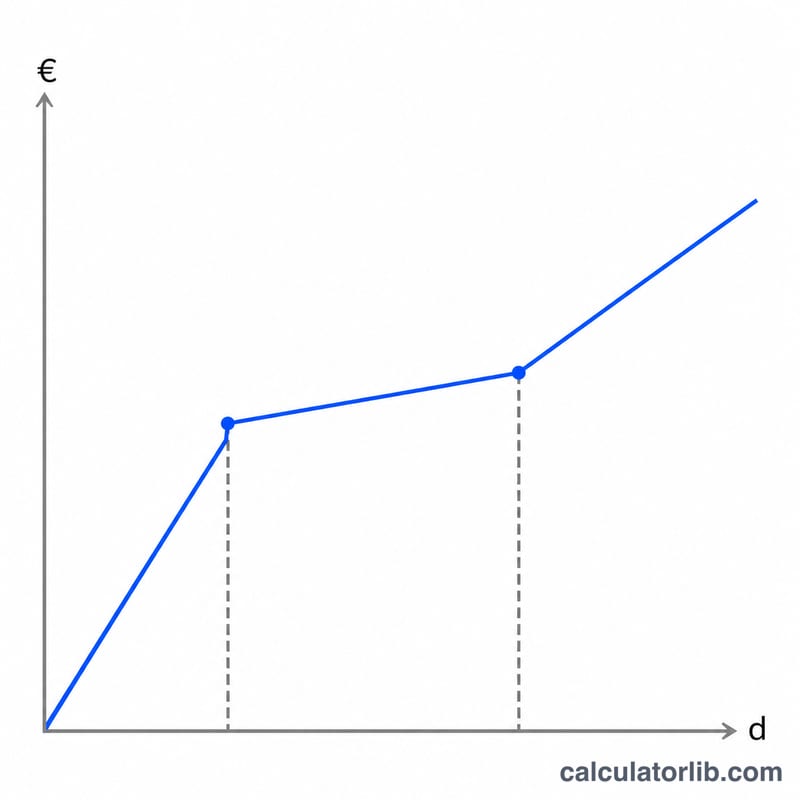
The whole annual distance falls into one bracket, and one of three formulas applies:
$$A = \begin{cases} d \times a & d \le L_1 \\ d \times b + c & L_1 < d \le L_2 \\ d \times e & d > L_2 \end{cases}$$\(A\) = allowance in EUR, \(d\) = annual professional distance in km, \(a, b, c, e\) = coefficients from the table for the vehicle, energy and power row. For cars \(L_1 = 5000\) and \(L_2 = 20000\); for two-wheelers \(L_1 = 3000\) and \(L_2 = 6000\). The total deductible is \(A + \text{tolls and parking}\), and the effective rate is \(A / d\).
Conventions and assumptions
- The 2026 scale is used as tabulated by Urssaf (page checked 24 April 2026).
- Electric vehicles use the dedicated 100% electric tables; no 20% uplift is computed, because the published coefficients are authoritative.
- Hybrid, plug-in hybrid and hydrogen vehicles use the thermal table.
- Three categories (car, motorcycle/scooter over 50 cm³, two-wheeler under 50 cm³), each thermal or electric, give six scales.
- Car rows: 3 CV or less, 4, 5, 6, and 7 CV or more. Motorcycle rows: 1-2, 3-5 and over 5 CV.
- The calculation is not marginal: the entire distance goes into a single bracket formula. The rule is not continuous at 20,000 km for cars, so it is applied literally.
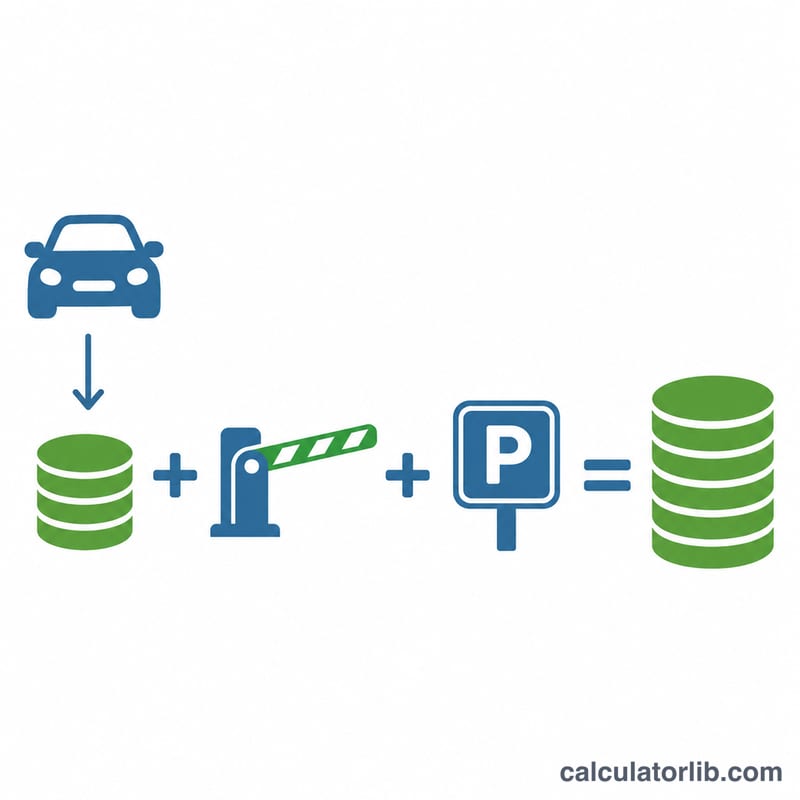
- Tolls and parking are added on top because the scale excludes them.
- The 40 km one-way home-work cap is not applied automatically; enter only the km you may claim.
- Values are unrounded internally and shown to 2 decimals in EUR.
Worked example
A car, thermal, 5 CV, 10,000 km a year, no tolls. The distance is between 5,000 and 20,000 km, so bracket 2 applies with the formula (d x 0.357) + 1395.
$$A = 10000 \times 0.357 + 1395 = 4965\,\text{EUR}$$$$\text{Total} = 4965 + 0 = 4965\,\text{EUR}$$$$\text{Rate} = \frac{4965}{10000} = 0.4965\,\text{EUR/km}$$The allowance is 4,965 EUR, the total deductible is 4,965 EUR, and the effective rate is 0.4965 EUR/km (shown as 0.497).
Reading the result and limitations
The scale amount covers depreciation, tyres, maintenance, fuel and insurance, so these should not be deducted again. Deductible loan interest is not modelled. The tax form may expect different rounding. This is an estimate, not tax advice; check eligibility of the claimed distance with the tax administration.
FAQ
Do hybrids use the electric scale?
No. Hybrid, plug-in hybrid and hydrogen vehicles use the thermal table. Only 100% electric vehicles use the electric table.
Are tolls and parking included?
No. They can be deducted in addition when justified, so enter them separately.
Why is fiscal power ignored for small two-wheelers?
The table for two-wheelers under 50 cm³ depends only on distance.
Is the calculation marginal by bracket?
No. The total annual distance is put into one formula according to its bracket.
What about long home-work trips?
Home-work distance normally counts for 40 km one-way at most unless justified. Enter the eligible km yourself.
Sources
- Indemnités kilométriques, Urssaf, 2026
- Frais de transport, DGFiP (impots.gouv.fr), 2026