
What this calculator does
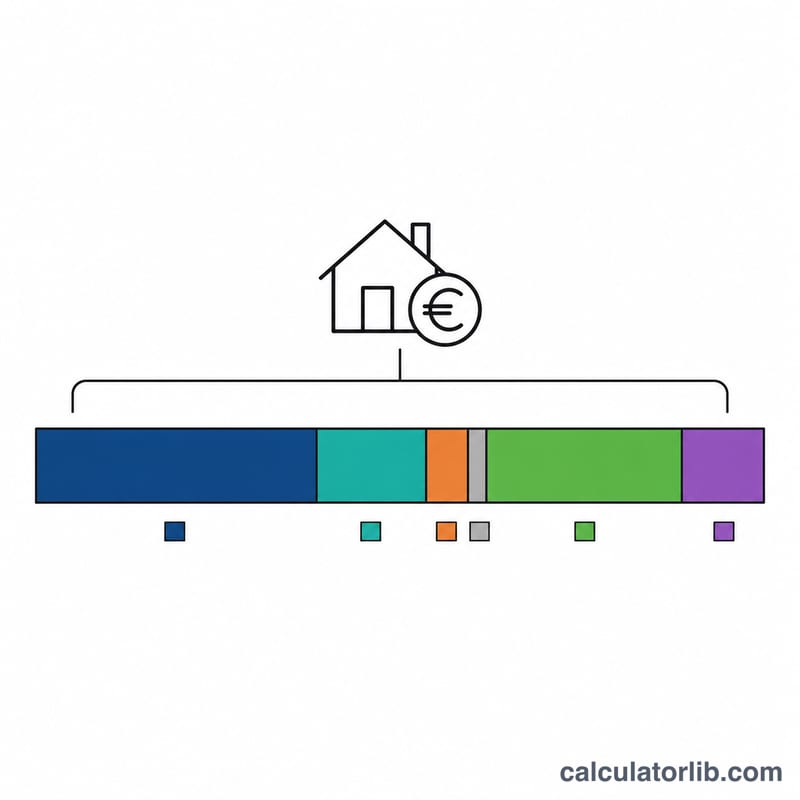
The calculator estimates the purchase costs commonly called frais de notaire on a property purchase in France. Most of this amount is not the notary's pay: it is mainly transfer duties (droits de mutation à titre onéreux, DMTO) collected for the State and local authorities. The tool adds the contribution de sécurité immobilière (CSI), then your own estimates of notary emoluments and disbursements. It suits buyers comparing budgets for existing or new property.
How to use it
Enter the following in order:
- Purchase price: the price in the deed, in EUR. For new property bought from a developer, enter the price including VAT.
- Property type: existing (ancien), new bought from an individual, or new bought from a professional.
- Departmental duty rate: 4.50% (the most common rate), 5.00%, or another rate. The 5.00% option is offered for information: no source used here confirms it or its dates, so check with your notary which rate applies in your département before relying on it.
- Other departmental rate: used only when the other-rate option is chosen, between 1.20% and 5.00%.
- Notary emoluments: your notary's estimate including VAT. Enter 0 to exclude.
- Disbursements: sums paid on your behalf (débours). Enter 0 to exclude.
Formula
For existing property or new property bought from an individual:
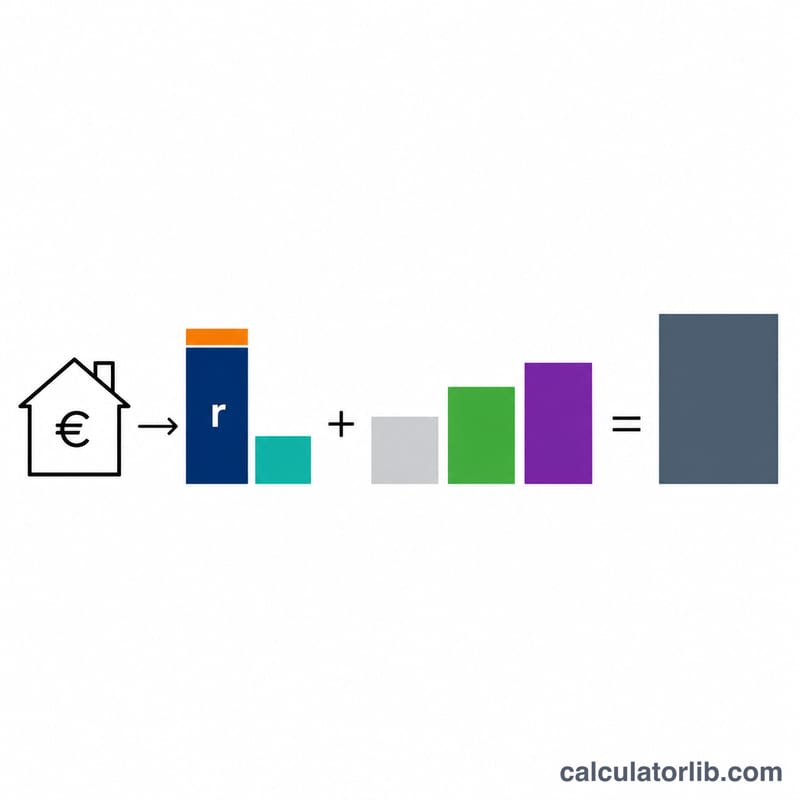
$$DMTO = P\,r + 0.012\,P + 0.0237\,(P\,r)$$
For new property bought from a professional:
$$DMTO = 0.0071\,P$$
Then:
$$CSI = 0.001\,P \qquad T = DMTO + CSI + E + D$$
\(P\) = purchase price in EUR; \(r\) = departmental rate as a decimal; \(E\) = notary emoluments; \(D\) = disbursements; \(T\) = estimated total fees. At \(r = 4.50\%\) the combined duty rate is 5.80665%, about 5.81%.
Conventions and assumptions
- Scope: metropolitan and overseas France, following the impots.gouv.fr guidance for existing and new property. Amounts are in EUR.
- Existing property: departmental duty, 1.20% communal surtax, and a State collection fee of 2.37% of the departmental duty. Treatment is the same whether the seller is an individual or a professional.
- New property (under 5 years old, or renovated back to new condition) bought from an individual: the same three components, no VAT.
- New property bought from a professional: a single reduced duty of 0.71% of the price. VAT is assumed to be included in the price you enter and is not added. VAT itself is a cost within that price (20%, or 5.5% under conditions, per the tax administration).
- CSI is 0.10% of the price for all types. No minimum amount is applied.
- Emoluments and disbursements are used exactly as entered; the regulated fee brackets are not modelled.
- The departmental rate selection is ignored for new property bought from a professional.
- Amounts are not rounded during calculation; display is to 2 decimals. Number entry follows the platform money parsing rules.
- The 7.5% flat acquisition-cost allowance for a later capital gain is shown for information only and is not part of the purchase cost.
Worked example
Existing property at \(P = 250{,}000\) EUR, rate 4.50%, emoluments 3,200 EUR and disbursements 1,200 EUR.
$$\text{Departmental duty} = 250000 \times 0.045 = 11250$$
$$\text{Communal surtax} = 250000 \times 0.012 = 3000$$
$$\text{Collection fee} = 11250 \times 0.0237 = 266.625$$
$$DMTO = 11250 + 3000 + 266.625 = 14516.625$$
$$CSI = 250000 \times 0.001 = 250$$
$$T = 14516.625 + 250 + 3200 + 1200 = 19166.625$$
The total is displayed as 19,166.63 EUR. The duty rate is 5.80665% and fees are 7.66665% of the price. Price plus fees is 269,166.625 EUR. The flat allowance is \(250000 \times 0.075 = 18750\) EUR.
Reading the result
The headline figure is an estimate of total upfront costs on top of the price. Most of it is fixed by the rates, while emoluments and disbursements depend on your file. For new property from a professional the duty is lower, but VAT is already inside the price, so compare total prices rather than duty alone. The tool does not model regulated emolument brackets, possible discounts, mortgage-related deed costs, agency fees, or any exemptions. Ask your notary for a written estimate before committing.
FAQ
Are frais de notaire the notary's salary?
No. Most of the amount is duties and taxes passed on to the State and local authorities. The notary's regulated emoluments are only one part.
Which departmental rate should I choose?
4.50% is the most common rate. Rates in the guidance range from 1.20% to 4.50%. If your notary tells you a different rate applies, such as 5.00%, use the other-rate option or the 5.00% option as instructed.
Does the duty on new property from a professional mean lower total cost?
Not necessarily. The reduced 0.71% duty replaces the usual duties, but the sale is subject to VAT, which is included in the price you enter. Compare total prices including all taxes.
What counts as new property?
A building less than 5 years old, or one renovated back to new condition. You choose the category yourself.
Why is the 7.5% allowance shown?
When computing a later capital gain, acquisition costs may be set at a flat 7.5% of the acquisition price. It is informational and not added to your costs.
Sources
- Achat dans l'ancien, DGFiP – impots.gouv.fr, modified 2016
- Achat dans le neuf, DGFiP – impots.gouv.fr, modified 2026
- BOI-RFPI-PVI-20-10-20-20 – Majoration du prix d'acquisition, Bulletin Officiel des Finances Publiques-Impôts, 2013