

What Is Gross Pay?
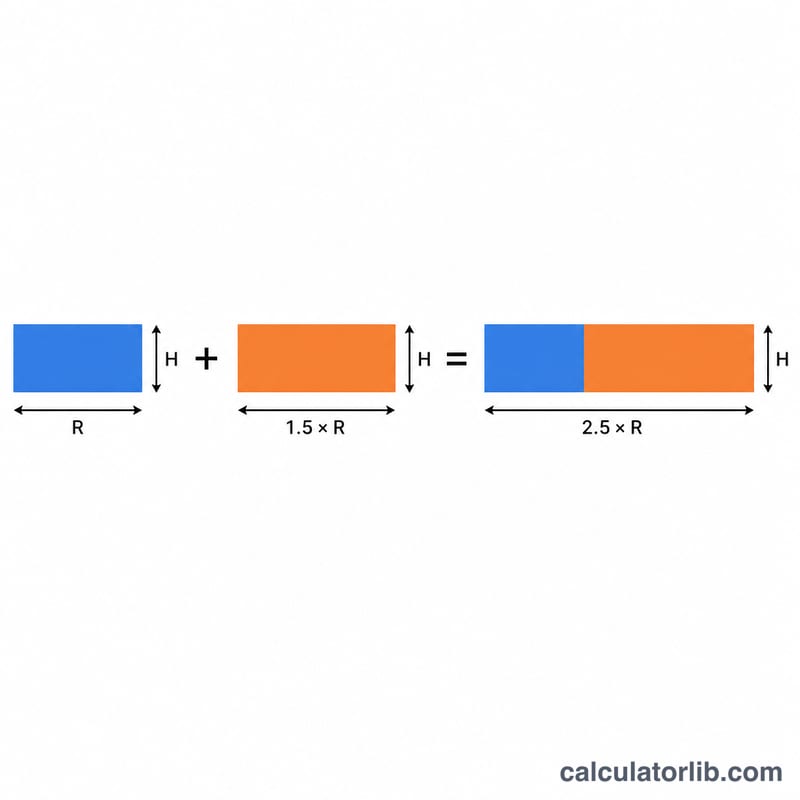
Gross pay is the total amount you earn in a pay period before any taxes, insurance, retirement contributions, or other deductions are taken out. For hourly workers, gross pay is built from two parts: regular pay for standard hours, and overtime pay for hours worked beyond the standard threshold. In many places overtime is paid at "time-and-a-half," meaning 1.5 times your normal hourly rate.
How to Use This Calculator
Enter your hourly rate, the number of regular (non-overtime) hours you worked, and the number of overtime hours. The calculator multiplies your regular hours by your rate, multiplies your overtime hours by 1.5 times your rate, and adds them together to show your total gross pay along with a breakdown.
The Formula Explained
The calculation uses: $$\text{Gross Pay} = (R \times H_{reg}) + (R \times 1.5 \times H_{ot})$$ The first term is straightforward straight-time earnings. The second term applies the 1.5 overtime multiplier so each overtime hour is worth one-and-a-half regular hours.
Worked Example
Suppose your hourly rate is $20, you work 40 regular hours, and 5 overtime hours. Regular pay = \(20 \times 40 = \$800\). Overtime pay = \(20 \times 1.5 \times 5 = \$150\). Gross pay = \(800 + 150 =\) $950.
FAQ
Does this include taxes? No. Gross pay is your earnings before deductions. Your net (take-home) pay will be lower after taxes and withholdings.
What overtime rate does it use? It assumes the common 1.5\(\times\) (time-and-a-half) rate. Some jobs use double time (2\(\times\)) for certain hours — adjust accordingly if that applies to you.
Can I enter partial hours? Yes, you can enter decimal values like 7.5 hours.