
What Is the Common Logarithm?
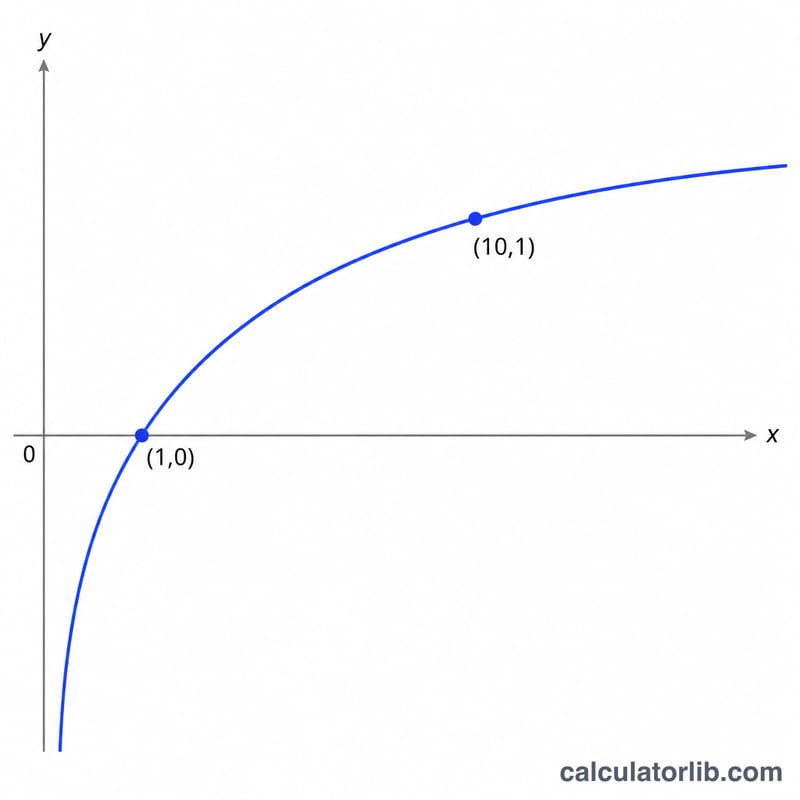
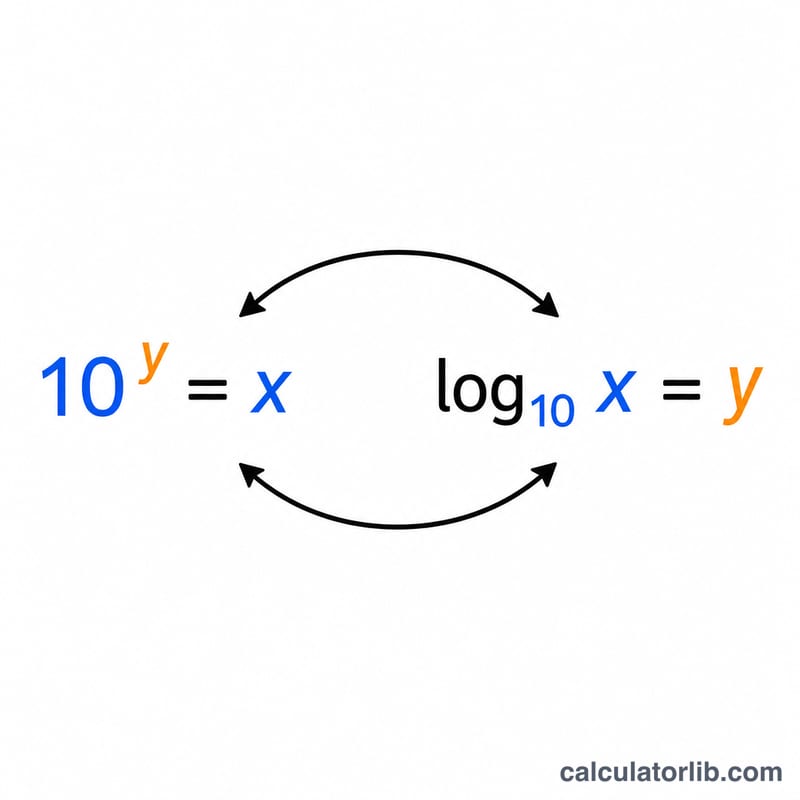
The common logarithm, written \(\log_{10}(x)\) or simply \(\log(x)\), is the base-10 logarithm of a number. It answers the question: "To what power must 10 be raised to produce x?" For example, \(\log_{10}(1000) = 3\) because \(10^3 = 1000\). Common logs appear throughout science and engineering — in the pH scale, decibels, the Richter scale, and orders of magnitude.
How to Use This Calculator
Enter any positive number in the field and the calculator returns its base-10 logarithm. For convenience it also shows the natural logarithm (ln, base e) and the base-2 logarithm. Logarithms are only defined for positive numbers, so x must be greater than zero.
The Formula Explained
The defining relationship is $$y = \log_{10}\left(\text{Number }(x)\right)$$ which is equivalent to \(10^y = x\). Because computers compute the natural log directly, this tool uses the change-of-base formula \(\log_{10}(x) = \ln(x) / \ln(10)\). The same idea gives \(\log_{2}(x) = \ln(x) / \ln(2)\).
Worked Example
Suppose \(x = 500\). Then $$\log_{10}(500) = \ln(500) / \ln(10) \approx 6.2146 / 2.3026 \approx 2.69897.$$ This means \(10^{2.69897} \approx 500\). Since 500 sits between 100 (\(10^2\)) and 1000 (\(10^3\)), the result falling between 2 and 3 confirms the answer.
FAQ
What is the difference between log and ln? "log" usually means base 10 (common log), while "ln" means base e \(\approx 2.71828\) (natural log).
Can I take the log of zero or a negative number? No. The logarithm is undefined for zero and negative numbers in real arithmetic, so this calculator requires a positive input.
What is \(\log_{10}(1)\)? It equals 0, because \(10^0 = 1\). The log of any base of 1 is always 0.