

What Is the Additional Medicare Tax?
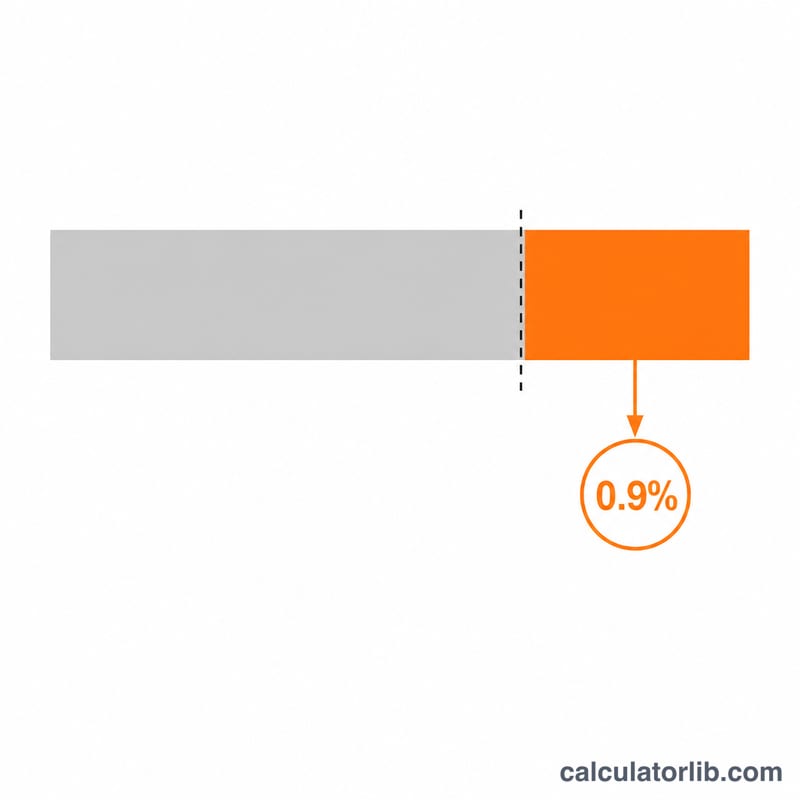
This calculator applies to the United States. The Additional Medicare Tax is a 0.9% tax introduced by the Affordable Care Act that applies to Medicare wages, Railroad Retirement (RRTA) compensation, and self-employment income above certain thresholds. It is paid by the employee or self-employed individual on top of the regular 1.45% Medicare tax. Note: thresholds are fixed by statute and are not indexed for inflation.
2023+ Filing Thresholds
The income threshold above which the 0.9% applies depends on your IRS filing status: Married Filing Jointly $250,000; Single, Head of Household, or Qualifying Widow(er) $200,000; Married Filing Separately $125,000. Enter your total Medicare wages (Box 5 of your W-2) and choose your status to see your estimated surtax.

How to Use This Calculator
1. Select your filing status. 2. Enter your total Medicare wages or net self-employment income. The tool subtracts the applicable threshold, applies the 0.9% rate to any excess, and shows the surtax owed.
The Formula
The math is straightforward: $$\text{Surtax} = 0.009 \times \max\!\left(0,\; \text{Wages} - \text{Threshold}\right)$$ The max(0, ...) ensures that if your income is at or below the threshold, no additional tax is owed.
Worked Example
A single filer earns $300,000 in Medicare wages. The threshold is $200,000, so the excess is $100,000. The surtax is $$\$100{,}000 \times 0.009 = \mathbf{\$900}$$
FAQ
Does my employer withhold this? Employers must withhold the 0.9% on wages over $200,000 regardless of filing status, so married couples or those with multiple jobs may owe more or less at tax time.
Are wages and self-employment income combined? Yes — for the threshold calculation, the IRS combines them, but wages are counted first. This tool gives a simplified single-income estimate.
Is this the same as the Net Investment Income Tax? No. The 3.8% NIIT is a separate tax on investment income; this 0.9% applies only to earned income.