
What is this calculator?
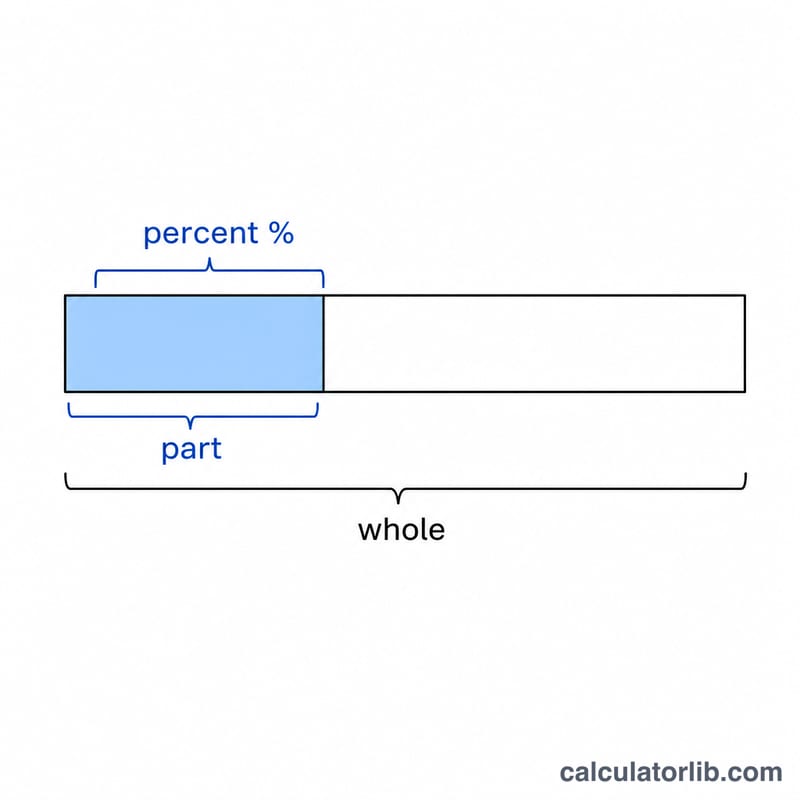
This tool answers the algebra question: "X is P% of what number?" When you know a part value and the percentage it represents, this calculator solves for the whole — the original 100% amount. It rearranges the basic percent equation to isolate the unknown total.
How to use it
Enter the part value (the known amount) and the percent it represents. The calculator instantly returns the whole. For example, if 25 is 20% of a number, the whole is 125.
The formula explained
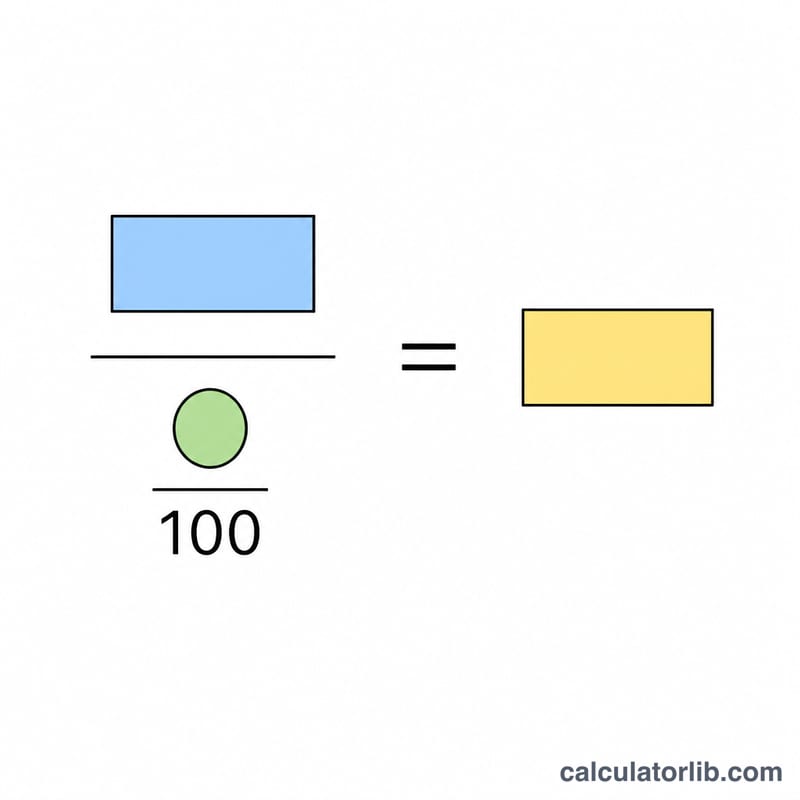
The core percent relationship is \(\text{part} = \text{whole} \times \dfrac{\text{percent}}{100}\). Solving for the whole gives $$\text{whole} = \frac{\text{part}}{\dfrac{\text{percent}}{100}}$$ Converting the percent to a decimal (dividing by 100) turns "percent of" into simple multiplication, so dividing reverses it to find the total.
Worked example
Suppose a deposit of $300 is 15% of a car price. Then $$\text{whole} = \frac{300}{15/100} = \frac{300}{0.15} = \$2{,}000.$$ The car costs $2,000.
FAQ
What if the percent is 0? Division by zero is undefined — a 0% part cannot tell you the whole, so the calculator returns 0 as a guard.
Can the percent be over 100? Yes. If the part is larger than 100% of the whole (e.g. 150%), the whole will be smaller than the part. For 60 at 150%, \(\text{whole} = 40\).
Is this the same as percentage increase? No. This finds the base total given a part and its share, not a change between two values.