
What This Calculator Does
A raise feels good — but if prices are rising just as fast, you may not be any better off. The Inflation-Adjusted Raise Calculator compares the pay raise you were offered against the inflation rate to reveal your real raise: the genuine change in your purchasing power. It also tells you exactly what raise you'd need just to break even.
How to Use It
Enter your current annual salary, the raise percentage you were offered, and the current (or expected) inflation rate. The calculator returns your real raise percentage, the break-even raise needed to keep pace with inflation, your new salary, and how that new salary stacks up against an inflation-adjusted break-even figure.
The Formula Explained
Because inflation compounds against your income, you can't just subtract the two percentages. The precise relationship is:
$$\text{Real Raise \%} = \left( \frac{1 + \dfrac{\text{Raise \%}}{100}}{1 + \dfrac{\text{Inflation \%}}{100}} - 1 \right) \times 100$$
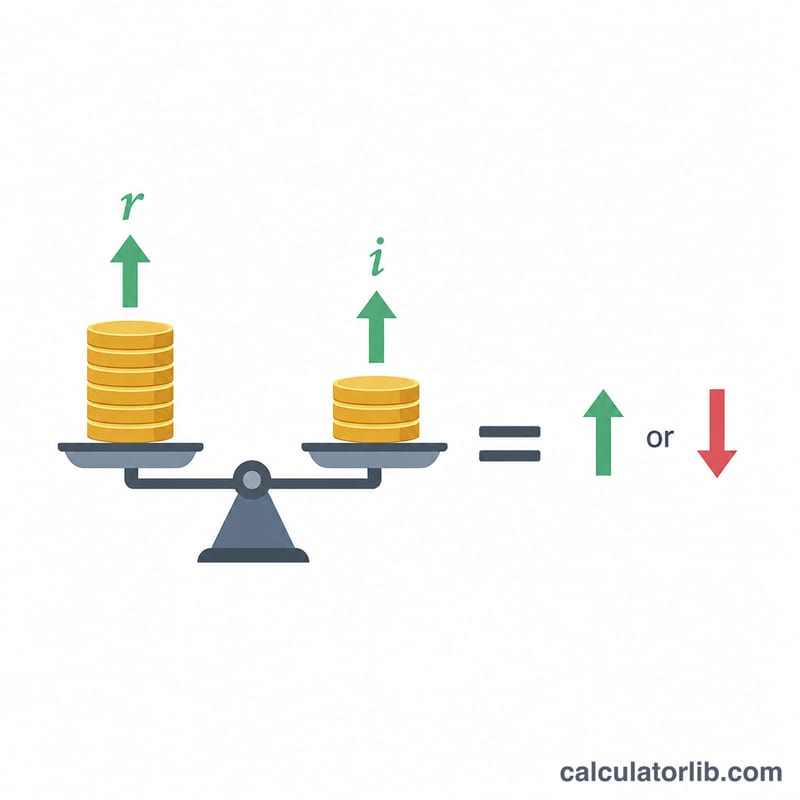
If the result is positive, your buying power grew. If it's negative, you effectively took a pay cut in real terms. To simply break even, your raise needs to equal the inflation rate.
Worked Example
Suppose you earn $60,000, are offered a 3% raise, and inflation is 4%. Your new salary is $61,800. The real raise is \(((1.03 \div 1.04) - 1) \times 100 \approx -0.96\%\) — a slight loss of purchasing power. To break even you'd need a 4% raise, which would lift your salary to $62,400, so you fall $600 short of standing still.
FAQ
Why isn't the real raise simply raise minus inflation? Subtraction is a close approximation at small rates, but the exact compounded formula is more accurate, especially when rates are high.
What inflation number should I use? Many people use the most recent annual CPI figure for their country, or their expected inflation over the year ahead.
What does a negative real raise mean? It means your raise didn't keep up with rising prices, so you can buy slightly less than before despite earning more nominal dollars.