
What Is the Hydraulic Diameter?
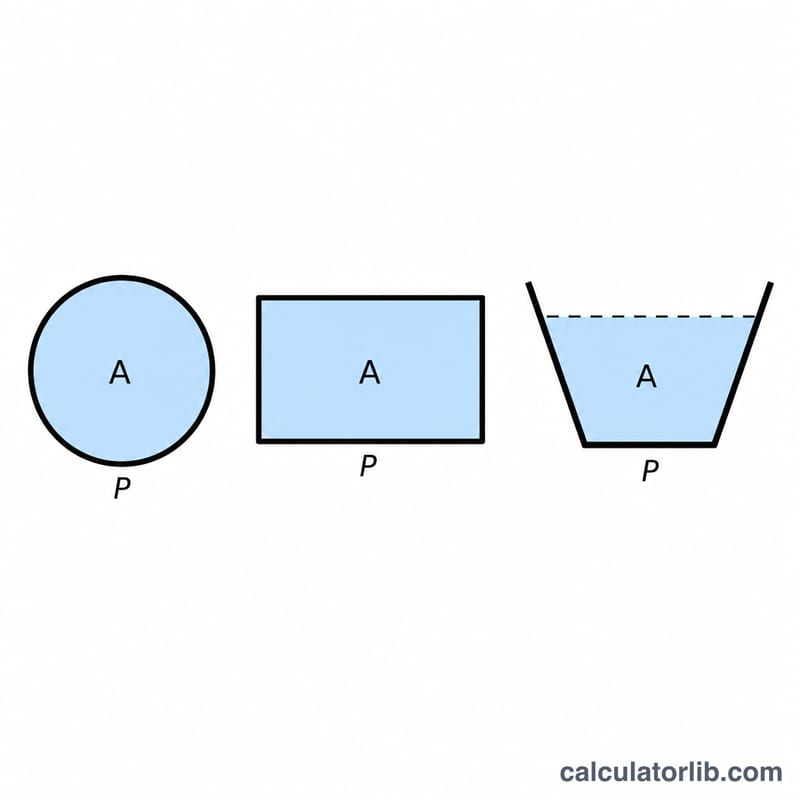
The hydraulic diameter (\(D_h\)) is an equivalent diameter used to analyze flow in non-circular conduits — rectangular ducts, open channels, annuli and partially filled pipes. It lets engineers apply circular-pipe correlations (such as the Reynolds number and Darcy friction factor) to any cross-section by reducing the geometry to a single length scale.
How to Use This Calculator
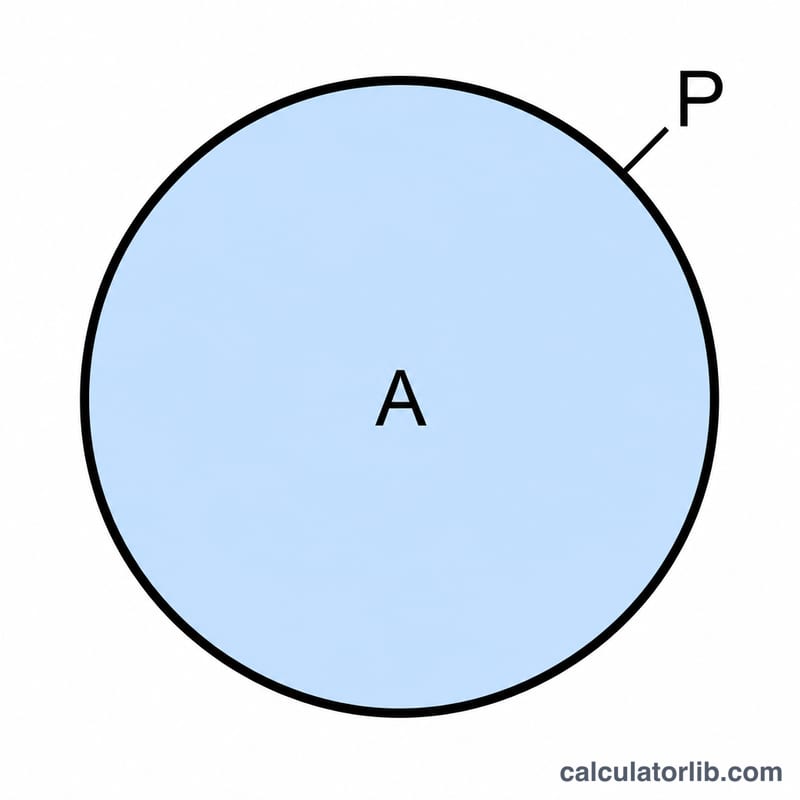
Enter the cross-sectional flow area A (the area actually occupied by fluid) in square meters, and the wetted perimeter P (the length of the cross-section boundary in contact with the fluid) in meters. The calculator returns the hydraulic diameter in meters. For a full circular pipe the result equals the actual pipe diameter.
The Formula Explained
The hydraulic diameter is defined as $$D_h = \frac{4 \cdot \text{Area } A}{\text{Wetted Perimeter } P}$$ The factor of 4 is chosen so that for a fully flowing circular pipe of diameter \(D\), where \(A = \pi D^2/4\) and \(P = \pi D\), the formula gives \(D_h = 4(\pi D^2/4)/(\pi D) = D\). Note that in an open channel the wetted perimeter excludes the free water surface, since that boundary has no wall friction.
Worked Example
Consider a rectangular channel 2 m wide carrying water 1 m deep. The flow area is \(A = 2 \times 1 = 2\ \text{m}^2\). The wetted perimeter is the bottom plus two sides: \(P = 2 + 1 + 1 = 4\ \text{m}\). Then $$D_h = \frac{4 \times 2}{4} = 2\ \text{m}$$
FAQ
Is hydraulic diameter the same as hydraulic radius? No. The hydraulic radius \(R = A/P\), so \(D_h = 4R\). They differ by a factor of four.
What units should I use? Any consistent units work — if \(A\) is in m² and \(P\) in m, \(D_h\) comes out in meters. Using ft² and ft gives feet.
Does the free surface count in the wetted perimeter? No. For open-channel flow only the solid boundaries (bottom and submerged walls) are included, not the top water surface exposed to air.