
What is the flash-to-bang method?
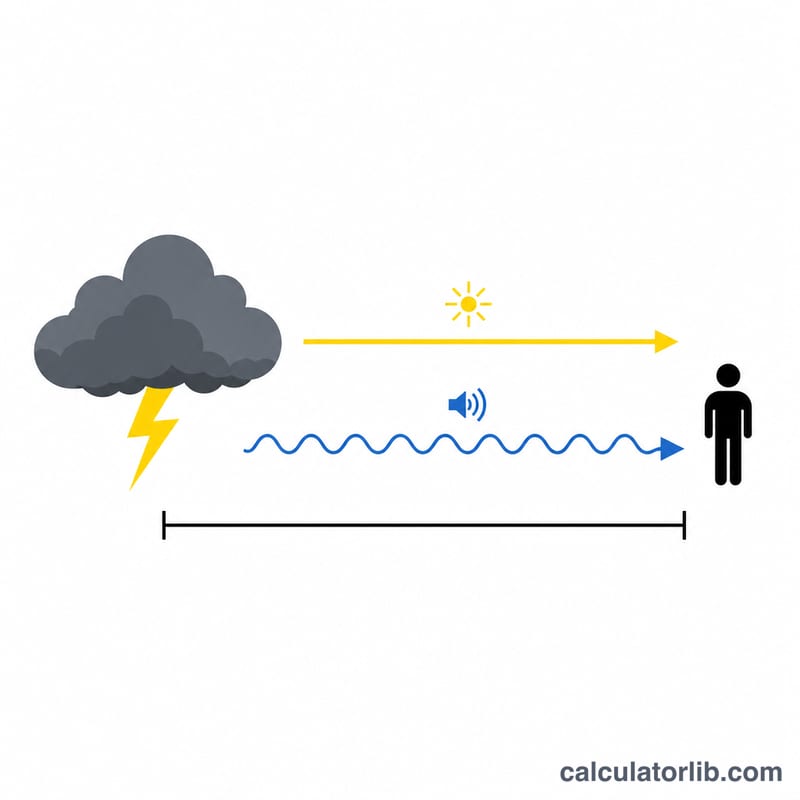
Light from a lightning bolt reaches you almost instantly, but the sound of thunder travels at about 343 metres per second. By counting the seconds between seeing the flash and hearing the bang, you can estimate how far away the storm is. This calculator converts that delay into a distance in kilometres, metres and miles.
How to use it
Watch for a lightning flash, then immediately start counting seconds (saying "one-thousand-one, one-thousand-two…" works well) until you hear the thunder. Enter that number of seconds and press calculate. The result shows how far away the lightning struck.
The formula explained
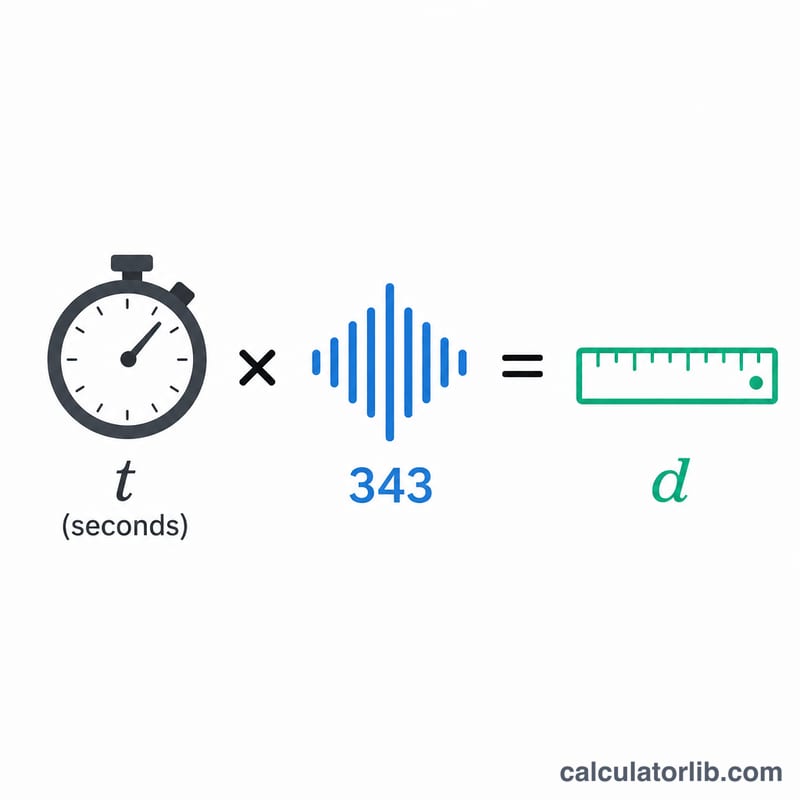
Distance equals time multiplied by speed. With sound travelling at 343 m/s, a delay of t seconds means the storm is \(t \times 343\) metres away, or \((t \times 343) / 1000\) kilometres. The full conversion is:
$$\text{Distance (km)} = \frac{\text{Seconds} \times 343}{1000}$$A handy mental shortcut is to divide the seconds by 3, since sound covers roughly 1 km every 3 seconds (and about 1 mile every 5 seconds).
Worked example
Suppose you count 9 seconds between the flash and the thunder.
$$\text{Distance} = 9 \times 343 = 3{,}087 \text{ metres} = 3.087 \text{ km} \approx 1.92 \text{ miles}$$The storm is about 3 km away — close enough that you should already be seeking shelter.
FAQ
How close is too close? If the delay is 30 seconds or less (about 10 km), lightning is near enough to be dangerous — go indoors. Wait at least 30 minutes after the last thunder before heading back out.
Why 343 m/s? That is the speed of sound in dry air at around 20°C. It changes slightly with temperature and humidity, so this is an estimate, not a precise measurement.
Does the rough divide-by-3 rule match this? Yes — dividing seconds by 3 gives almost the same answer as the full formula because 343 m/s is close to 333 m/s (1 km per 3 s).