What is a Fraction to Percentage Calculator?
This calculator converts any fraction or "part out of a whole number" into a percentage. Whether you want to know what 2 out of 3 is as a percent, or how a score of 47 out of 60 stacks up, you simply enter the numerator (the part) and the denominator (the whole), and the tool returns both the percentage and the underlying decimal value.
How to Use It
Enter the numerator — the smaller "part" value such as a score, a count, or a quantity. Then enter the denominator — the total or "whole" it is measured against. The result updates to show the percentage. For example, 2 out of 3 becomes 66.67%.
The Formula Explained
The conversion is straightforward: percentage = (numerator ÷ denominator) × 100. The division gives you the decimal proportion (a number between 0 and 1 for proper fractions), and multiplying by 100 expresses that proportion as a percent. If the denominator is zero, the result is undefined, so this calculator guards against dividing by zero.
$$\text{Percentage} = \frac{\text{Numerator}}{\text{Denominator}} \times 100\%$$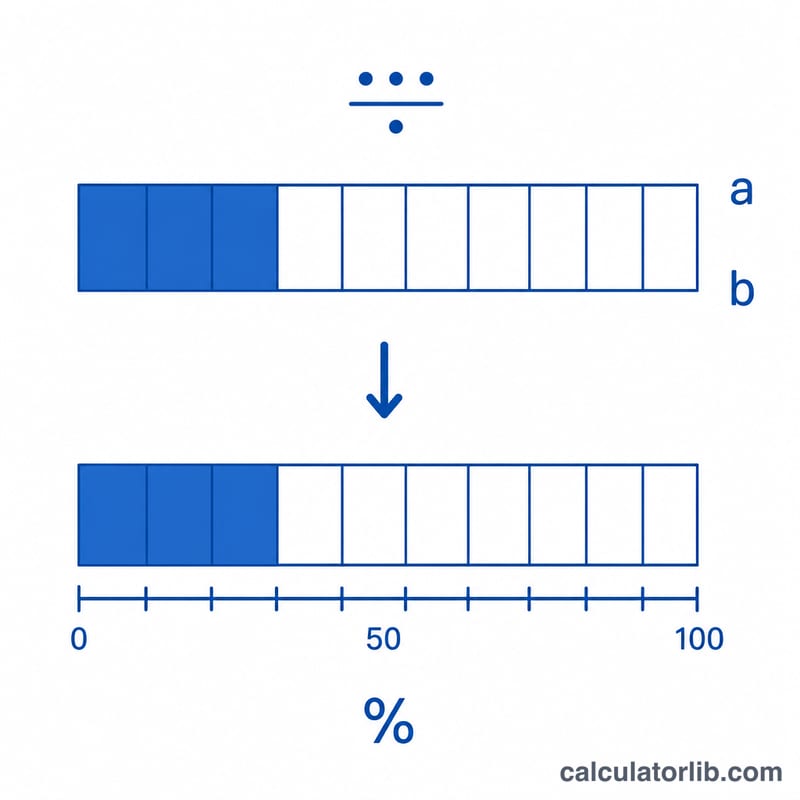
Worked Example
Suppose you scored 45 marks out of a possible 50. Numerator = 45, denominator = 50. Dividing gives 45 ÷ 50 = 0.9, and multiplying by 100 gives 90%. So your score is 90 percent.
$$\frac{45}{50} = 0.9 \times 100 = 90\%$$
Common Fractions as Percentages and Decimals
The table below lists frequently used fractions with their decimal and percentage equivalents. Repeating decimals (such as 1/3, 2/3, 1/6 and 5/6) are rounded to two decimal places in the percentage column, and to four places in the decimal column.
| Fraction | Decimal | Percentage |
|---|---|---|
| 1/2 | 0.5 | 50% |
| 1/3 | 0.3333 | 33.33% |
| 2/3 | 0.6667 | 66.67% |
| 1/4 | 0.25 | 25% |
| 3/4 | 0.75 | 75% |
| 1/5 | 0.2 | 20% |
| 2/5 | 0.4 | 40% |
| 3/5 | 0.6 | 60% |
| 4/5 | 0.8 | 80% |
| 1/6 | 0.1667 | 16.67% |
| 5/6 | 0.8333 | 83.33% |
| 1/8 | 0.125 | 12.5% |
| 3/8 | 0.375 | 37.5% |
| 5/8 | 0.625 | 62.5% |
| 7/8 | 0.875 | 87.5% |
| 1/10 | 0.1 | 10% |
| 1/20 | 0.05 | 5% |
How to Convert a Fraction to a Percentage by Hand
- Divide the numerator by the denominator. For 2/3, compute \(2 \div 3\). Long division: 3 goes into 20 six times (18), remainder 2; bring down another 0 to get 20 again, and the pattern repeats. The result is \(0.6666\ldots\)
- Multiply by 100. \(0.6666\ldots \times 100 = 66.666\ldots\)
- Round and add the % sign. Rounded to two decimals, \(66.666\ldots\) becomes 66.67%, because the third decimal digit (6) is 5 or more, so the second digit rounds up from 6 to 7. Rounded to one decimal it is 66.7%, and to a whole number 67%.
Full formula: $$\frac{2}{3} \times 100\% = 0.6666\ldots \times 100\% \approx 66.67\%$$
Alternative method: scale the denominator to 100
When the denominator divides evenly into 100 (for example 2, 4, 5, 10, 20, 25, 50), multiply the top and bottom by the same number so the denominator becomes 100. The numerator is then the percentage. Example: $$\frac{3}{5} = \frac{3 \times 20}{5 \times 20} = \frac{60}{100} = 60\%$$
Why 2/3 is a repeating decimal
A fraction in lowest terms has a terminating decimal only if its denominator has no prime factors other than 2 and 5. The denominator 3 does not divide any power of 10, so no scaling to 100 works and the division never ends: each step leaves remainder 2, which produces another 6. Thus 2/3 = 66.666…% exactly, and 66.67% is only a rounded approximation (slightly larger than the true value). The same applies to 1/3, 1/6 and 5/6.
FAQ
What is 2/3 as a percentage? Two divided by three is 0.6667, which is 66.67% (rounded to two decimals).
Can the numerator be larger than the denominator? Yes. If the part exceeds the whole, you simply get a percentage above 100%, for example 5 out of 4 equals 125%.
Does it work with decimals? Yes — you can enter decimal numerators and denominators, such as 1.5 out of 4, and the calculator handles them correctly.